
Pins really close to the handle edge

Joined
May 14, 2016
Messages
70
Hey guys. I posted earlier about the knife I am making from a kit. Last night I glued the scales on and inserted the pins. Today I roughed out the scales with a file and was planning on peeking the pins when I noticed how close some pins are to the edge of the handle. I will attach a picture below.

My question is: should I try pinning the pins near the edge or just sand them? I counter sunk the holes to give room for the pins to expand, but I'm worried the wood (cocobolo) may crack and expose the pins. I also need to contour the handles still, so the pins may be exposed anyway. Also, if they are exposed should I just sand it down or try to cover it with epoxy or something?
Thanks
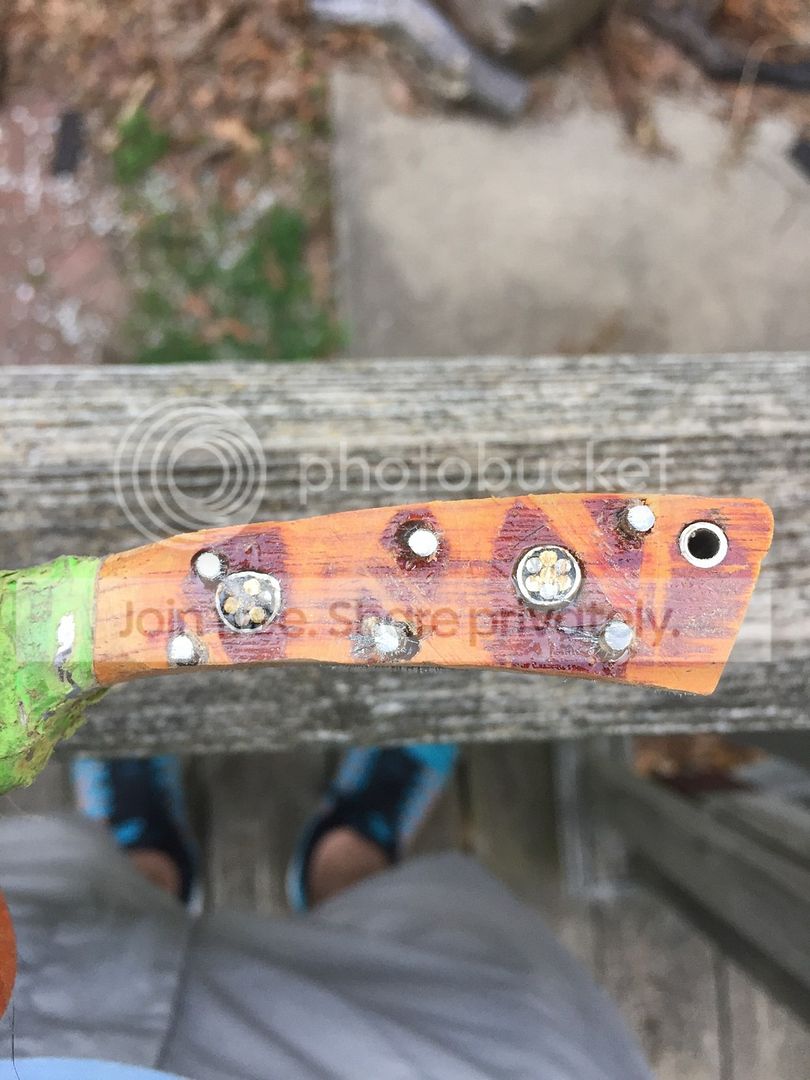
 
If scales have sufficient thickness /because you counter sunk the holes / and if the hole in wood is exact measurement for that pins / just sand it .
 
I drilled the holes bigger than the pins. I read they should be bigger to allow expansion of the metal when peening
 
I first drilled the holes slightly larger than the pins then counter sunk the holes so I could sand the flush with the handle. I didn't want to risk the wood cracking. Right now they are held solid with epoxy, but since I countersunk the holes there is a gap around the pins.

I'm not sure what metal it is. It isn't very hard steel, I can remove material easily from them with a file
 
And then you filled the countersunk holes with epoxy.......
 
Next time I would encourage you to put a little more forethought into your pin placement. A little bit of layout goes a long way.

Aside from that, I typically like to place pins AT LEAST a diameter away from the edge. In other words, if it's an 1/8" pin, I want at the very least an 1/8" of handle material from the edge of the handle to the pin. This may change slightly depending on handle shape, material, pin size, etc... but the last thing you want is a cracked handle because you didn't leave enough material. You also don't want to blow it out when peening.
Speaking of peening, there a few different ways to allow for material expansion, including slightly larger drills, countersinks, and tapered reamers. I prefer an appropriately sized tapered pin reamer. Don't ask the material to fill more than it needs to. It really doesn't take very much at all to get a very secure peen.

Looking at your handle, it appears that you used a larger drill bit to counter bore? I seems that you went a few sizes too big. The next size up should be plenty, especially if using epoxy as well. Use quality sharp drill bits, and make sure your drill press table is nice and square. Do a dry fit before gluing or taper reaming/counter boring. Pins should be fairly snug with no gaps, but you shouldn't have to pound the in with a hammer either.

If you want a really precise fit, get some reamers sized for your pin stock.

For whether or not to peen before contouring, that depends on how much you plan on contouring. I normally leave enough that I'm not going to grind the head of my pin off, but I'll also rough up the middle of the pin, and counterbore the tank and back of the the scales to give the epoxy more room to flow. Hope this helps.
 
I did not drill the holes in the tang, the blade came with the holes already drilled.

I will probably just sand down the pins closest to the edge and peen the rest of them. If holes end up forming i will fill them with epoxy
 
Just sand it out and let it be what it is. There will be a "halo" around the pins from the epoxy. This isn't the end of the world, and should look fine.

In the future, drill the holes in the handle scales only slightly larger than the pins. The pin should just slide in the hole without pushing or tapping in.
The hole in the tang is the one that should have about 25-50% extra room. You don't want any binding there at all.
When putting the pins in the handle, use slow set epoxy. The 24 hour stuff is best, but 4-6 hour is OK. Forget the 5 minute stuff unless you just like to cuss a lot.
Put the glue on the tang and scales and put some glue in a hole with a piece of wire or a toothpick. Rub the pin in some epoxy and slide it in the hole while turning t. This will assure a full contact with the epoxy between the pin and handle.
 
Thanks, next time I won't drill the holes as big.

Should I just sand all the pins down and not bother with peening?
 
Yes, at this point you can't change anything.

Peening is done when you first install the pins and the epoxy is not cured. Once hardened, you would crack the scales by peening the pins. I make a fillet knife with multiple pins. I just drill and glue as I described, and do not peen pins on handles like yours. Peening is a good procedure for single and double pins, but not really needed on most handles with more than three pins.
 
Sloppy tolerances make for sloppy work. If you drill the holes 25-50% larger then the pin stock then you are going to have 20-50% slop.

I drill the hole so the pin can slide freely, so when you install the slabs onto the blank with the pins at glue up it all fits and slides together perfectly so it will not move and gives a precision fit.

The pins should be exactly the same distance from the edge of the tang all the way aroun when done, if there is slop in the tang holes that is when you can see the pins are not exactly the same distance in all locations around the tang.

As for "peening" it only takes a few taps to expand that pin, you only want to slightly expand it. You are not installing a rivet and smashing the hell out of it.

A piece of advice that was given to me long ago is to take a look at a craftsman work, it speaks louder then his words.
 
My main point on drilling the tang larger is to allow for pin expansion on peening. If the hole is a snug fit for the pin, hard peening will make the pin swell at the hole, and the scale or bolster can raise up off the tang. This is a big problem in bolsters when the tang hole is too snug.

In scales, the extra room allows for misalignment issues. It is rare, even when the holes are drilled perfect, that three or more pins will all slide through without one binding. The epoxy fills the extra room, creating a strong bond around the pin from scale to scale, and thus making the whole handle assembly stronger. My standard suggestion of 25-50% oversize only allows for a small amount of wiggle room. On a 1/8" ,(0.125") pin, the 50% oversize hole is 0.1875". this leaves .03" of clearance around the pin. If you drill the hole only 25% oversize, the clearance is about three sheets of printer paper. In machinist terms, that is really sloppy, but in practical terms. 15 thousandths of an inch is not that much.
 
Ah okay. I will just sand it down and try to disguise any gaps with epoxy and saw dust. Thank you for the help, I will remember your advice for the next knife I make of if I redo the handles
 
I did not drill the holes in the tang, the blade came with the holes already drilled.

I will probably just sand down the pins closest to the edge and peen the rest of them. If holes end up forming i will fill them with epoxy

But you drill holes by hand in the scale and they go close to the edge ? Or you use drill press ?
 
Back
Top