2014 BF Knife - Blade Finish Issue

Joined
Mar 1, 2014
Messages
205
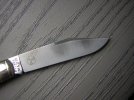
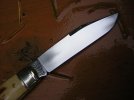
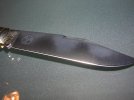
I’ve had this knife for just over a week now, and finally got around to doing something about some “smudges” on one side of the blade (see pics). At first I thought they might be some sort of residue from the manufacturing process, or even the beginning of a weird natural patina pattern.

Prior to today, all I had done was to simply wipe the blade clean with a clean cloth each time I handled the knife. Since that wasn’t having any effect removing or reducing the smudges, I tried cleaning them up today beginning with isopropyl alcohol, then Break Free CLP, and finally acetone, with no effect whatsoever.

Does anyone have any thoughts on what these smudges might be, or how they can be removed (Flitz, something else?)?

By the way, the knife has been handled and carried, but not used to cut anything other than a single small piece of cardboard. Also, I have not done anything to force a patina.
smudges1.jpgsmudges2.jpgsmudges3.jpg
 
They look like a bit of beginning patina. Flitz would be the recommended solution. A mild abrasive to polish it off.
 
I've never seen anything like it, but I would get hold of Christine at GEC and send it back for them to look at.
 
It could just be buffing marks, if they come off with metal polish then all is well. If not, follow Jeff's suggestion.

Thanks, Will
 
Yeah, I think I'll take Flitz to the blade later today or tomorrow, and report the results back here.


I had to look that up...but why is only one side "Hamonized", though :confused:

(It does look like someone did a three fingertip acid wash to the blade, but there is no corresponding thumbprint on the opposite side.)
 

Lol!

I agree it looks like buffing issue.
You can also just use it and allow a natural patina to develop. That should even it out over time. Some commonly found things that will create a natural patina are apples, citrus fruit, hot sauce, vinegar, strawberries, mustard, cooked meat juices (e.g. steak) and coffee grinds. There's lots of other stuff that will work too. Some will produce patina faster than others. Just be sure to wash the bkade with good ole soap and water before cutting any food you intend to eat.
 
My new one has some light "scuffing" from the buffing process, It is my understanding GEC does not make them to be pristine collector pieces and and I can easily find scratches, marks and such on most of my GEC knives. This is not a knock on them or the OP, I like them for what they are and just accept it on mine.
 
Were those blades buffed? From what I can see it appears they have a glaze finish, in which case they wouldn't have seen the buffer at all, but rather the double header. It could be that the operator didn't quite get an even finish on the blade, or perhaps something was a bit off with the etching machine and you got some reaction with the current. In either case the blade shouldn't be affected at all. Some Flitz or similar abrasive polish should take it out, but be forewarned that you may also lose some of the etch in the process.

Eric
 
Some Flitz or similar abrasive polish should take it out, but be forewarned that you may also lose some of the etch in the process.

Eric

I agree. I would put a small piece of painters tape over the PPP etch before using the Flitz, just to be safe and I am assuming that you want to keep the etch intact.
 
Were those blades buffed? From what I can see it appears they have a glaze finish, in which case they wouldn't have seen the buffer at all, but rather the double header. It could be that the operator didn't quite get an even finish on the blade, or perhaps something was a bit off with the etching machine and you got some reaction with the current. In either case the blade shouldn't be affected at all. Some Flitz or similar abrasive polish should take it out, but be forewarned that you may also lose some of the etch in the process.

Eric

Listen to him!^^^
 
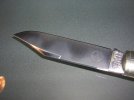
OK, I polished the blade with Flitz and all is good again (well, except for the PPP etch which had to be sacrificed in exchange for blade finish homogeneity).

My backup plan would have been to mask the factory smudges with either a natural or forced patina, but that’s not my favorite blade finish so I’m glad the Flitz job was successful.

Pic of the polished blade is attached. Note that the dark spots are shadows from nearby trees, and not any remaining smudges.

Thanks to everyone for their response!

post-Flitz.jpg
 
I think it looks great; glad it was only a minor cosmetic issue.

Good looking knife.
 
Back
Top