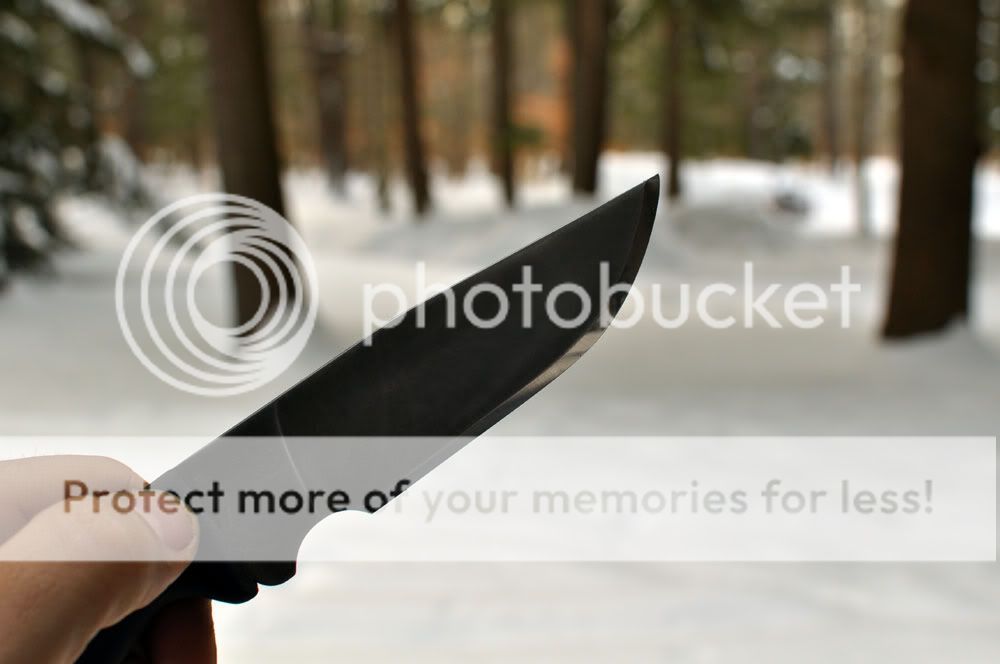
4 hours worth of sharpening and the thickest original edge ever

Joined
Jul 10, 2009
Messages
3,094
This scrapyard dumpster mutt had to have been sharpened to about 35-40 degrees per side. It was no match for the extra coarse DMT. Finished with .5 micron. From start to finish i'd say it took around four hours. When I finished the first half I regretted even starting it took so long. Now i'm happy.

dm-1.jpg


dm2-1.jpg


Not my best pictures but Its cold as hell out and I wasn't wearing a jacket.
 
you should try a crusader forge to what what thick edge means ... :D

nice work btw:thumbup::thumbup::thumbup:
 
Wow, nice! What do you think the inclusive angle is now? I haven't looked up how thick your particular knife is, so I'm having a hard time estimating the new angle. Looks great though!
 
Wow, nice! What do you think the inclusive angle is now? I haven't looked up how thick your particular knife is, so I'm having a hard time estimating the new angle. Looks great though!

I'm going to take the chance and gugess that it's 30* inclusive...

Wonder how close I am.

Edit:

Ahh, no fair, 230 you posted before I hit submit... Now my guestimation seems fradulent
 
ooo 4 hours, I remember those days and still not getting a decent edge. You should really try a paper wheel system. Much faster, could have gotten the same edge in like 5 mins instead of 4 hours!
 
ooo 4 hours, I remember those days and still not getting a decent edge. You should really try a paper wheel system. Much faster, could have gotten the same edge in like 5 mins instead of 4 hours!

Then you would have had much more time to go tell someone else about paper wheels.
 
ooo 4 hours, I remember those days and still not getting a decent edge. You should really try a paper wheel system. Much faster, could have gotten the same edge in like 5 mins instead of 4 hours!

Shirley you jest.....
 
ooo 4 hours, I remember those days and still not getting a decent edge. You should really try a paper wheel system. Much faster, could have gotten the same edge in like 5 mins instead of 4 hours!

If you knew 230 a little better you would have known that he has used paper wheels, EP, belt sanders, and freehand, I know it may be shocking to you but some of us do enjoy putting a edge on a knife the old fashioned way. Take a little of that time you saved and read up on sharpening, you might find some interesting things.
 
I'd say 30 inclusive too. I am re-doing my ESEEs and they end up looking like that...mine are not nearly so polished I must say...nice work there.

Here is what I am doing. I use a trigonometry website (which I'd mention but I think they sell things so I won't...I found it with Google in about 2 minutes). I measure the width of the blade in millimeters and enter that. Then I enter 15 (half of 30) into the angle and bingo...it gives me a figure on how high to hold the spine (the center of the spine that is) off the stone. So my ESEE 4 is 31.5 millimeters wide so that figures out to holding the spine 8.something mm off the stone. Then I take a paper clip and bend it up and clip it off to 8 mm high, measuring carefully.

Now let me be clear. This is just a guide for me...a point of registration if you will for my strokes. Most of all it is a learning tool for me as I get better at freehanding. I am very pleased with how it works. The tip is kind of tough with this method and obviously a knife that is all curve will be a challenge but my ESEE drop points have a nice straight portion to work with. For the tip, i take another measurement and I have a second reference point.

I have found with just that little visual queue there sitting on the stone that my eye and my hand just seem to tend to work together and I hold the thing pretty well. I am very please with this method. At least as you start each stroke on the stone, you are sure you're holding it at the right angle.

Give it a try.
 
ooo 4 hours, I remember those days and still not getting a decent edge. You should really try a paper wheel system. Much faster, could have gotten the same edge in like 5 mins instead of 4 hours!

Having owned paperwheels (my first "good" edge came off paper wheels), I can tell you with full certainty, no I couldn't.

If you knew 230 a little better you would have known that he has used paper wheels, EP, belt sanders, and freehand, I know it may be shocking to you but some of us do enjoy putting a edge on a knife the old fashioned way. Take a little of that time you saved and read up on sharpening, you might find some interesting things.

^^ exactly. I've sharpened with EVERYTHING. The EP was the best out of the guided systems for me, but I still sold it as it had its limitations, sadly I can get a better edge free hand than with the system, no idea why. The paper wheels would be what I would use if I had too put a good edges on a whole pile of knives. I still love my belt sander, i'm a convexing fool, but lately I just convex larger/chopper knives. Everything else gets hit free hand the old fashioned way. I actually find it really enjoyable. I'm a CNC machinist/programmer, in a world of automation, I like doing it myself. The same way when the opportunity arises, I love hopping on a bridgeport or an old school turret late. Besides, I can get it way sharper by hand.

230grains, how did you keep such an even bevel free hand?
Awesome job! :thumbup:

Hands of a surgeon and practice.
 
I'd say 30 inclusive too. I am re-doing my ESEEs and they end up looking like that...mine are not nearly so polished I must say...nice work there.

Here is what I am doing. I use a trigonometry website (which I'd mention but I think they sell things so I won't...I found it with Google in about 2 minutes). I measure the width of the blade in millimeters and enter that. Then I enter 15 (half of 30) into the angle and bingo...it gives me a figure on how high to hold the spine (the center of the spine that is) off the stone. So my ESEE 4 is 31.5 millimeters wide so that figures out to holding the spine 8.something mm off the stone. Then I take a paper clip and bend it up and clip it off to 8 mm high, measuring carefully.

Now let me be clear. This is just a guide for me...a point of registration if you will for my strokes. Most of all it is a learning tool for me as I get better at freehanding. I am very pleased with how it works. The tip is kind of tough with this method and obviously a knife that is all curve will be a challenge but my ESEE drop points have a nice straight portion to work with. For the tip, i take another measurement and I have a second reference point.

I have found with just that little visual queue there sitting on the stone that my eye and my hand just seem to tend to work together and I hold the thing pretty well. I am very please with this method. At least as you start each stroke on the stone, you are sure you're holding it at the right angle.

Give it a try.

I used to know a formula actually, I use a lot of trig day to day, but I like knife sharpening to be cathartic experience to escape my day to day life, math just complicates matters :D
 
I used to know a formula actually, I use a lot of trig day to day, but I like knife sharpening to be cathartic experience to escape my day to day life, math just complicates matters :D

There are days that I get out my Norton India stone and some kerosene in my garage, put on some Oak Ridge Boys, and spend several hours sharpening. Some quality beer and a cigar don't hurt, either.
 
If you knew 230 a little better you would have known that he has used paper wheels, EP, belt sanders, and freehand, I know it may be shocking to you but some of us do enjoy putting a edge on a knife the old fashioned way. Take a little of that time you saved and read up on sharpening, you might find some interesting things.

Like anything else, it's all a matter of grit steps. Whatever system you use has little to do with it. I've added a .5 micron compound loaded paper wheel that will do exactly what I expected. The stock white compound that comes with the wheel is a 2 micron jacksonlea C-5, a very good general purpose finish.
 
You can't attain the same level of edge refinement jumping from 400 grit or whatever grit your grit wheel has on it all the way to .5 micron, nor can you from 400 grit to the 2 micron. You will basically have a 400 grit knife with the bur removed. I can strop a 400 grit knife all day on .5 compound and it will not look or perform like a knife that has gone through the several grit steps.

For the hell of it, I busted out my paper wheels. Before you ask, I'm very familiar with them and how to use them. I've sharpened on them easily 200+ times so it's not the user. I decided to sharpen my dulled american lawman, used the polish wheel loaded with .5 compound to remove the bur. It's sharp, very sharp, and It was done in under ten minutes. The finish is "shiny", but no where near the same refinement as if I did this knife like I did the scrapyard above. Under magnification, you can still see a courser scratch pattern. This is fine if you want a less polished edge. Me personally? I like my bevels to be pure mirrors and I like the cutting performance it gives me. Would a paper wheel edge work for any of my tasks? Yes, but I always like pushing the limit. Will a paper wheel edge at the same angle as a highly polished edge last longer? No, there's no reason it will. Sure my high polished knife will be around the same level of sharpness as a paper wheel sharpened knife will be after cutting up a cardboard box, but I enjoy hitting new levels of sharpness as well as the cosmetic apeal of a mirror finished bevel.

That said, paper wheels are still a good system and will give you razor sharp results.

 
Back
Top