
4-Speeds with one step pulley(pics)

Joined
Dec 13, 2008
Messages
2,986
Our Coote isnt designed for more than 2000 rpm's so using step pulleys back to back would be wasted because we couldent use one of the pulleys due to the speed being way to fast..So we made this mounting bracket that lets you use one step pulley and move the motor.The motor mount slides on a piece of 16ga 3/4" tubing which fits perfectly on 5/8" round. Two stops made from the same with thumb screws at either end to stop the motor from drifting while running. One acts as a gauge as the shaft is marked in all 4 spots corresponding to the pulley changes.Just move the stop to the corresponding mark and tighten it.then slide the motor over.Takes about 6-7 seconds to change speeds..The step pulley is 4"-3 1/2"-2 1/2"-2"..The pulley on the grinder is 4".The motor is 1725rpm's, 1 1/2 H.P.This gives us..
1725 RPM's
1509 RPM's
1078 RPM's
862 RPM's
.
Not a VFD but better than single speed and no wasted pulleys..
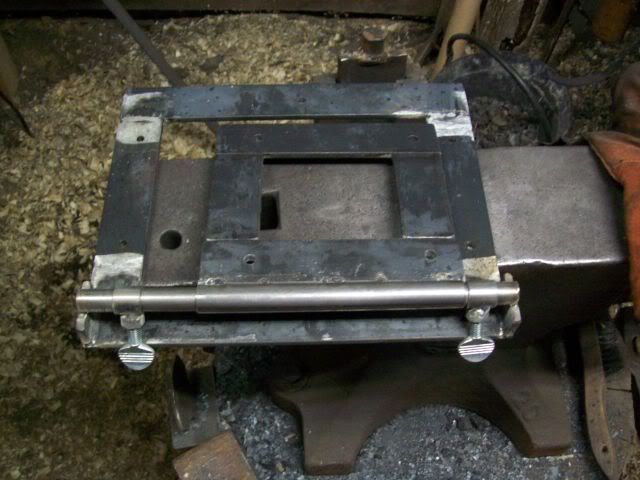
newpics538.jpg

Heres the bracket before mounting and clean-up.
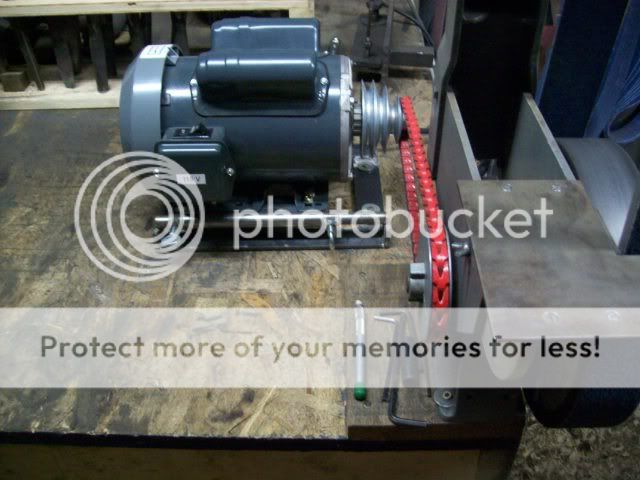
newpics539.jpg

After mounting. before final clean-up and painting..
 
That is exactly what I was talking about in the recent thread on multi-speed for a grinder. It is a simple and cheap way to change speed in seconds. Yours looks very well built.
 
Thats very nice. Do you adjust for changes in belt length by removing or adding links? Never used one of those belts before so just curious.
 
Looks like motor will be fine for all belt speeds. Just at a different lean angle.
Very nice.
Cw
 
I know this motor moves to achieve straight belt run, but how far off straight can the link belts run? Could a single pulley to three pulley work without shifting?
 
Wow! Very cool project! That turned out really well and seems like tit would do the trick for sure:thumbup: Nice job.
 
Thats very nice. Do you adjust for changes in belt length by removing or adding links? Never used one of those belts before so just curious.

Now you have to make ANOTHER adjustable sliding mount to adjust the distance to the drive wheel. You solve one problem and make another.

I'm curious to know how you address this issue also. I like the set up. I will keep it in the back of my mind for the day I get a REAL grinder. Thanks for sharing with us.

- LonePine
Alias Paul Meske, Wisconsin
 
You guys are misunderstanding the purpose of the hinged and movable plate. You lift the motor on the hinge, slide it over a bit to match the desired pulley groove, and lower the motor. The motor's weight can be enough to keep tension if the motor hangs from the table, but a spring is normally attached to the hinge. When it is in the smallest groove, the motor s farther back from the drive pulley. When it is in the largest, the motor is higher and the belt still fits.
 
Last edited:
You guys are misunderstanding the purpose of the hinged and movable plate. You lift the motor on the hinge, slide it over a bit to match the desired pulley groove, and lower the motor. The weight can be enough to keep tension if the motor hangs from the table, but a spring is normally attached to the hinge. When it is in the smallest groove, the motor s farther back from the drive pulley. When it is in the largest, the motor is higher and the belt still fits.

Looking at it closer I see my error. Why that's a smart way of doing it! Probably why it didn't cross my mind. ;-)

Thanks.

Paul Meske
 
Back
Top