
425 too hot for 1084 temper?

Joined
Nov 28, 1999
Messages
14,985
Ok, I ground out a medium sized utility knife out of Aldo's 1/4" thick, 1.5" wide 1084FG, and another smaller, slightly slimmer blade out of some other 3/16" 1084(from Kelly Cupples, I believe), did 3 normalizing cycles on each in the gas forge, quenched in Park's 50 and tempered them twice for 2 hours at 400. During testing, some side pressure snapped the smaller 1084 blade off at mid blade. ???

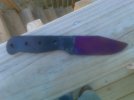
I really don't believe I overheated the steel during normalizing and heat treat, as the grain on the snapped blade is super fine and frosty looking. Believing that maybe my tempering oven(a toaster oven that I really don't know how accurate the temperature control is) was not hot enough, I tempered the bigger blade one more time, but raised the temperature to 425 and tempered the blade for another 2 hours. The bigger blade came out of the oven with some really cool purple-ish blue colors on the blade. Is this blade now way too soft, and do I need to re heat treat it? What kind of Rockwell hardness can I expect this blade to be?
 

Attachments

  • IMG00010-20101121-1348.jpg
    IMG00010-20101121-1348.jpg
    36.5 KB · Views: 98
The purple is likely due to oil....residual quenching oil, or skin
oil. Don't go by that. Regardless of initial hardness, clean 1084
will start to show dark yellow around 425-450f, and purple specs will
start to show around 475f....
 
If you reached the upper level of hardness in your quench, I would concur with Stacy. tempered at 450°, you will lose very little in hardness, but gain a bit more toughness.
 
one problem with using toaster ovens for tempering is that the blade is really close to unshielded elements which heat it directly with infrared energy which will cause it to get far hotter than what the thermostat is gauging the air inside the oven at. You will really want some sort of muffle with the thermostat inside of it for accurate tempering, or do what I do and muffle the inside of my regular oven

-Page
 
Is is possible the P50 was too fast for 1084? Maybe there was a microcrack pre temper???

Askin' - not sayin'... :confused:

Rob!
 
Is is possible the P50 was too fast for 1084? Maybe there was a microcrack pre temper???

Askin' - not sayin'... :confused:

Nope, Parks #50 should be right on for 1084. Any cracking from the quench would show up as a dark area in the fracture, which I'm sure Danbo would have mentioned. It all depends on your initial hardness after quench. When you hit it just right you actually need to bump your tempering temps up a bit.

-d
 
This has been gone over before, but with good HT procedures--temp control and good HT oil for starters--you are likely to hit a higher as quenched hardness than those using a torch and used french fry oil. So I'll go with Stacy on the tempering temps.

As for the colors, Russ gave one very good explanation, and I'll offer one more. When I temper in a digitally controlled Evenheat oven at 425 degrees for a single 2-hour cycle the colors are as advertised. When I go for three 2-hour cycles without cleaning the blade in between, I get some very dark colors, even though I am 100% sure the temp never broke 425. So there may be some cumulative coloring going on as well.
 
After both blades were tempered twice at 400, I ground a little on both with a brand new Blaze 60 grit belt. After the slimmer 1084 blade snapped off in the vise, the bigger blade went back into the toaster oven at 425. Those purple colors are after cleaning up on the grinder at 60 grit.
 
We have found that an increase in tempering temperature of 15 f. is a very significant increase. If your steel is all the same you can even play inbetween + or - 15 degrees to find the best tempering temp.

To answer your question about re-hardening, we have found that with 52100 and jd5160 you can re-harden using Texaco Type A.

We have not worked with 1084. I would suggest making the remaining blade and what is left of the smaller blade experimental blades and learn all you can from them.

Good Luck
 
After both blades were tempered twice at 400, I ground a little on both with a brand new Blaze 60 grit belt. After the slimmer 1084 blade snapped off in the vise, the bigger blade went back into the toaster oven at 425. Those purple colors are after cleaning up on the grinder at 60 grit.
So let me get this straight, you HTed the blade, tempered it, then ground it and the color as we see it is after grinding?

My guess is that you overheated it with the 60 grit grinding belt, and yes, you kinda ruined the HT

-Page
 
So let me get this straight, you HTed the blade, tempered it, then ground it and the color as we see it is after grinding?

My guess is that you overheated it with the 60 grit grinding belt, and yes, you kinda ruined the HT

-Page

No, the grinding was done after the second temper cycle. Those colors are how it came out of the tempering oven, once I did the 3rd temper cycle, having raised the temp to 425.
 
Did you preheat the oven?
If you put the blade in then brought the oven up to temp there's a good chance it overheated since the blade has low thermal mass in relation to surface area, the blade will get hotter than the oven. If you let the oven get up to temp and sit for a while before putting the blade in you are less likely to have had a problem

-Page
 
Anything in the oven cannot get hotter than the oven itself, unless it can generate it's own heat. Possibly I am misunstanding what you are trying to say.
 
Anything in the oven cannot get hotter than the oven itself, unless it can generate it's own heat. Possibly I am misunstanding what you are trying to say.

no, you are misunderstanding radiational heating. The elements in a toaster oven are usually unshielded so that they provide direct infrared heating to your toast. an unshielded (no muffle or baffle between the blade and the blade and the elements) will absorb infrared energy and heat quickly, like leaving a car in the sun. The interior of the car is a lot hotter than the surrounding air. When I do outdoor shows I always need to shade the knives and jewelry so that they do not become uncomfortable to touch if the sun is out. Recently setting up a new piece of test equipment in which the sample ( a piece of metal a half inch by half inch by 1 inch) was put in a furnace which had exposed heating elements. The operator did not understand concepts like thermal mass, radiational heating etc. and put the sample in a cold furnace and heated it to the test temperatures, then wondered why we had never seen structures so horrific in a test sample. Troubleshooting what happened I had him duplicate his setup with a thermocouple in contact with the sample, and while the indicated furnace temperature was still in the 500-600 degree range, the sample was over 1500. making no procedural change other than preheating the oven, letting it equilibrate for a half hour, then putting the sample in the results were almost perfect.

-Page
 
I started using a house hold oven, then one time a toaster oven which was a wreck.
One of our most valuable pieces of hardware is our Paragon oven. It is very reliable provided we give it a chance.

Blades go in with then Paragon at room temp. turn it to the desired heat and let it heat up for one hour, if we want to temper at 388 it takes one hour to get to that temp, nice and slow. Then soak for 2 hours at that temp and let it cool down in the closed Paragon to room temp. Then to the house hold freezer for over night then another cycle.

The soak at the right temp is the most important aspect, color of the steel means nothing when tempering for extended times, the oxidation is a function of time and temperature.

Slow progressiion to the correct temp, soak and slow cool down are very significant in our process, hurry any aspect and it is a wreck.

Most important, test your blades and see for yourself what the results of your methods are for yourself and you will know.
 
Anything in the oven cannot get hotter than the oven itself, unless it can generate it's own heat. Possibly I am misunderstanding what you are trying to say.

This is a common misconception. To test the theory, set your oven to 200F. Reach in and touch the heating element after one minute.....I am willing to bet this years salary that it is more than 200F.

As Page said, a toaster oven is not designed to have the mass of its lining heat up and hold the heat as in a HT oven. Toaster ovens are radiant, and the heat is absorbed by the food. Since the temperature control is not needed to be critical, the thermocouple that turns the element on and off is designed to receive about as much heat energy as the food, but fluctuates a lot. Food, like toast, is not a good absorber of energy ( that is why it toasts on the outside), however, steel is an excellent heat absorber. It will heat up much faster and get hotter than the thermocouple until it becomes the radiant source that affects the TC. This can be result in a rise of more than 100F higher than the setting until the oven settles down. Not a real problem for toast....but if it is your knife blade it may well become...well...toast.

The way to avoid this with a simple toaster oven is to put a 1/4" steel or aluminum plate on the shelf. Run the oven for 10 minutes before placing in the blade. A good oven thermometer( sitting on the plate) would be a wise $10 spent to check the actual temp.

The link to the "Toaster oven PID conversion" has much more detail. Notice that if it is done to the max, the TC is actually embedded in the aluminum plate, and will read the exact temp of the knife blade laying on the plate.
http://www.bladeforums.com/forums/showthread.php?t=599423&highlight=PID
 
Last edited:
Good information here. I have a temp meter with a laser beam function. I'm going to shoot a blade with it just to see what it really is. I do know at a shop I used to work at we had an infrared heater that made all the metal in the shop warmer than the air in the room.
no, you are misunderstanding radiational heating. The elements in a toaster oven are usually unshielded so that they provide direct infrared heating to your toast. an unshielded (no muffle or baffle between the blade and the blade and the elements) will absorb infrared energy and heat quickly, like leaving a car in the sun. The interior of the car is a lot hotter than the surrounding air. When I do outdoor shows I always need to shade the knives and jewelry so that they do not become uncomfortable to touch if the sun is out. Recently setting up a new piece of test equipment in which the sample ( a piece of metal a half inch by half inch by 1 inch) was put in a furnace which had exposed heating elements. The operator did not understand concepts like thermal mass, radiational heating etc. and put the sample in a cold furnace and heated it to the test temperatures, then wondered why we had never seen structures so horrific in a test sample. Troubleshooting what happened I had him duplicate his setup with a thermocouple in contact with the sample, and while the indicated furnace temperature was still in the 500-600 degree range, the sample was over 1500. making no procedural change other than preheating the oven, letting it equilibrate for a half hour, then putting the sample in the results were almost perfect.

-Page
 
Back
Top