8CR13MOV rust and stains?

Joined
Feb 21, 2011
Messages
748
Hi all, I apologize if I am duplicating another thread but couldn't find one after several search attempts.

I bought two knives with 8CR13MOV steel a couple of months ago, a Kershaw Tremor and a Kershaw Asset. I like both knives but have noticed a couple of odd things.

First, I used the Tremor to cut a kiwi. I immediately washed the blade with soap and water, dried it, and coated it in rem oil. However, the section of the blade that went through the fruit is stained a slightly lighter color than the rest of the blade. Is this from the acidity of the kiwi? For the record, I don't care - it isn't a big deal on a value knife - I am just curious.

Second, I carried the Asset in my waistband for a day - a very hot day. The knife did have sweat/condensation on it. However, at the end of the day I coated it with rem oil. The next morning it had a cluster of tiny rust spots near the tip. Is the rem oil not good enough or is it just a function of the steel not being rust resistant?

I just received a Tenacious a few days ago for my birthday and plan on carrying it pretty frequently. I don't want the rust spots to develop on it if I can help it.


Thanks for the input guys/gals.
 
A handful of possible contributors here. I'm sure the acid from the fruit contributed to the problem. Kershaw has also had troubles with rust in the past, especially with bead-blast finished blades. The 'textured' look of bead-blast also makes for lots of nooks for moisture, salt and other dirt/grime to get stuck to the blade. If it's not COMPLETELY cleaned up beforehand, oiling the blade can simply trap all that stuff against the steel, and compound the problem. And the steel itself (8Cr13MoV) is sort of on the 'threshold' of not being stainless. The 'Cr13' in the name is a reference to the percentage of chromium content in the alloy. 13% is what usually defines 'stainless'. Less than that, and a steel would likely be classified as 'non-stainless' steel. More rust-resistant knife steels might have from 14-16% chromium content.

And a big possible contributor is one's own body chemistry. Some 'sweat' is more acidic & salty than others. And your environment (humid or not) is obviously a factor. Pretty muggy in Chicago in the summer, I bet?

The first thing I'd do is polish the blade somewhat. More polished finishes have less nooks & pores for moisture, dirt and salt to hide in. And before putting the knives away for the day, make sure they're very clean and dry. Cleaners that do a good job removing skin oils (which contain salt) work well; isopropyl alcohol and Windex are pretty good for that, in my experience.
 
Kiwifruit has the highest vitamin C content of any fruit (apparently). Vitamin C is Ascorbic Acid. If you were cutting a Kiwifruit, I'm not surprised if you got some acid patination from it. If you were actually cutting a Kiwi, the staining must have been from the blood. (NZ'ers usually refer to themselves as Kiwis)

PS. The clue is in the name, Stainless, because it stains less than carbon. Rust-proof is something else.
 
A handful of possible contributors here. I'm sure the acid from the fruit contributed to the problem. Kershaw has also had troubles with rust in the past, especially with bead-blast finished blades. The 'textured' look of bead-blast also makes for lots of nooks for moisture, salt and other dirt/grime to get stuck to the blade. If it's not COMPLETELY cleaned up beforehand, oiling the blade can simply trap all that stuff against the steel, and compound the problem. And the steel itself (8Cr13MoV) is sort of on the 'threshold' of not being stainless. The 'Cr13' in the name is a reference to the percentage of chromium content in the alloy. 13% is what usually defines 'stainless'. Less than that, and a steel would likely be classified as 'non-stainless' steel. More rust-resistant knife steels might have from 14-16% chromium content.

And a big possible contributor is one's own body chemistry. Some 'sweat' is more acidic & salty than others. And your environment (humid or not) is obviously a factor. Pretty muggy in Chicago in the summer, I bet?

The first thing I'd do is polish the blade somewhat. More polished finishes have less nooks & pores for moisture, dirt and salt to hide in. And before putting the knives away for the day, make sure they're very clean and dry. Cleaners that do a good job removing skin oils (which contain salt) work well; isopropyl alcohol and Windex are pretty good for that, in my experience.

Thanks for your input. I believe in the case of the Asset I coated it with rem oil without first cleaning it. I guess I trapped some of the crud against the blade. What really bugs me is that I used to neglect my knives and never had any rust issues but I tried to take good care of the Asset and created a problem. I will definitely remember to clean them properly from now on before oiling them.

And yes, Chicago is very humid in the summer so that didn't help I'm sure.
 
Thanks for your input. I believe in the case of the Asset I coated it with rem oil without first cleaning it. I guess I trapped some of the crud against the blade. What really bugs me is that I used to neglect my knives and never had any rust issues but I tried to take good care of the Asset and created a problem. I will definitely remember to clean them properly from now on before oiling them.

And yes, Chicago is very humid in the summer so that didn't help I'm sure.

As you've surmised, coating it with oil, over the dirt/salt/etc., might've made some difference this time around. A lot of people here who prefer non-stainless blades don't oil them at all, and don't have any major issues. 99% of the time, the main thing is to make sure it's clean & dry before putting it away.

I spent a couple of extended periods (~6 months each) in the Chicago area, a long time ago. Both times from late fall through winter. VERY, VERY COLD, and bone dry both times. Never got to experience the place in warmer seasons, although a friend of mine did, and he did say it was quite humid up there. :)
 
I have also several 8Cr13MoV blades, they are all satin finished, so rust is not easily formed. I polish some further (getting polished edge too) and so far it's ok. On non polished parts (tang/notch of the backlock), if not dried completely after washing, rust spots will show he next day. The good thing is, some oiled cloth wiping easily remove them. It seems that they are less resistant than Victorinox that mirror polished the tools and perhaps having 14-15% Cr.

David, is it true that the higher the Cr while keeping the C same, will make the blade less able to take and hold sharpness well? I'm womdering as it only has 0.8% C it has to keep the Cr low.
 
Last edited:
Chris "Anagarika";9982396 said:
I have also several 8Cr13MoV blades, they are all satin finished, so rust is not easily formed. However, they are still less resistant than Victorinox that mirror polished the tools and perhaps having 14-15% Cr.

David, is it true that the higher the Cr while keeping the C same, will make the blade less able to take and hold sharpness well? I'm womdering as it only has 0.8% C it has to keep the Cr low.

Steel manufacturers have gotten a LOT better at increasing rust resistance AND improving edge fineness and edge-holding. Some of the better examples I've seen, are steels produced by Sandvik. Their 12C27M is 0.52% carbon, 14.5% chromium (see the link below). Opinel uses it in their stainless knives. Takes and holds a very fine edge, due to Sandvik's fine-grain refinement process, and was formulated specifically for kitchen knives & utensils (for corrosion resistance, in other words). It's spec'd by Sandvik up to 59 RC. So, in the 8Cr13MoV steel, 0.8% carbon isn't bad at all. Especially considering a lot of so-called 'hi-carbon' stainless steels are only around 0.5% carbon, like 420HC, which can be quite good with the right heat treat (it's Buck's mainstay steel).

http://www.sandvik.com/sandvik/0140...83a450e4d0011eaac12577de004bf9f6!OpenDocument
 
Last edited:
David,

Thank you! So it's not only the chemistry, but other processing as well. Steel is indeed complex :)

You just tempted me to get an Opinel ;) which one is better to try out (steel, edge refinement): carbon or stainless? Will the sandvik be up to plain carbon Opinel?
So far only dealed wih stainless 440c, 8Cr, AUS 6 & 8 ...
 
Last edited:
Chris "Anagarika";9982728 said:
David,

Thank you! So it's not only the chemisty, but other processin as well. Steel is indeed complex :)

You just tempted me to get an Opinel ;) which one is better to try out (steel, edge refinement): carbon or stainless? Will the sandvik be up to plain carbon Opinel?
So far only dealed wih stainless 440c, 8Cr, AUS 6 & 8 ...

The Opinels aren't expensive. Get BOTH! :D

Seriously, I'd encourage trying one of each. BUT, if not, I'd base the decision on what you plan to use it for. As with most carbon blades, the 'carbone' model will sharpen easily and take a very, very fine edge. The stainless does too, but maybe takes just a little longer to sharpen. And I think it actually holds the edge a bit longer. I think the stainless model might be heat-treated to slightly higher hardness than the carbone model. With mine, I've noticed it's a little easier to ding the edge on the carbone model, and also easier to round it off when stropping. The other downside to the carbone model is, if you plan to use it for food prep, it'll impart a typically carbon steel 'flavor' (metallic taste) to whatever acidic foods you cut (fruit, especially). Also have to make sure to clean it well afterwards. I sliced some grapes with mine, and some of the juice seeped back into the pivot of the handle. Got a bit sticky & stiff, as I think it oxidized on the steel in there.

They're both great, but perhaps for different purposes. I'd reserve the carbone model for more utilitarian uses, and use the stainless for food prep and other 'wet' uses. Base your choice on how you plan to use yours.
 
David,

Thank you very much! I'm in the stage of learning about steel characteristic, but on limited budget. As cheap as opinels are, 20$ + shipping will not come cheap where I live. A normal officer's lunch costs about 2.5$ at max, at the public food court just to provide some background.

Might get both, as both are new steels ... Using it is another matter, but it will test the edge.

Back to topic, my 8Cr13MoV Enlan EL01 is polished with 1000 grit sandpaper + stropping on metal polish pasted on light cardboard (those grey one side, white the other, usually to pack small items, non corrugated). The edge gets sharp & lasts quite ok for my daily use.

The Navy k631 is said to be 440c but I tend to guess they're also 8Cr as well. Currently being tested, no conclusion yet. Dropped the knife, some chipping on the edge (hit cramic tiles) :(, that I cannot take out completely without major resharpening. I just smoothed it out and see how it goes. Lost 1mm of the tip too (bent & microchip).
 
Last edited:
I polished the steel and it rust much lesser. You might like to try the mora. Its a fixed blade. They are harder than the opinels. There are three types , laminated, carbon and stainless, all very sweet.
 
Just a side note: If you are using your knives to cut food I would go with Mineral oil after cleaning. Don't think Rem oil is meant to be ingested. You can pick it up at the local drug store.
 
Thanks for all the input, but we're moving off topic here with moras and opinels..;)

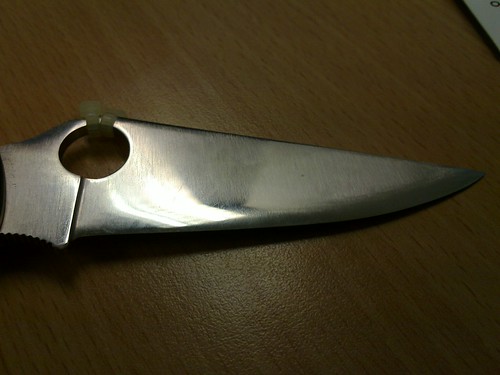
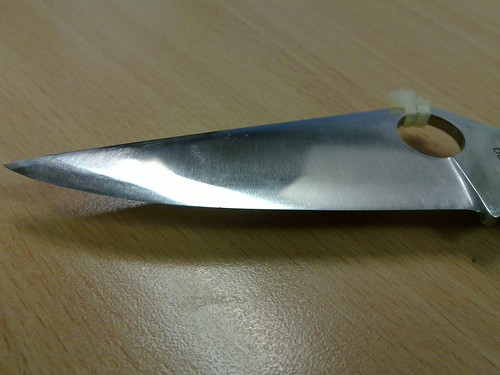
Here is the feeble attempt at polishing it. The chip is obvious on first picture, where it's shiniest.
Trying to upload the convexed & thinned down k631 here
6129420782_18de31ee5e.jpg

6128871945_fb990eae07.jpg
 
Last edited:
I've noticed that my bead-blasted Kershaws like to rust, no matter what the steel. So as soon as I get the knife home, I take it apart and get rid of all bead blasting, even on the handles.
Start with 000 steel wool, then work to a very fine grit sandpaper. run the parts under hot water in between to get rid of any dust. Then gently apply some simichrome polish and let it sit for two or three minutes. Wipe off the excess, then start polishing with a soft cloth. Cotton works best for me, but I've found that soft toilet paper works well. When you've got it to the level of shine you want it, spread some Tuff Glide or Rem Oil on it. Evenly coat the blade (and handle if you did it). Let that sit for about an hour. wipe off the excess, then lightly oil the metal. you're done.
 
Back
Top