

Nathan the Machinist
KnifeMaker / Machinist / Evil Genius
Moderator
Knifemaker / Craftsman / Service Provider
- Joined
- Feb 13, 2007
- Messages
- 18,980
Hey, when was the last time I started a thread...
There was a thread recently about "what kind of epoxy do you use" that got me thinking. That is actually a fairly open ended question, I use a few different epoxies. The OP was using a fast set Loctite, which I use very frequently, but not for knife handles. Since I have some projects going on right now where I'm using it for part hold down, I thought I'd do a thread about fixturing. A thread about fixturing with epoxy would be a short thread, so here's an entire thread about fixturing in general and a day in my little shop.
To start with, I have a little job to make a few polycarbonate windows, and I won't be using glue. They're a very specific size and have a specific radius on each corner, so I need to machine all around the part. There is a way to do this where you use some sacrificial material under the part, you clamp it down and machine part of it, your move your clamps and cut the rest of it. Personally I hate this approach. The part can get dented by the clamp, the part can move while fiddling with the clamps, it is possible to hit the clamp with the tool holder or spindle, and it is tedious if you have a bunch of parts to do. So I use a vacuum table:
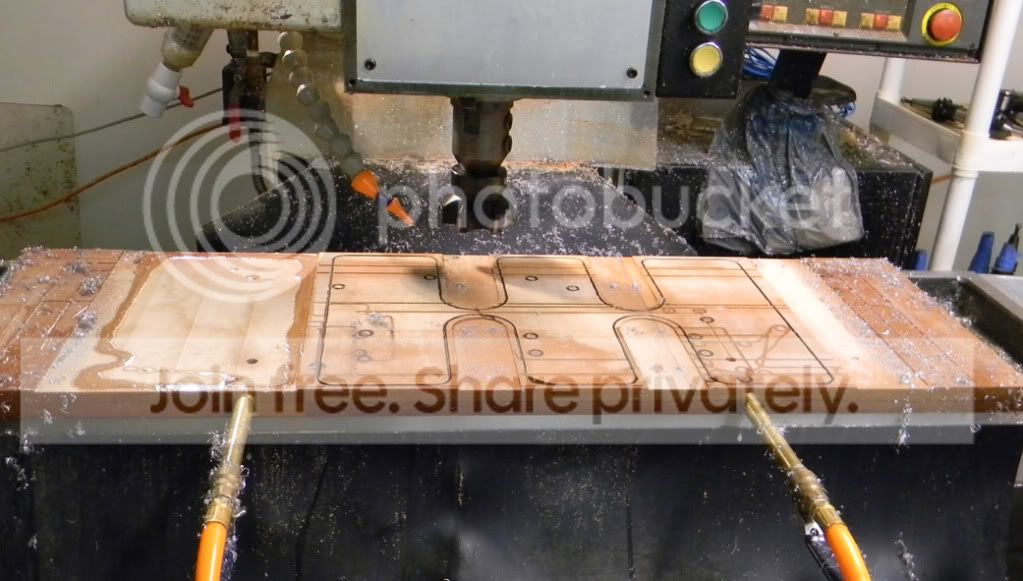
This evil contraption is made of micarta, it uses a vacuum to hold the part down. I cut a 1/8" slot .055" deep around the inside profile of my part, then I make a gasket with some 1/16" o-ring cord stock (which is actually .070", not really 1/16") using superglue to glue the ends together. It doesn't take much more time to do it than it takes to describe it. There is an approach to this that uses an MDF spoil board that forgoes the gasket, but it isn't compatible with coolant and you can't achieve as hard a vacuum, so I always use a gasket in my shop. After a while the fixture gets pretty hacked up, so I fill in the grooves with epoxy and flatten it out. You can kind of see that here:
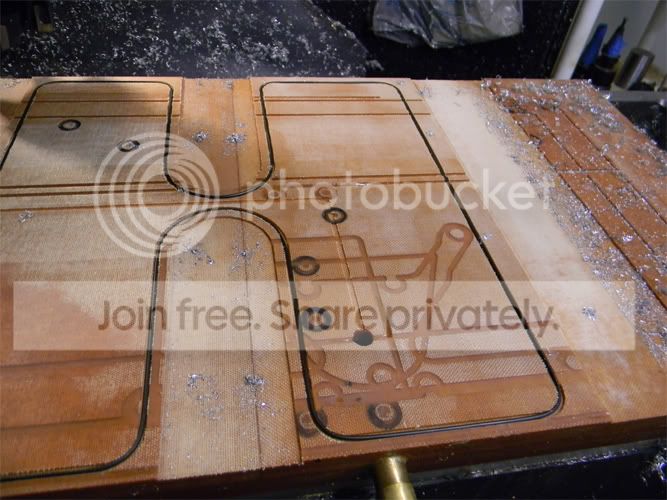
As you can see, I use o-rings for a gasket where a hole is drilled though the part. I hacked up the fixture last week for a multi level part, so I just milled it down flat for a (relatively) fresh start. There is still one old gasket trace left behind, which I filled in with epoxy before refacing.
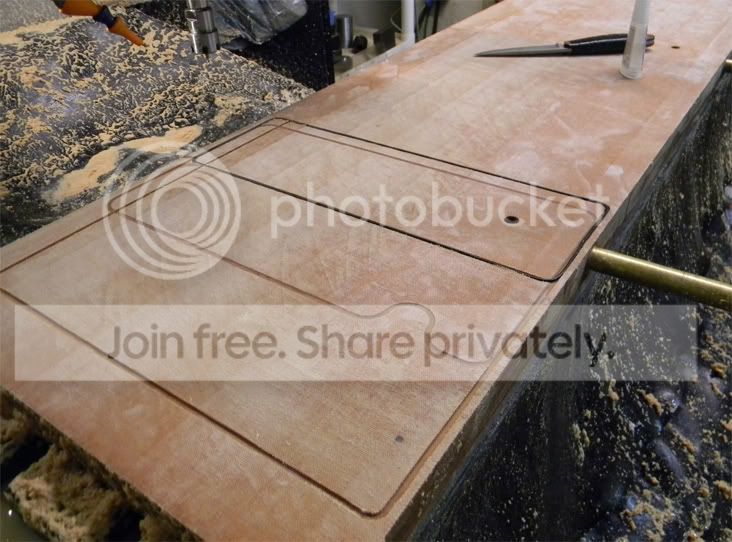
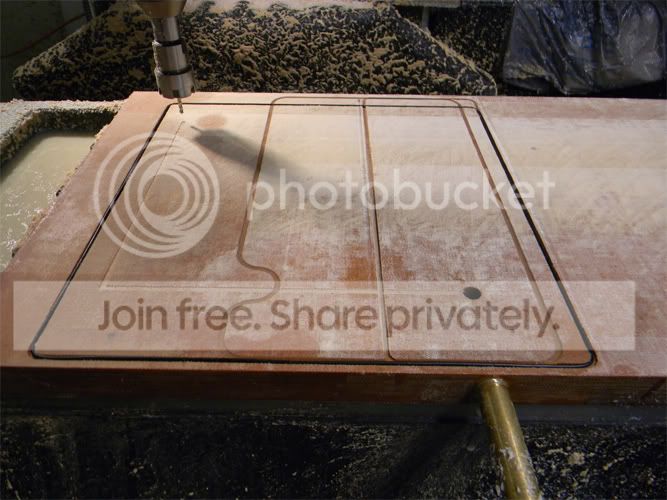
So, then I cut in the profiles of the polycarbonate parts.
And suck some down and start making parts.
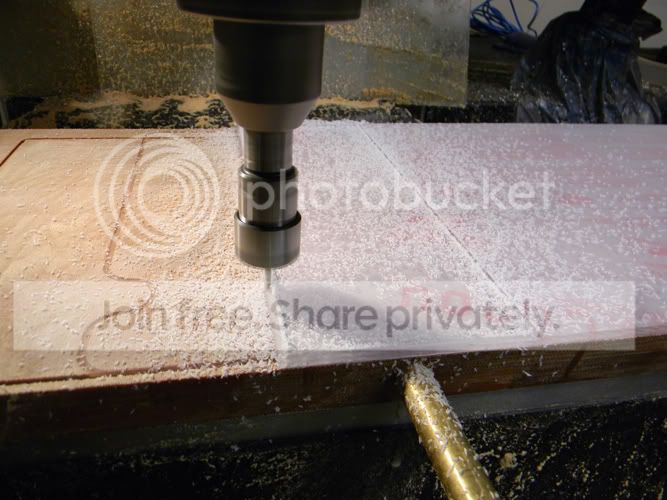
Finished part, still sucked down to the fixture. I'm leaving the protective film still on the part. Those are plastic chips, the part isn't actually fuzzy.
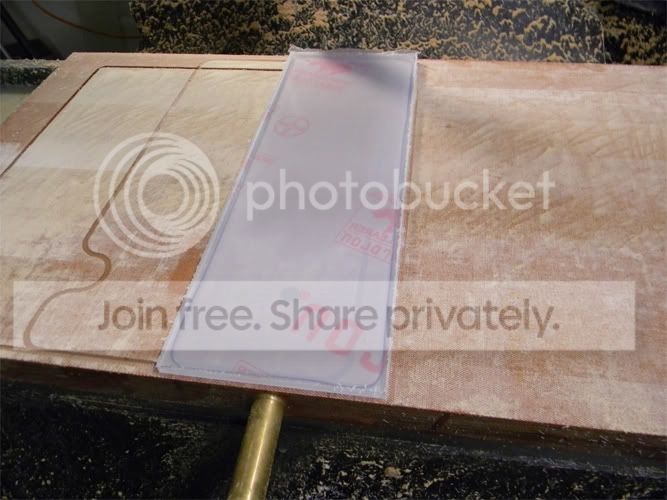
I make some of the smaller window, then I change to gasket over to a larger window. This part is a little larger so it needs a shallow groove cut out from the vacuum hole to allow air flow out to the perimeter of the part.
So, while all this is going on, I'm setting up another part on a different mill, this time using epoxy on a sub plate fixture. Let me talk about this fixture, because sub plates come up here from time to time.
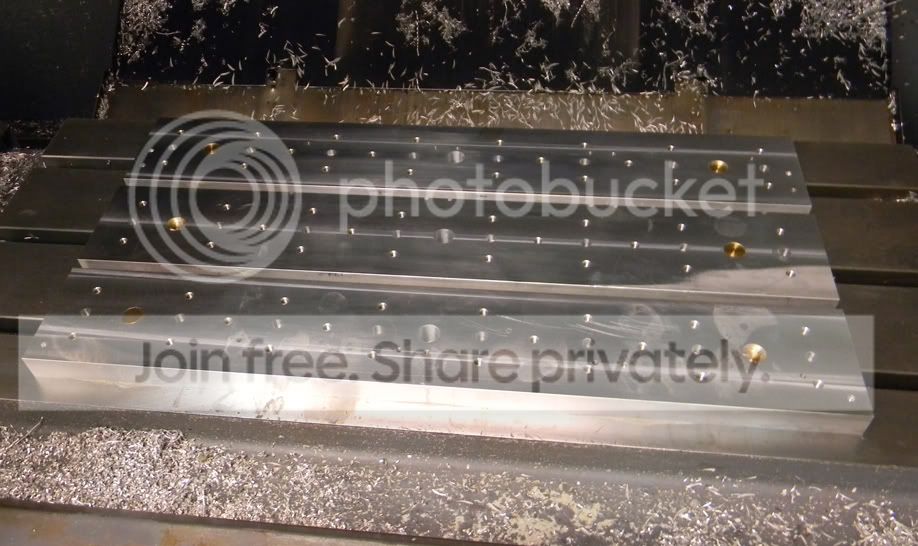
This is actually three 1" by 4" bars, 26" long, machined flat on all surfaces and bolted to the table with eight 1/4"-20 socket head cap screws per bar. The reason for so many hold down fasteners is to minimize unsupported span so the fixture and table behave more like a single solid mass. There are brass dowel pins on each bar that key to the T-slots on the table. This particular mill, a relatively large Bridgeport, has T slots that are .7087" inches. They're very consistent and they're perfectly in line with the X axis so they can be used to locate a fixture. So I carefully bored holes in my fixture to .7087" (plus or minus a couple tenths) and turned some brass dowel pins to .7085" (plus or minus a couple tenths) and can set the bars onto the table perfectly square. I center up one bar, indicate off of it and align the other bars to it within a few tenths relatively easily. While I was set up to bore the .7087 holes I popped a hole in the dead center of the bar that I can pick up with a coaxial indicator to simplify programming later. There is a 1/4-20 threaded hole pattern to aid in part clamping.
The bolt holes were reamed to .3760" so they can also be used with dowel pins. I have a piece to fixture, so I pop in three 3/8" dowel pins, and epoxy a work piece down onto the fixture.
Because I zeroed off the big hole, and I know where the dowels are located relative to the center hole, my work piece is already square and located. Fast and easy.

Let me talk about this a minute. This is going to be a relatively precision part, a lifter plate used in an automated assembly that processes fiber optic connectors. It registers the fixture above it (that I also make) relative to a laser for scribing the fiber optic cable. It needs to be flat and accurate so everything ends up where it is supposed to be, the automated assembly line is blind. I've been making these parts for years and this is part of the reason I use epoxy and vacuum for machining. Let me explain:
If you want to machine a part flat, you're going to run into problems with warping after the cut. Using extruded aluminum that has been stretched rather than rolled plate eliminates residual stress gradient across the thickness of the part, so you can machine one side without it drawing toward the cut (so long as you don't induce new stressors with your tooling or machining strategy). But if you clamp or vacuum or in any other way apply force to the work piece to hold it for machining, you'll spring it. And when you unclamp it, your perfectly flat surface will distort as the metal returns to its unstressed state. Hence my use of epoxy and the genesis of this very long thread.
I have used double sided tape, super glue, and even purpose made heat activated fixturing film. When you consider setup time, reliability of bond, ease of removal and compatibility with machining, I have found that fast set epoxy is the best. And of the epoxy I've tried, the Loctite 5 min epoxy works the best. It isn't rubbery or sticky so it doesn't gunk up the cutter. It has very repeatable poor bond strength so you can use it over large areas without fear of permanently attaching your work to your fixture. When you're finished, it peals off cleanly without leaving bits of resin on your parts or fixture, so clean up is easy. Other adhesives I've tried were too strong, requiring heat to release, and discouraging use over large areas, which doesn't help chatter etc.
So, anyhoo, epoxied work piece being machined:
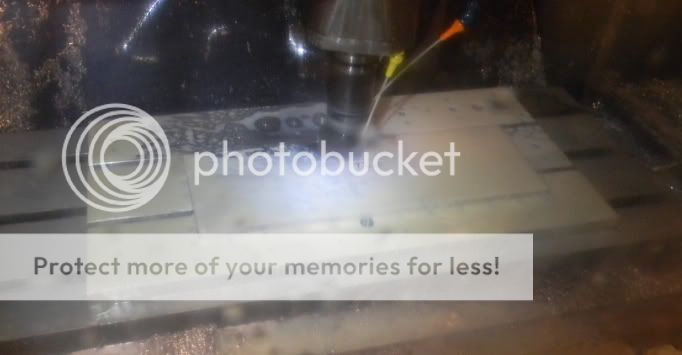
The mostly finished part
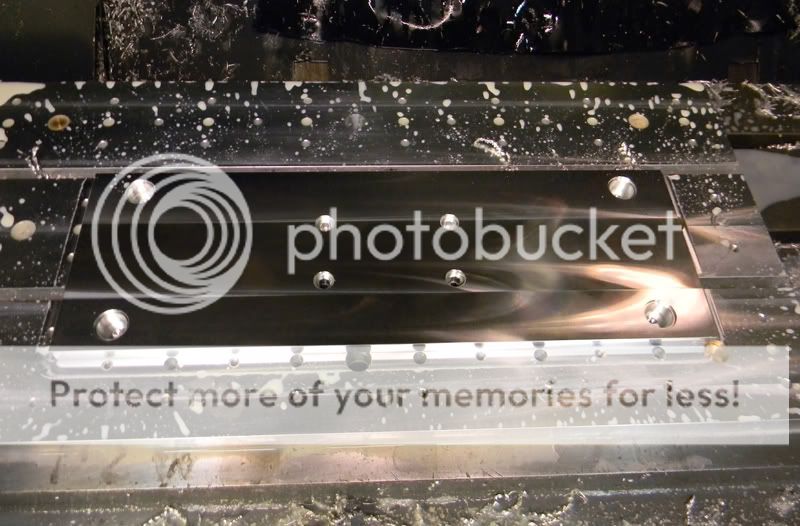
Machined on all five surfaces (this was all done very quickly, by the way)

While the epoxy was curing I was running polycarbonate windows and I setup a toolpost grinder on a lathe to grind relief behind the sphere of some bullet nose dowel pins that will be used with this lifer plate. This makes them resistant to binding, which is great on automated equipment. This isn't really relevant to a thread about fixturing. Or is it?
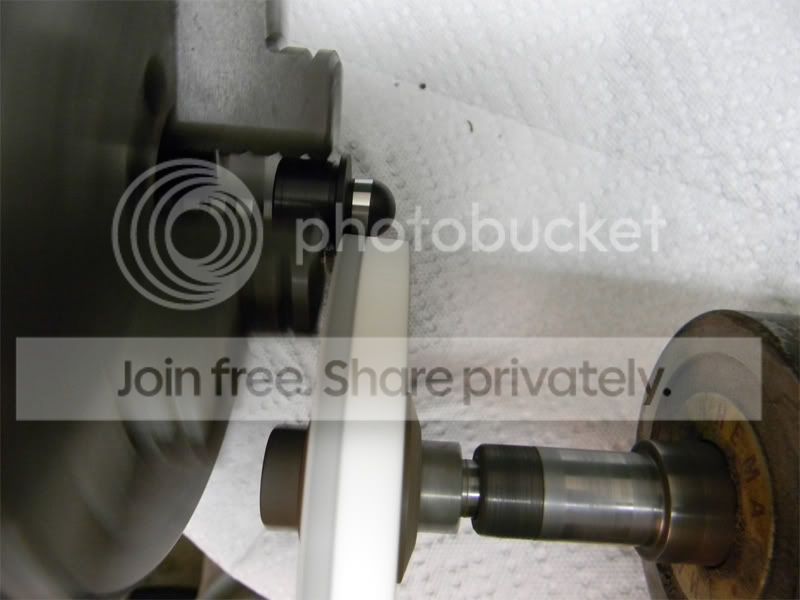
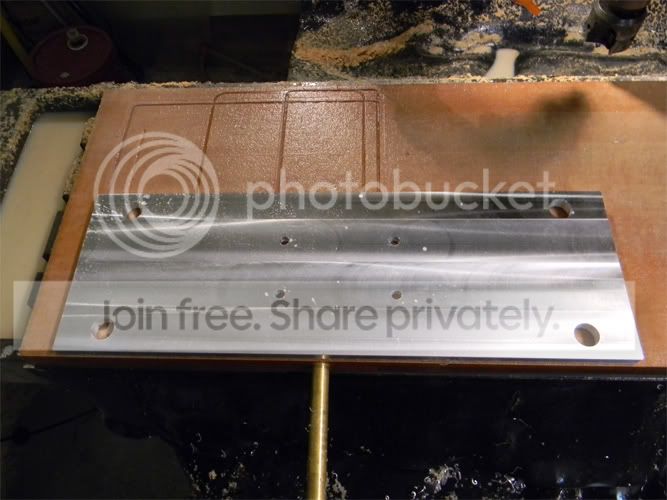
I cut a trace on the vacuum fixture to flatten the back side of this lifter plate
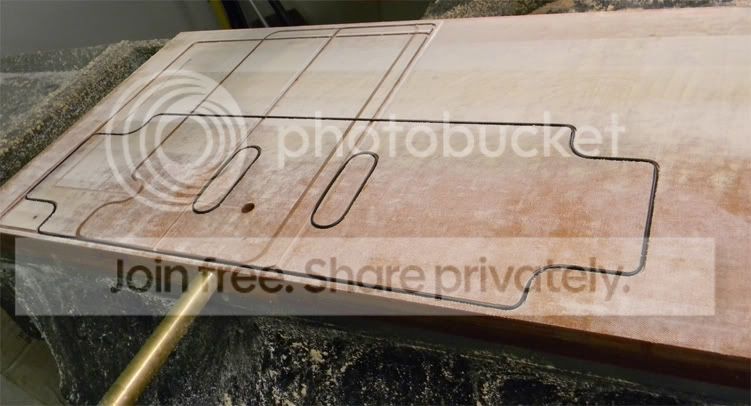
and mow it down
I deburred it and pressed the pins in and boxed it up and hustled to get it and the windows out before the post office closed.
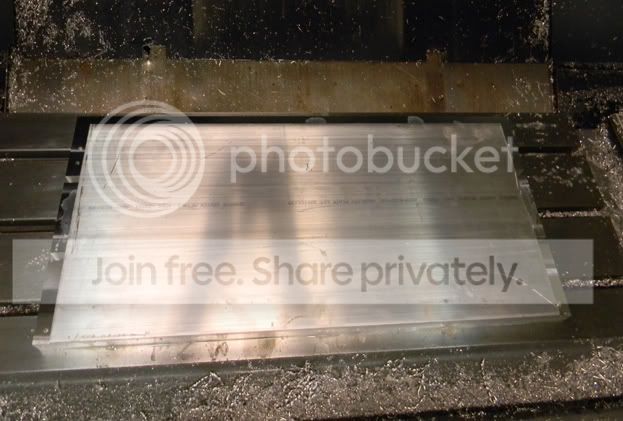
Later I skimmed a couple thou off the subplate (good as new) and glued another workpiece on for tomorrow. This one is 12X24.
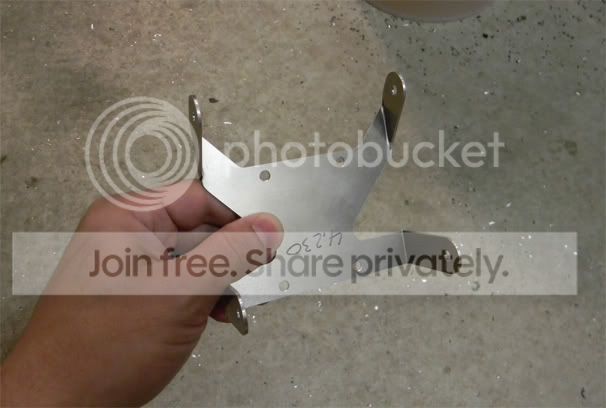
As I'm finishing up here, this is a picture of a bracket that was profiled on the vacuum fixture. I don't have one that hasn't already been bent, you'll have to use your imagination. This represents about the limit of minimum surface area required to hold a work piece for machining. Any smaller and the hold down force from the vacuum is inadequate for the task. My hand included for scale
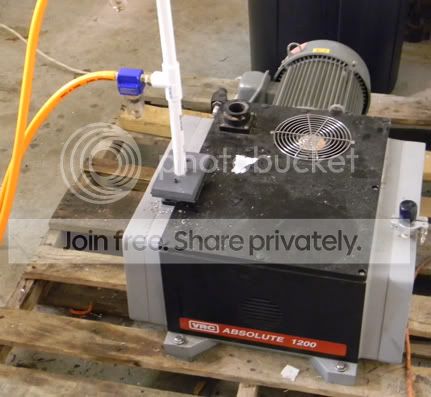
This is the poor unfortunate vacuum pump that got drafted into service in my shop. It hates its life. I do filter the air going into it to prevent it ingesting coolant in case something goes wrong. Something goes wrong on a fairly regular basis in my shop.
I also use conventional fixturing, which I haven't discussed. But I thought I'd take a moment today to illustrate some unconventional fixturing. Many of us have vacuum pumps for stabilizing, that's a great way of holding thin stock in repetitive operations. And those of us machining things like pocket knife liners might do well using epoxy to hold their work down. A sub plate can be a sacrificial piece. You can use things like dowels to speed assembling onto your mill. You can include threaded holes and dowel pins holes to speed accurate work holding. Epoxy is a good way to hold a part without distorting that part.
Thanks for following along.
There was a thread recently about "what kind of epoxy do you use" that got me thinking. That is actually a fairly open ended question, I use a few different epoxies. The OP was using a fast set Loctite, which I use very frequently, but not for knife handles. Since I have some projects going on right now where I'm using it for part hold down, I thought I'd do a thread about fixturing. A thread about fixturing with epoxy would be a short thread, so here's an entire thread about fixturing in general and a day in my little shop.
To start with, I have a little job to make a few polycarbonate windows, and I won't be using glue. They're a very specific size and have a specific radius on each corner, so I need to machine all around the part. There is a way to do this where you use some sacrificial material under the part, you clamp it down and machine part of it, your move your clamps and cut the rest of it. Personally I hate this approach. The part can get dented by the clamp, the part can move while fiddling with the clamps, it is possible to hit the clamp with the tool holder or spindle, and it is tedious if you have a bunch of parts to do. So I use a vacuum table:
This evil contraption is made of micarta, it uses a vacuum to hold the part down. I cut a 1/8" slot .055" deep around the inside profile of my part, then I make a gasket with some 1/16" o-ring cord stock (which is actually .070", not really 1/16") using superglue to glue the ends together. It doesn't take much more time to do it than it takes to describe it. There is an approach to this that uses an MDF spoil board that forgoes the gasket, but it isn't compatible with coolant and you can't achieve as hard a vacuum, so I always use a gasket in my shop. After a while the fixture gets pretty hacked up, so I fill in the grooves with epoxy and flatten it out. You can kind of see that here:
As you can see, I use o-rings for a gasket where a hole is drilled though the part. I hacked up the fixture last week for a multi level part, so I just milled it down flat for a (relatively) fresh start. There is still one old gasket trace left behind, which I filled in with epoxy before refacing.
So, then I cut in the profiles of the polycarbonate parts.
And suck some down and start making parts.
Finished part, still sucked down to the fixture. I'm leaving the protective film still on the part. Those are plastic chips, the part isn't actually fuzzy.
I make some of the smaller window, then I change to gasket over to a larger window. This part is a little larger so it needs a shallow groove cut out from the vacuum hole to allow air flow out to the perimeter of the part.
So, while all this is going on, I'm setting up another part on a different mill, this time using epoxy on a sub plate fixture. Let me talk about this fixture, because sub plates come up here from time to time.
This is actually three 1" by 4" bars, 26" long, machined flat on all surfaces and bolted to the table with eight 1/4"-20 socket head cap screws per bar. The reason for so many hold down fasteners is to minimize unsupported span so the fixture and table behave more like a single solid mass. There are brass dowel pins on each bar that key to the T-slots on the table. This particular mill, a relatively large Bridgeport, has T slots that are .7087" inches. They're very consistent and they're perfectly in line with the X axis so they can be used to locate a fixture. So I carefully bored holes in my fixture to .7087" (plus or minus a couple tenths) and turned some brass dowel pins to .7085" (plus or minus a couple tenths) and can set the bars onto the table perfectly square. I center up one bar, indicate off of it and align the other bars to it within a few tenths relatively easily. While I was set up to bore the .7087 holes I popped a hole in the dead center of the bar that I can pick up with a coaxial indicator to simplify programming later. There is a 1/4-20 threaded hole pattern to aid in part clamping.
The bolt holes were reamed to .3760" so they can also be used with dowel pins. I have a piece to fixture, so I pop in three 3/8" dowel pins, and epoxy a work piece down onto the fixture.
Because I zeroed off the big hole, and I know where the dowels are located relative to the center hole, my work piece is already square and located. Fast and easy.
Let me talk about this a minute. This is going to be a relatively precision part, a lifter plate used in an automated assembly that processes fiber optic connectors. It registers the fixture above it (that I also make) relative to a laser for scribing the fiber optic cable. It needs to be flat and accurate so everything ends up where it is supposed to be, the automated assembly line is blind. I've been making these parts for years and this is part of the reason I use epoxy and vacuum for machining. Let me explain:
If you want to machine a part flat, you're going to run into problems with warping after the cut. Using extruded aluminum that has been stretched rather than rolled plate eliminates residual stress gradient across the thickness of the part, so you can machine one side without it drawing toward the cut (so long as you don't induce new stressors with your tooling or machining strategy). But if you clamp or vacuum or in any other way apply force to the work piece to hold it for machining, you'll spring it. And when you unclamp it, your perfectly flat surface will distort as the metal returns to its unstressed state. Hence my use of epoxy and the genesis of this very long thread.
I have used double sided tape, super glue, and even purpose made heat activated fixturing film. When you consider setup time, reliability of bond, ease of removal and compatibility with machining, I have found that fast set epoxy is the best. And of the epoxy I've tried, the Loctite 5 min epoxy works the best. It isn't rubbery or sticky so it doesn't gunk up the cutter. It has very repeatable poor bond strength so you can use it over large areas without fear of permanently attaching your work to your fixture. When you're finished, it peals off cleanly without leaving bits of resin on your parts or fixture, so clean up is easy. Other adhesives I've tried were too strong, requiring heat to release, and discouraging use over large areas, which doesn't help chatter etc.
So, anyhoo, epoxied work piece being machined:
The mostly finished part
Machined on all five surfaces (this was all done very quickly, by the way)
While the epoxy was curing I was running polycarbonate windows and I setup a toolpost grinder on a lathe to grind relief behind the sphere of some bullet nose dowel pins that will be used with this lifer plate. This makes them resistant to binding, which is great on automated equipment. This isn't really relevant to a thread about fixturing. Or is it?
I cut a trace on the vacuum fixture to flatten the back side of this lifter plate
and mow it down
I deburred it and pressed the pins in and boxed it up and hustled to get it and the windows out before the post office closed.
Later I skimmed a couple thou off the subplate (good as new) and glued another workpiece on for tomorrow. This one is 12X24.
As I'm finishing up here, this is a picture of a bracket that was profiled on the vacuum fixture. I don't have one that hasn't already been bent, you'll have to use your imagination. This represents about the limit of minimum surface area required to hold a work piece for machining. Any smaller and the hold down force from the vacuum is inadequate for the task. My hand included for scale
This is the poor unfortunate vacuum pump that got drafted into service in my shop. It hates its life. I do filter the air going into it to prevent it ingesting coolant in case something goes wrong. Something goes wrong on a fairly regular basis in my shop.
I also use conventional fixturing, which I haven't discussed. But I thought I'd take a moment today to illustrate some unconventional fixturing. Many of us have vacuum pumps for stabilizing, that's a great way of holding thin stock in repetitive operations. And those of us machining things like pocket knife liners might do well using epoxy to hold their work down. A sub plate can be a sacrificial piece. You can use things like dowels to speed assembling onto your mill. You can include threaded holes and dowel pins holes to speed accurate work holding. Epoxy is a good way to hold a part without distorting that part.
Thanks for following along.

 ! Awesome thread, Nathan. I have to read it a few more times to understand more of it. What I did get was great. Thank you.


 --- but I think it's very cool stuff and appreciate you taking the time to document it for us Nathan!