
A Knife That Went Through A War

Jack Black

Seize the Lambsfoot! Seize the Day!
Platinum Member
Joined
Dec 2, 2005
Messages
71,449
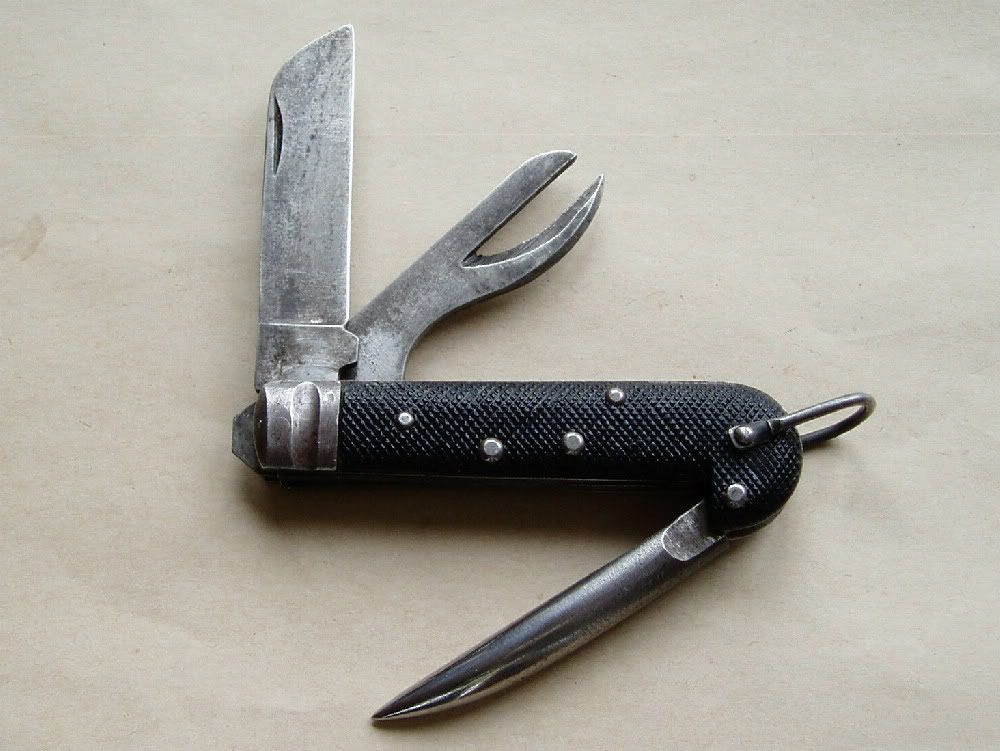
This is a British Army clasp knife dated 1939, when this pattern was first adopted, and made in Sheffield by Wraggs of Arundel Street. I bought it from an antiques shop earlier in the week. It’s been well-used, and hard, and has its scars, but then it did go through a war. I reckon it could probably tell a few tales.

More recent discussion on clasp knives here: http://www.bladeforums.com/forums/showthread.php/1031348-Another-Belgian-Clasp-Knife


 
Very cool old knife, Jack!:thumbup:

When I see old knives like that, I can't help but wonder what tales they could tell if they could indeed speak. Was it carried at Dunkrk? Maybe Juno Beach? Or was it on the other side of the world, defending the Empire's borders by India and Burma? It's apparent from blade wear it was used a great deal for cutting, and I can only guess how many cans of Bully Beef it opened for some hungry soldier. I've always admired those old clasp knives, they have a timeless rugged look to them, much like the .303 Enfield rifle. Somethings just capture the era, like the M1 and the demo knife for us yanks, and the Enfield and clasp knife for you Brits. Like the Kabar for us and the Fairbain for you all.:thumbup:

Carl.
 
Great looking knife with a lot of history. I wish it could tell something from that time. Thanks for sharing, Jack :)
 
Great old knife Jack. The scales show remarkably little shrinkage. The blade and screwdriver were well used. I'm sure there is a very interesting story to accompany this one. Note the copper shackel which was replaced with steel in 1941. Thanks for posting it for us.
 
I think I hear the can opener speaking. Something about the Supermarine Walrus, R. J. Mitchell and the Battle of Britain. Bloody fine knife
 
Thanks a lot fellers, your comments are much appreciated :)

Is it a "nailbreaker"?

The blade opens with relative ease, about the same as an average pocket knife, though it's possible the spring has weakened over the years. The can-opener has a stiffer pull.

Very cool old knife, Jack!:thumbup:

When I see old knives like that, I can't help but wonder what tales they could tell if they could indeed speak. Was it carried at Dunkrk? Maybe Juno Beach? Or was it on the other side of the world, defending the Empire's borders by India and Burma? It's apparent from blade wear it was used a great deal for cutting, and I can only guess how many cans of Bully Beef it opened for some hungry soldier. I've always admired those old clasp knives, they have a timeless rugged look to them, much like the .303 Enfield rifle. Somethings just capture the era, like the M1 and the demo knife for us yanks, and the Enfield and clasp knife for you Brits. Like the Kabar for us and the Fairbain for you all.:thumbup:

Carl.

All iconic Carl. Whenever I see a Kabar I think of Rober Mitchum in Heaven Knows Mr Allison :)
 
Love the bolsters of this knife....they seem like something I've not seen before on a clasp knife....or maybe I just forgot.

The copper bail really does it for me though. Is that original?

You keep searching Jack!
 
Love the bolsters of this knife....they seem like something I've not seen before on a clasp knife....or maybe I just forgot.

The copper bail really does it for me though. Is that original?

You keep searching Jack!

I guess the bolsters were dropped later to simplify production and reduce costs during WW2. The ever informative Smiling Knife tells us that the original copper bail was replaced with steel in 1941.

I was only went in the shop to buy some pre-decimal coins for Gevonovich, but I couldn't pass this up! :D
 
I guess the bolsters were dropped later to simplify production and reduce costs during WW2. The ever informative Smiling Knife tells us that the original copper bail was replaced with steel in 1941.

Great thread, Jack. I have posted this before, but it illustrates the evolution of these knives.

Rigger1.jpg


The steel bail indicates that this is post-1941, and I gather that the lack of a bottle opener means it is pre-1945. The bolsters were probably eliminated sometime in this time period, since I don't think I have ever seen one of these with both bolsters and a bottle opener.

This one has always been a bit of mystery. I bought it around 1980 in a surplus store in Toronto. It was in a large bin of identical knives, all of them battered and abused as well as rusty, clearly not new stock, so it would be reasonable to assume that they were military surplus. However, it has no markings at all. No issue mark, no maker's stamp, nothing. Does anyone have an idea where it came from?

One thing I have noticed is that all these knives have the nail nick on the main blade set up for left-handed opening, even though there is plenty of room to put it on the other side, above the can opener. Was this part of the military specification?
 
Your knife is in beautiful condition iSaur, thanks a lot for sharing it, you've got a real piece of history there :thumbup:
 
iSaur - That is a great example of this kind of knife. Thanks for sharing.

I guess the bolsters were dropped later to simplify production and reduce costs during WW2. The ever informative Smiling Knife tells us that the original copper bail was replaced with steel in 1941.

Then, considering how worn* the blade is, I'm impressed its still there!

*Tommy and his grinding wheel strikes again! ;)
 
Then, considering how worn* the blade is, I'm impressed its still there!

*Tommy and his grinding wheel strikes again! ;)

Yeah, I guess they made things to last then. Those grinding wheels have been cruel to a lot of knives over the years though! ;)
 
That's an interesting example. Without marks it is difficult to provide any further information. One thing that does strike me is the bolster is quite different than the others I have seen. Note the groove in the middle of the bolster compared to the bolster on Jack's knife which is typical on the British knives. Wondering if maybe it is a foreign made knife in the style of a British knife?
 
Could be, s-k. This is the only one I've ever actually had my hands on, although I've seen many pictures in these forums. I know there are many minor variations on the general theme, and many companies made these. If it's foreign, it adheres very closely to the standard design, and it's a solid knife, utilitarian but not cheaply made. Incidentally, why the grooved (rattail?) bolster? It seems like an unnecessary bit of refinement and an extra manufacturing step for a working knife.

I don't know if the Canadian military ever used this style. The ones I've seen are different - larger and with metal handles.
 
Back
Top