A knife with a convex, lens-shaped cross section?

Joined
Sep 5, 2010
Messages
1,998
Hi all, anyone know of or maybe even have some pictures of any knives with a convex grind such that the middle of the blade along the length swells and is thicker than the spine? Think swedge, or maybe a double-edged knife, but instead of hard angles it's all smoothed and convexed and the spine is not sharpened. A cross section of the knife would like kind of like a convex lens or an apple seed or the shape of an eye. Just more flat and sharp, of course.

I just got that idea in my head and wonder how it actually looks. Kind of want to get a custom knife like that, either mirror polished or satined.

Any ideas on the practicality of it? Some disadvantages I can think of are a more obtuse angle on the spine that makes it difficult to strike ferro rods, maybe slightly difficult to baton with... I can't think of any advantages, but I'm just really curious about the visual effect the blade would have, to look almost spherical rather than flat.
 
That's weird-- I was thinking about this the other day. Not in the sense that I would want it-- more out of curiosity of whether or not someone could make it work functionally and aesthetically. I'm sure there are a bunch of reasons why you wouldn't want it for practical purposes (reasons that I am not in a position to articulate) but it might make an interesting art knife.
 
i have pictures of a sar 5 that has a full convexed blade that i can email you. the full convex looks like an appleseed more or less. i made a few full convex blades many years ago when i first started out making knives and they cut ok.
 
i have pictures of a sar 5 that has a full convexed blade that i can email you. the full convex looks like an appleseed more or less. i made a few full convex blades many years ago when i first started out making knives and they cut ok.

Cool. Thanks, Richard I just sent you an e-mail via BF with my e-mail address.
I'm sure the convex to the spine doesn't affect how it cuts as much since it's the complete opposite side of the blade, but I'm sure there are reasons to have and not to have it as well besides the cutting
 
i made a few full convex blades many years ago when i first started out making knives and they cut ok.

Also I'm surprised you started out with those. Not that I'm an expert knifemaker or anything, but those seem more difficult to make... not a beginner thing!
 
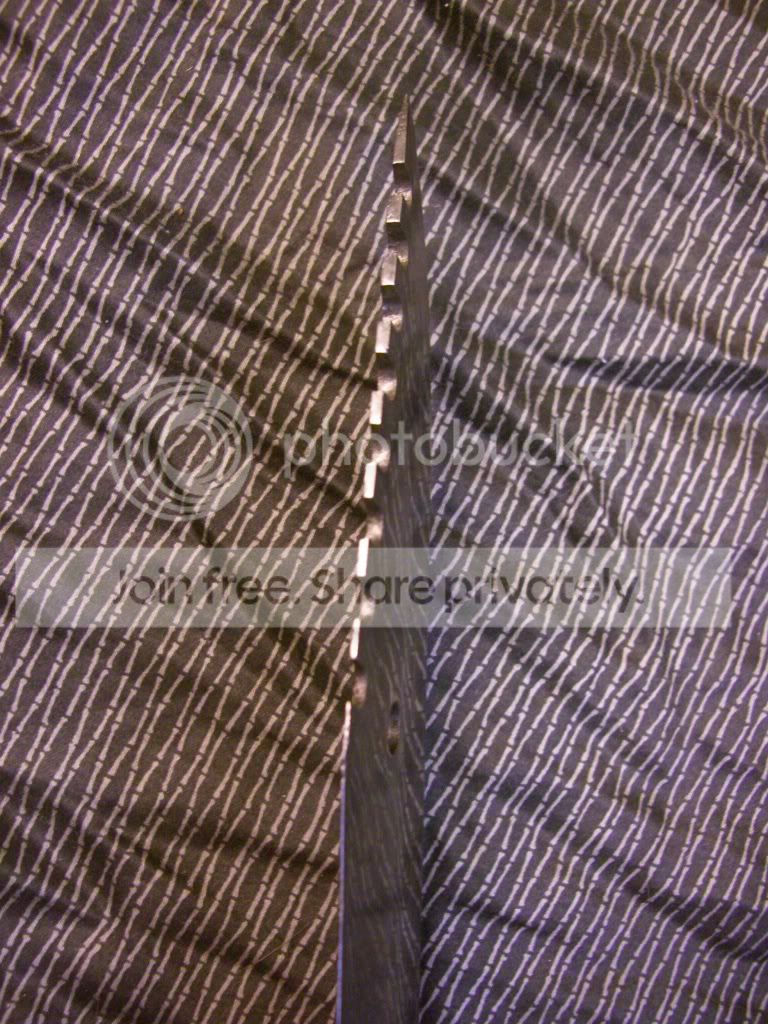
This antique cleaver (I call it my "chicken chopper") has a lens-shaped cross section.

CIMG8962.jpg


You can see how the teeth of the meat tenderizer get thicker as they approach the tip, which is at the center of the "lens"

CIMG8960.jpg
 
Wow :eek: I have never seen anything like that. That is pretty cool. And even though it's got that mottled patina I can kind of see the effect I'm looking for of a "spherical blade."

I don't suppose that's an easy-to-find cleaver :) thanks for sharing
 
Actually, I guess they turn up all the time on eBay, usually labeled as a bowie knife of some kind. No one seems to know who made them, but they seem to have been pretty well distributed and made in large quantities. It's a great chopper for culling old laying hens. :D:thumbup:
 
This Mike Malosh of mine is full convex or appleseed ground.

MaloshHunter.jpg


The spine isnt "zero ground"...I'm not sure what the advantage of that would be. But it does reach its greatest thickess about 3/4 up from the edge to the spine.

If that's what you are asking about.
 
Isn't a katana's cross section similar to what you're talking about?

You're almost exactly right. I can't believe that didn't cross my mind before--when I was drawing it out, that shape looked so familiar. I am thinking about a katana's cross section, just with zero edges.

If a blade like a katana is ground like that, I assume there must be some advantages. Those old katanas were no joke. I guess it makes the blade lighter, for one.

This Mike Malosh of mine is full convex or appleseed ground.

MaloshHunter.jpg


The spine isnt "zero ground"...I'm not sure what the advantage of that would be. But it does reach its greatest thickess about 3/4 up from the edge to the spine.

If that's what you are asking about.

That's pretty cool looking, bud! It gives me a good idea of what a blade with that grind and finish would look like. You almost can't tell whether it's convex or concave, and it has a weird illusion of being round and blunt. Pretty nifty!
 
Also I'm surprised you started out with those. Not that I'm an expert knifemaker or anything, but those seem more difficult to make... not a beginner thing!
i built my own belt sander back then and a full convex blade was easy for me to make on it. most of the guys that wanted a knife never knew how to maintain a convex edge so most i made had a v edge. i only make full convex blades when i get in the mood to do one.
 
i built my own belt sander back then and a full convex blade was easy for me to make on it. most of the guys that wanted a knife never knew how to maintain a convex edge so most i made had a v edge. i only make full convex blades when i get in the mood to do one.

Sounds like something I'd be interested in. I'm gonna send you an e-mail soon about that :)
 
Isn't a katana's cross section similar to what you're talking about?

Trapezoidal scandi blade with convexed edge is similar shape as well. Some of the old school scandinavian smiths still make blades like that.
The biggest drawback for me with that shape is as a stick tang, they're a PITA to get a decent bolster fit, and also it's difficult to do an assisted cut, putting weight on the spine when it's almost another edge.
 
Trapezoidal scandi blade ....

Heh? I'm not getting that at all. Trapezoid=four sides, one set of parallel sides. Are you talking about something with a diamond-shaped cross section (technically a kite or rhombus) with A and C rounded off by convexing?

trap_kite6.gif
 
The first time I saw one I was told it was double ground. Like you mentioned but it had a ridge in the center. Then I saw a Scagel that was named the Mermaid of the Great Lakes, she had no ridge anywhere, everything blended. My next knife to come to me was unsigned. All supremely blended, a fighter and it turns out to have been made by Rudy Ruana in 1938. An absolutely beautifully developed blade, well thought out. I call them the natural knife, built like a shark to flow through tissue smoothly.

I made a few and enjoyed experimenting with them greatly. Michael Price's father made some also, beautiful knifes.
 
Back
Top