

- Joined
- Jun 4, 2010
- Messages
- 6,642
Lately I've been focusing on my waterstone technique and trying to simplify my process overall without compromising results. When using these stones I like to raise a slurry during the inital work at a given grit value because I find it reduces burr formation, then once the bevel is nice and clean to the apex I give it a rinse, work it a bit more till just the smallest burr begins to form, then strop. Most recently I've been using diamond pastes, but have and use the crayon variety and SiC dust as well.
One of the drawbacks to the waterstone is the need to lap it to maintain perfect flat. There are lots of ways to do this, but I use an old AlumOx stone that's been carved up with a diamond saw to speed up the flattening effect. I use a DMT coarse wallet card to build a slurry for grinding so I don't get a bunch of shed particles in the mix that might be much larger than the stone's rating. This is slowly killing my DMT card, and that says I AM shedding some abrasives into my slurry whether I can see evidence of them or not, despite using a very light touch and plenty of water. For a while now I've been thinking of ways to do both at the same time with some other material, then I never have to worry about the stone dishing, can whip up a slurry without contamination, and have less stuff bouncing around in my gear bag.
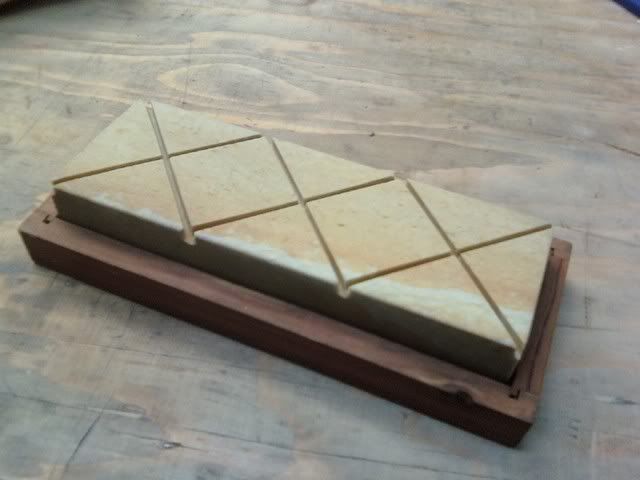
While cleaning out my sharpening supply shelf, came across one of my old soft Arkasas stones. These are great stones in their own right, but I don't much care for 6" stones anymore and my Arkies don't work so well on the tougher stainless steels till I get up to a translucent or black surgical. That said, the individual particle size of novaculite is between 1 and 5 micron and subject to further fracturing with use, so I decided to make some cuts to the soft Arkansas and try it for lapping and slurry creation with my waterstones. Any pieces that do break off (which shouldn't be too many - Arkansas stones are mighty tough) shouldn't contaminate my slurry too much if at all.
Gave it a try and it worked great - I failed to see any evidence of larger particles causing trouble in the slurry, the stone passes a pencil cross-hatch test, and I did have all the clean slurry I could care to experiment with. Gently mopped up some of the slurry with a sheet of phonebook paper and, with the paper plastered to my waterstone, stropped with it following my usual practices. It removed a small burr and did a great job of refining the edge. It actually seemed to do a better job than my strops including my most recent darling, the diamond paste on balsa or leather.
I had to take a closer look at what was happening. I have a pretty good handle on the basic grind I get from a waterstone, so my focus was more on the stropping procedure. Took a 1095 carbon steel knife that had been sharpened up on my King 1200 grit stone and stropped with 6 micron diamond paste (I like a toothy edge). First I took a picture of the edge, then stropped it on some damp paper 60 passes/side and took a pic, finally stropped it with the slurry on damp paper 25 passes/side and took a pic.
Images are:
Modified soft Arkansas lapping/slurry stone
Edge following 6 micron stropping on leather

Edge following 6 micron stropping on leather and stropping on paper

Edge following stropping on paper loaded with waterstone slurry

You can clearly see that the wet paper did some polishing - the scratch is a tiny bit smaller and the whole thing is shinier. The pic of the blade post stropping on paper with slurry is a bit surprising. The scratch troughs are a fraction of the size they were coming off the stone, couldn't find the exact spot on the blade for the pic because the reference scratch was unrecognizable.
This is about the best toothy edge I've ever whipped up - sends facial stubble flying and I actually cut my arm shaving some arm hair - only the second time in my life that's happened. .
Anyway, I know plenty of members already are aware that their slurry can be used, from a variety of stone types, but I'm impressed with the performance and simplicity of this method - my strops are going to start collecting dust. Another thing this clearly shows is how much of an effect a softer surface makes on the effective grit rating of an abrasive particle - keep in mind this is one sheet of wet phonebook paper on a waterstone and the abrasive path is a fraction of what it was on the stone. I'll be testing this out at 4000 and 6000 grit levels in the near future to see if there's appreciable contamination at any grit level.
Sorry for the length, but wanted to convey as clearly as possible.
One of the drawbacks to the waterstone is the need to lap it to maintain perfect flat. There are lots of ways to do this, but I use an old AlumOx stone that's been carved up with a diamond saw to speed up the flattening effect. I use a DMT coarse wallet card to build a slurry for grinding so I don't get a bunch of shed particles in the mix that might be much larger than the stone's rating. This is slowly killing my DMT card, and that says I AM shedding some abrasives into my slurry whether I can see evidence of them or not, despite using a very light touch and plenty of water. For a while now I've been thinking of ways to do both at the same time with some other material, then I never have to worry about the stone dishing, can whip up a slurry without contamination, and have less stuff bouncing around in my gear bag.
While cleaning out my sharpening supply shelf, came across one of my old soft Arkasas stones. These are great stones in their own right, but I don't much care for 6" stones anymore and my Arkies don't work so well on the tougher stainless steels till I get up to a translucent or black surgical. That said, the individual particle size of novaculite is between 1 and 5 micron and subject to further fracturing with use, so I decided to make some cuts to the soft Arkansas and try it for lapping and slurry creation with my waterstones. Any pieces that do break off (which shouldn't be too many - Arkansas stones are mighty tough) shouldn't contaminate my slurry too much if at all.
Gave it a try and it worked great - I failed to see any evidence of larger particles causing trouble in the slurry, the stone passes a pencil cross-hatch test, and I did have all the clean slurry I could care to experiment with. Gently mopped up some of the slurry with a sheet of phonebook paper and, with the paper plastered to my waterstone, stropped with it following my usual practices. It removed a small burr and did a great job of refining the edge. It actually seemed to do a better job than my strops including my most recent darling, the diamond paste on balsa or leather.
I had to take a closer look at what was happening. I have a pretty good handle on the basic grind I get from a waterstone, so my focus was more on the stropping procedure. Took a 1095 carbon steel knife that had been sharpened up on my King 1200 grit stone and stropped with 6 micron diamond paste (I like a toothy edge). First I took a picture of the edge, then stropped it on some damp paper 60 passes/side and took a pic, finally stropped it with the slurry on damp paper 25 passes/side and took a pic.
Images are:
Modified soft Arkansas lapping/slurry stone
Edge following 6 micron stropping on leather
Edge following 6 micron stropping on leather and stropping on paper
Edge following stropping on paper loaded with waterstone slurry
You can clearly see that the wet paper did some polishing - the scratch is a tiny bit smaller and the whole thing is shinier. The pic of the blade post stropping on paper with slurry is a bit surprising. The scratch troughs are a fraction of the size they were coming off the stone, couldn't find the exact spot on the blade for the pic because the reference scratch was unrecognizable.
This is about the best toothy edge I've ever whipped up - sends facial stubble flying and I actually cut my arm shaving some arm hair - only the second time in my life that's happened. .
Anyway, I know plenty of members already are aware that their slurry can be used, from a variety of stone types, but I'm impressed with the performance and simplicity of this method - my strops are going to start collecting dust. Another thing this clearly shows is how much of an effect a softer surface makes on the effective grit rating of an abrasive particle - keep in mind this is one sheet of wet phonebook paper on a waterstone and the abrasive path is a fraction of what it was on the stone. I'll be testing this out at 4000 and 6000 grit levels in the near future to see if there's appreciable contamination at any grit level.
Sorry for the length, but wanted to convey as clearly as possible.
Last edited:


