

- Joined
- Sep 28, 2005
- Messages
- 4,527
I've been trying to get my mind around this topic for a long time now, so I hope I make sense. (At least a little bit!)
I've found the traditional forum to be a great home base for my Bladeforums wanderings, but it hasn't been easy, much because of the great diversity in slipjoints, which is both daunting and a draw. What I have come to understand as a truth for me, is that understanding slipjoints is all a matter of perspective.
What do I mean by that? I'm not really sure to be honest- because the perspective changes from person to person and day to day!! Some are drawn to Slipjoints because of the heart- reminding us of grandpa/Mr. Van/dad. Some are drawn to the romance of a simpler time/romance of a good hard days work (often romanced by those who have never undertaken a day of back breaking labour!). Sometimes it is just the use of a good working tool, the need for a variety of blade shapes, or a better quality tool; or we need to replace a lost old friend. Or we are looking for a new direction to collect, or collect certain handle materials, or..........
Okay, so why does our perspective matter to this discussion? Because it sets us up for love (or not) with slip joints. I'll set things up with my personal experience to try and clarify what I mean.
I come from a strong knife friendly culture. At 37 years old now, my world was much different as a kid than it is now. We lived with my grandpa, mom, dad and myself on a poor small farm. I shared a room with grandpa, and we had most of our guns hanging on the wall, with the hunting knives in a gun cabinet. We had a drawer in the kitchen just for knives- dad was a butcher on and off, so knives were plentiful and a regular part of life.
Except slipjoints. Slipjoints were those little things at the bottom of purses, jewelry boxes or junk drawers. They were there, but nobody paid them much attention. We had knives in the tractor tool boxes, all over the house and usually carried a fixed blade on my belt. Or if nothing else- a buck 110 style folder; it was fun to lift a hay bale, let go with one hand and "spyderdrop" the blade open, flip it in my hand and cut the strings in one fluid motion! I was a rural mall ninja!! (Okay maybe not that far but I did try to have fun with less appealing tasks!!)
Imagine my surprise when I started finding this forum, lo those eight or so years ago. These people were suggesting that these little knives were useful?!? Especially as a replacement for a full sized knife! Saying my big knife was unnecessary?!?
That was the first time that perspective got in the way of understanding Slipjoints. For somebody on the outside looking in, this world can be quite daunting!!
I had never seen/noticed full sized trappers, pruners, folding hunters. The largest Slipjoints to my world were maybe 3" stockman patterns, nothing that could compare to a 4" bladed fixed blade.
The next factor I had to wrap my brain around was only listing closed length!! But I want to know how much cutting edge the knife has! Coming from the fixed blade/pocket clip world this seems to often be a stumbling point with people discovering this type of knife collecting! And with good reason- after all, each of these knives are the same length, but appear to have much different characteristics when looked at as a whole knife:

These two are the same length closed (4")imagine your surprise if you were expecting a wharncliffe length on the sheepsfoot!!

Both 4"

Then, the new person has to figure out how the different lengths quantify in the hand. Come on, there really isn't that much of a difference between a 3.25" & a 3.75" knife is there? Well once you understand slip joints, and how the length discrepancy actually doubles as you extract the blade, it's easy to see how a 1/4" difference is a big deal, but for the new person it is similar to understanding the difference between a 3/32" or 5/32" thick blade- it doesn't seem like much until it's in your hand!
This picture may help newcomers understand closed lengths a bit more:

But then again- closed length doesn't tell much about blade length either!! (And after inputting data on multiple slipjoint blade lengths in my spreadsheet I do understand why many don't give the blade length lists- it's annoying to write out, and physics tell us that with Slipjoints the blade can not be longer than the handle, so we can extrapolate).
To me, I had to break through a barrier in my thinking about slipjoints. I now break them into two groups- the under 3" group and over 3" group (roughly). To me, the under 3" group are the utility/better than nothing else blades. The little big cutters like the peanut, tuxedo, basically what others would call a "Sunday, go to meeting knife". The knife that you will have with you, small, unobtrusive, but usually quite limited. Food preparation is usually limited to peeling, maybe sectioning small things like apples. Cutting string, opening packages, cleaning fingernails are more the expected tasks. Light duty, which IMO is one reason why one doesn't find many small knives with a punch- pressed into work as opposed to made for it.
Then there is the 3"+ group. For me its closer to 3.5-4", but in reality it seems to me that the change is closer to 3"-3.5". This is where the blade is long enough for most tasks to be performed comfortably. The handles get proportionally larger, more hand filling, and blades get even more robust. Blade lengths within the knife may be more variable (stockman pattern) as there is more length to play with. Accessory tools built for work may be included (punches, cap lifters, saws)
, and the knives generally have a more solid feel. I find more utility based scales, versus fancier scales on the smaller knives (traditionally, in my collection I like fancy materials even on my workers)

An extreme example:

The newcomer to Slipjoints has also entered into a new lexicon-
cut and drawn swedges (which are also representative of long pulls and nail nicks in this picture...hmmmmm)

pinched/threaded and rat tailed bolsters:

long pulls and nail nicks:
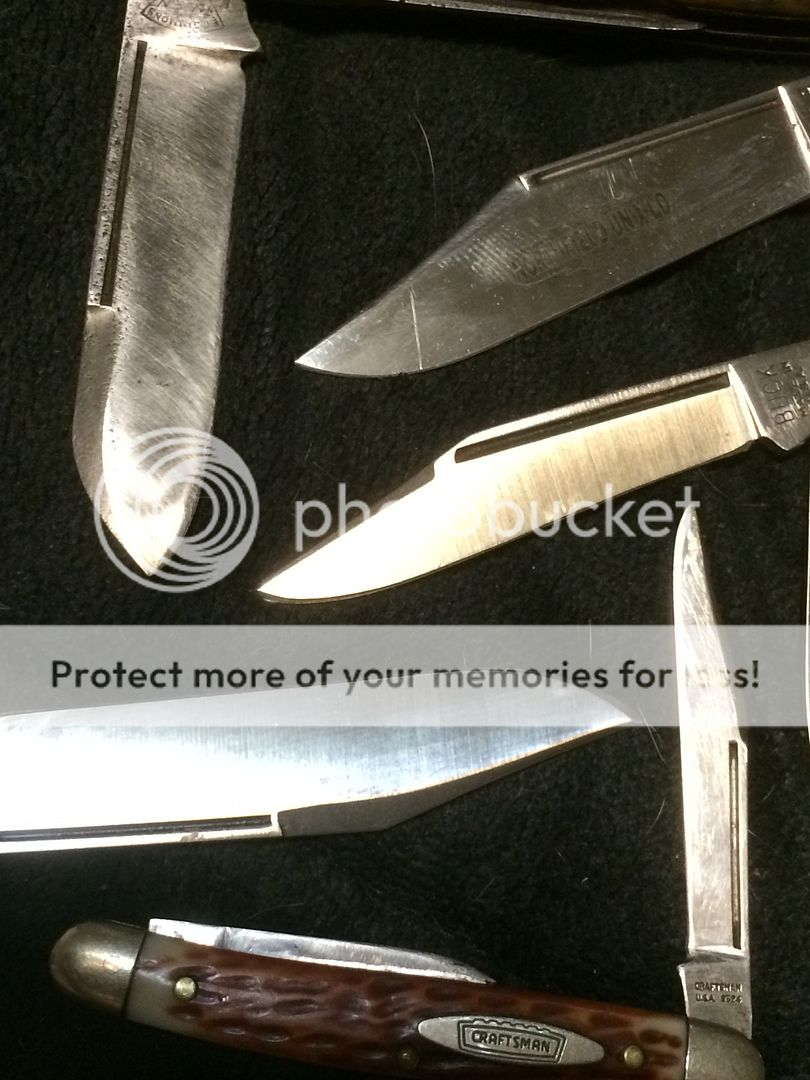

Match strikers on pulls?!? Huh?

shields- oh the seemingly endless variety of shields!!

What about the blades- a new variety of terms with some crossover from other knife genres.
Clip

Spear/Pen:
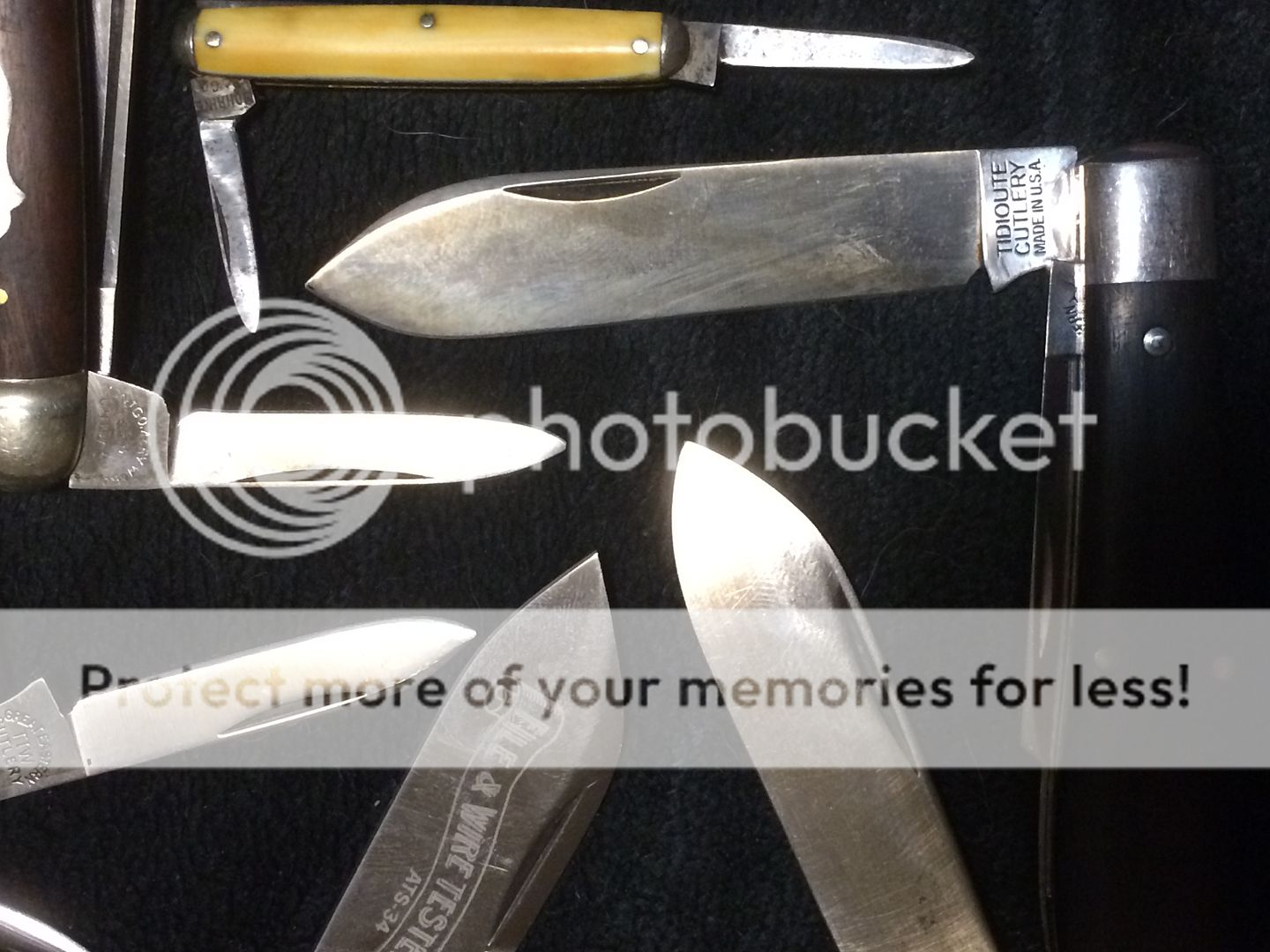
Hawksbill/hooked/pruner
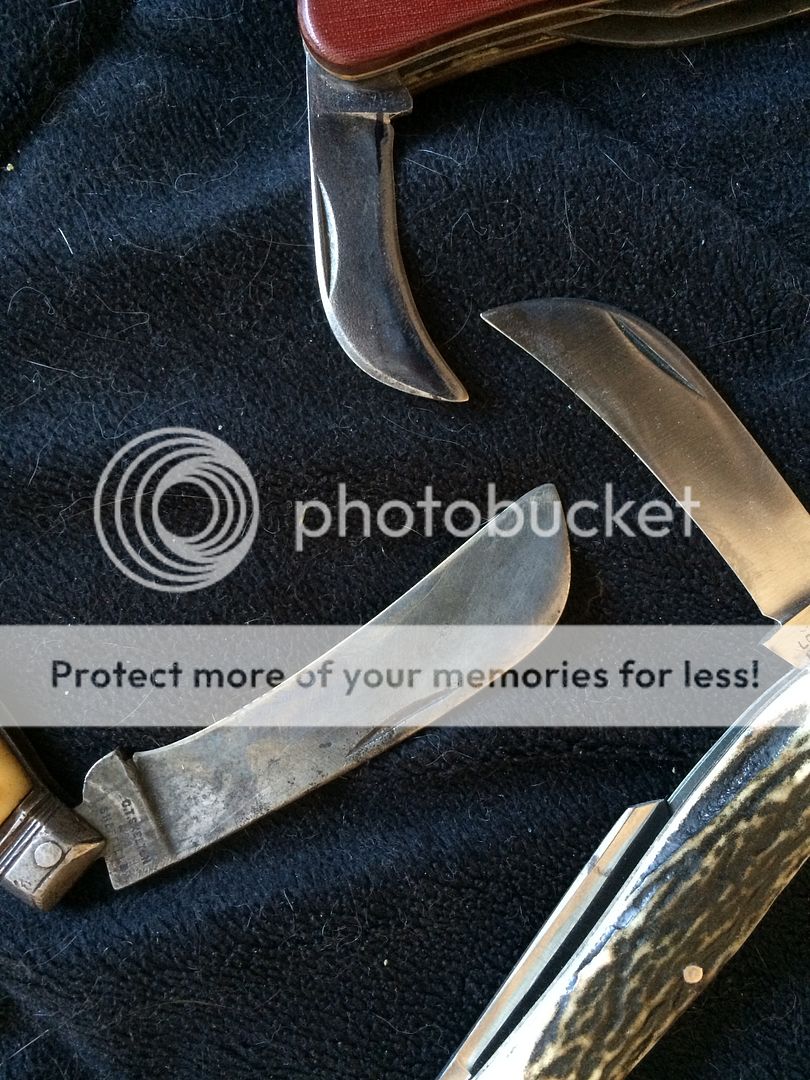
Spey

Coping
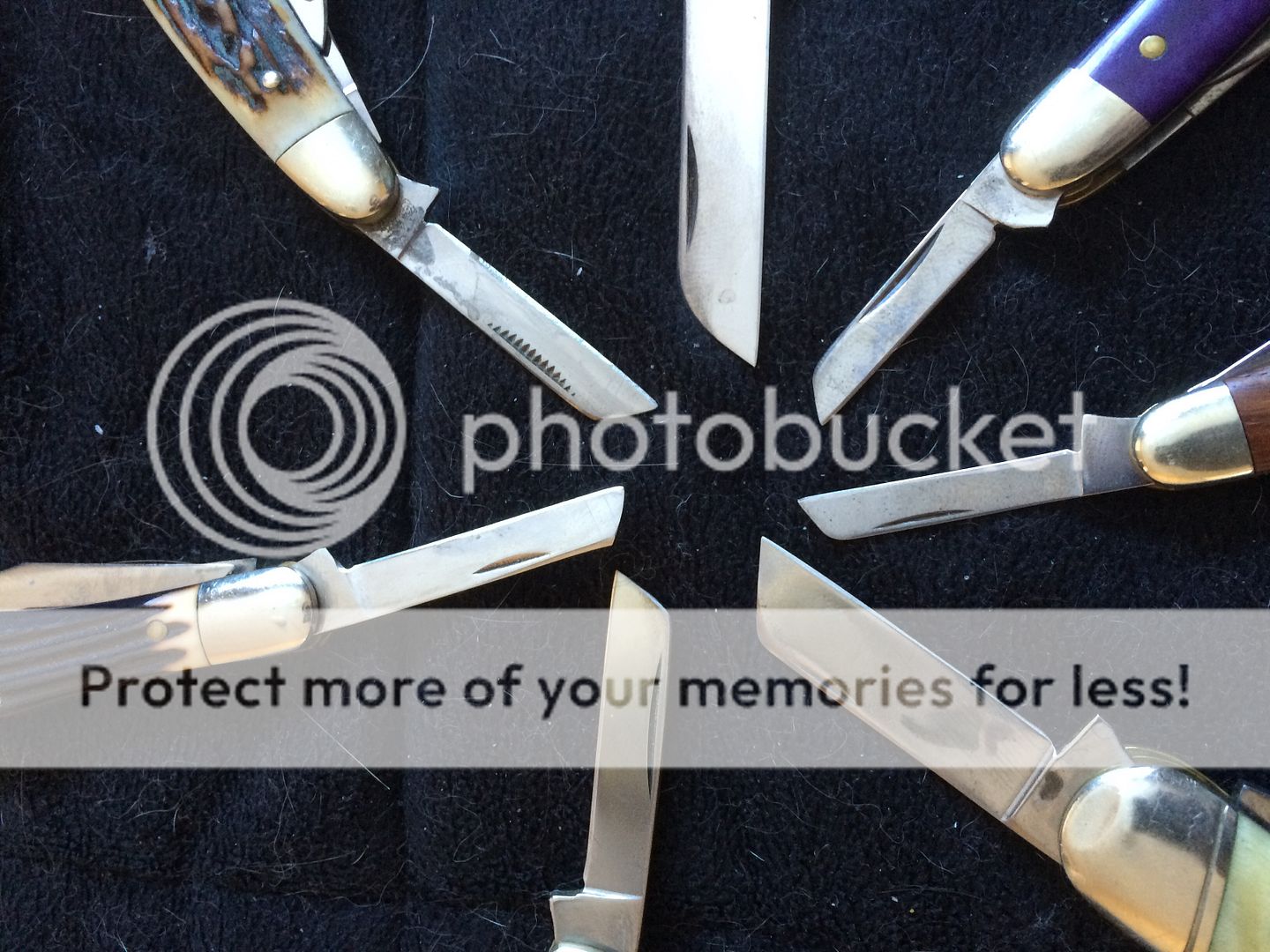
Wharncliffe

Sheepsfoot
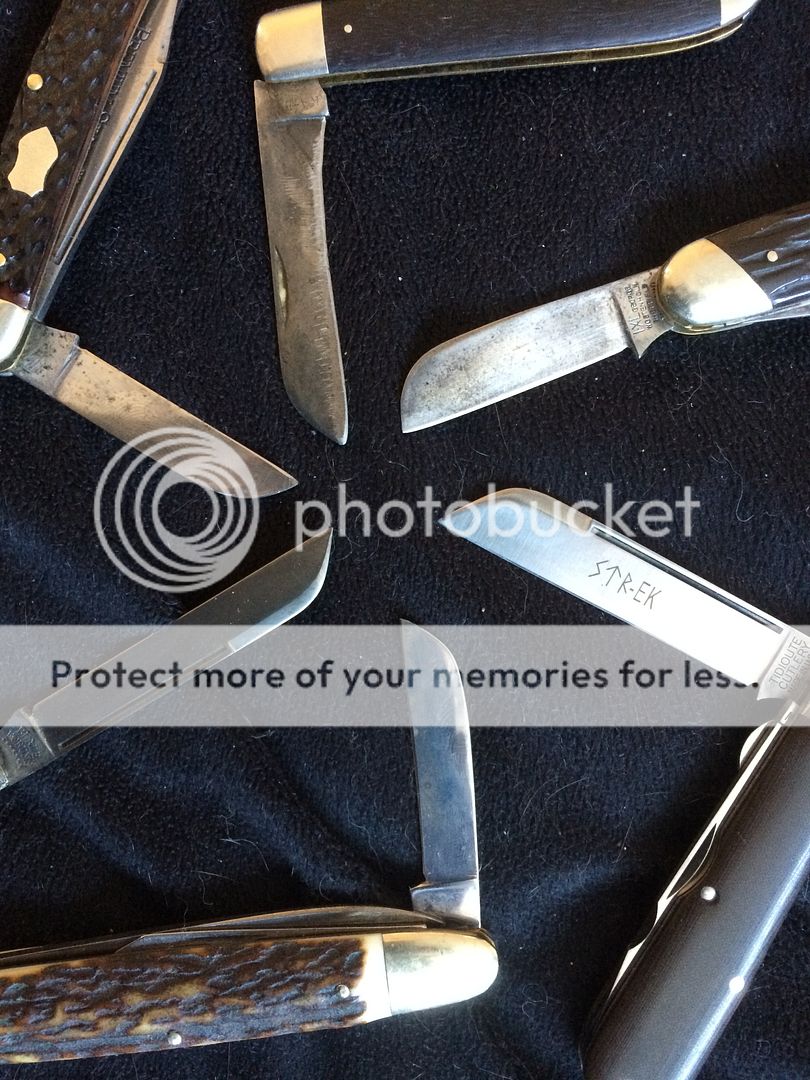
Punches:

What about the other tools on knives- can openers, cap lifters,screwdrivers, nail files, saws......
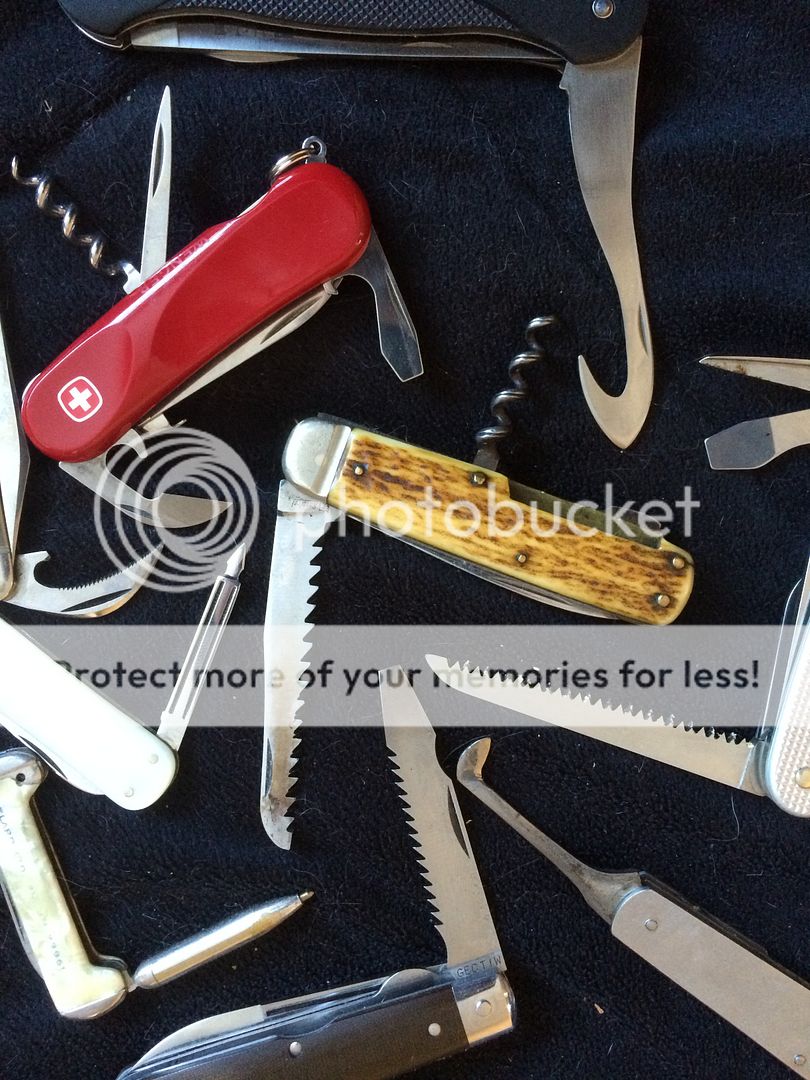
What is that thing on the bottom!?!

(A modified coping blade that had a very bad chip taken out mid blade)- which is another can of worms- modifications!!!
Walk and talk (huh?? Knives can't move or say anything?!?), flush in all positions, cam vs half stop, shadow or barehead, coined/swedged....... The lexicon is vast to a beginner looking in.
But why are they so darn expensive? They don't have CPM steels, they are small- can't be hard to make right- they don't even have locks? Oh the things a neophyte learns (and the things I have yet to learn!!)
What is a crimped blade?
A catch bit?
Extended springs?
Do I even know if I'm using the right terms??
😝
What is this kind of spring/tang called, and why isn't it used any more?
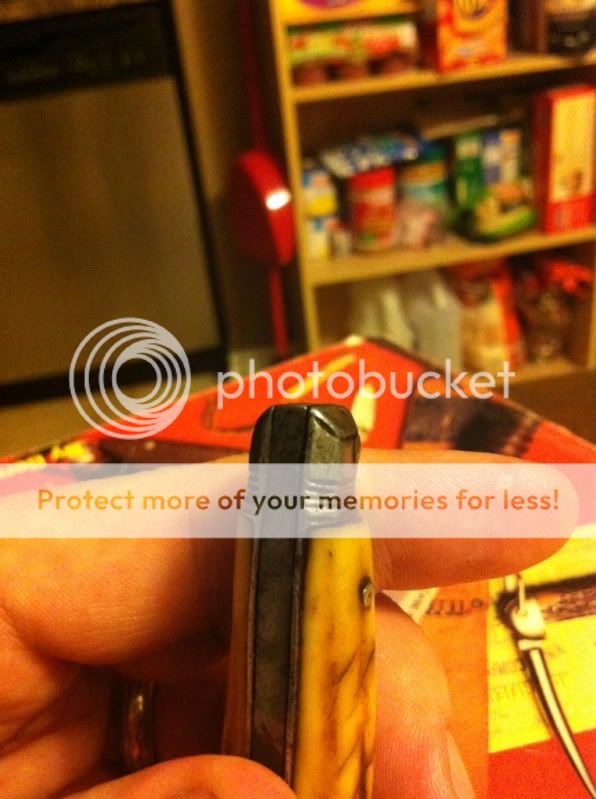
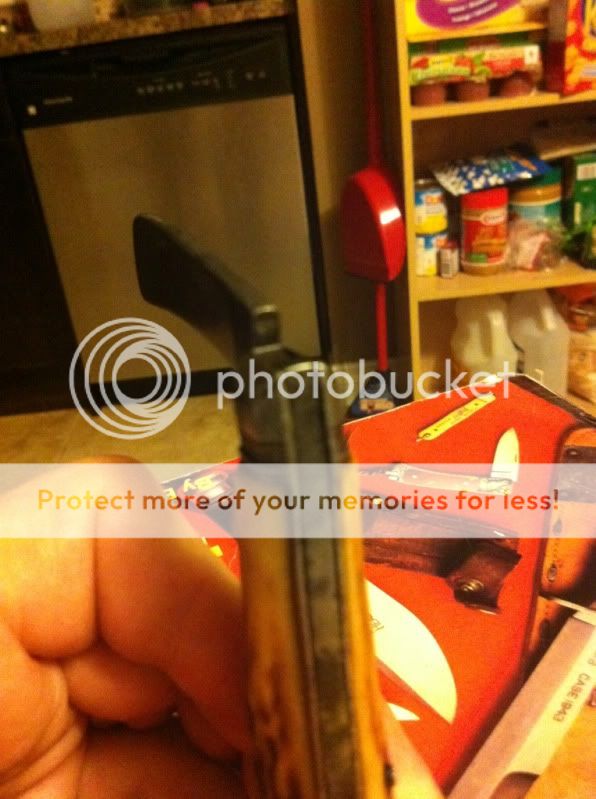
Handle material: metal, bone and all of its engraved/jigged/scratted and dyed (or not) varieties, all of the different woods (cocobolo, ebony, rosewoods- then the more modern woods, ivory, pearl; synthetics like acrylic, celluloid, micarta, G10, glow in the dark!! Why do some people go after stag, and what makes good stag from bad stag.....
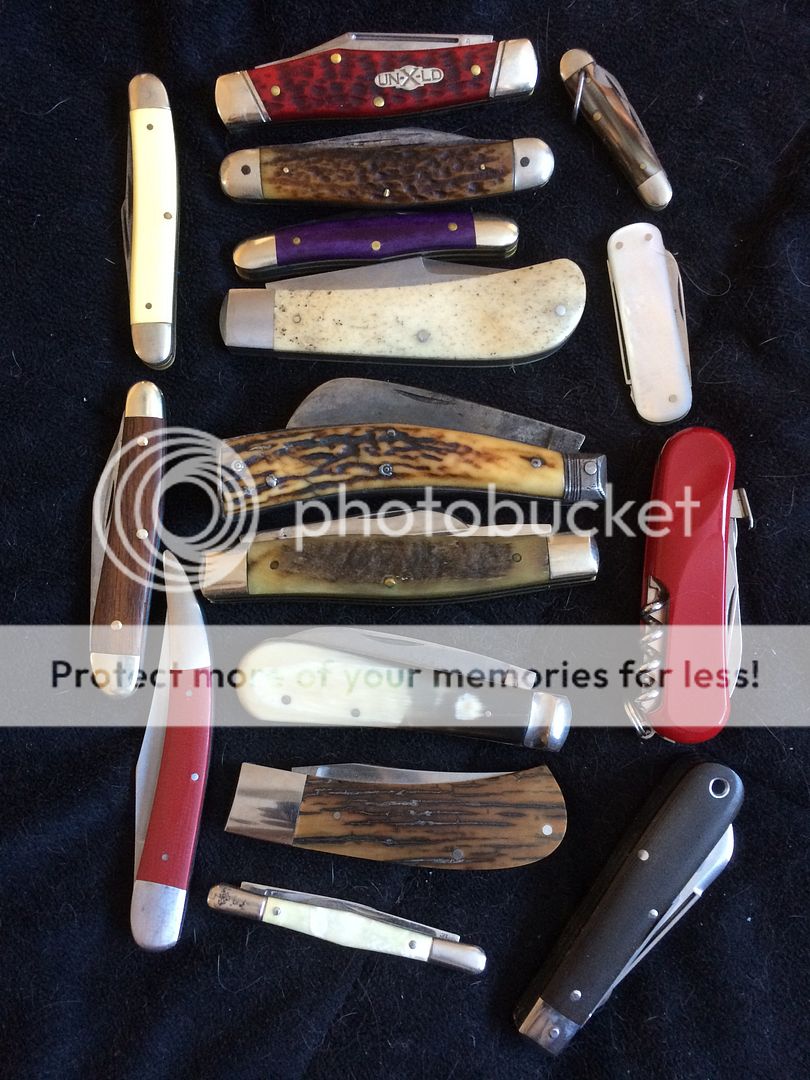
I then started looking at construction more. Split spring whittlers, crimped blades versus multiple springs, pen vs Jack, eureka versus serpentine versus cigar versus......
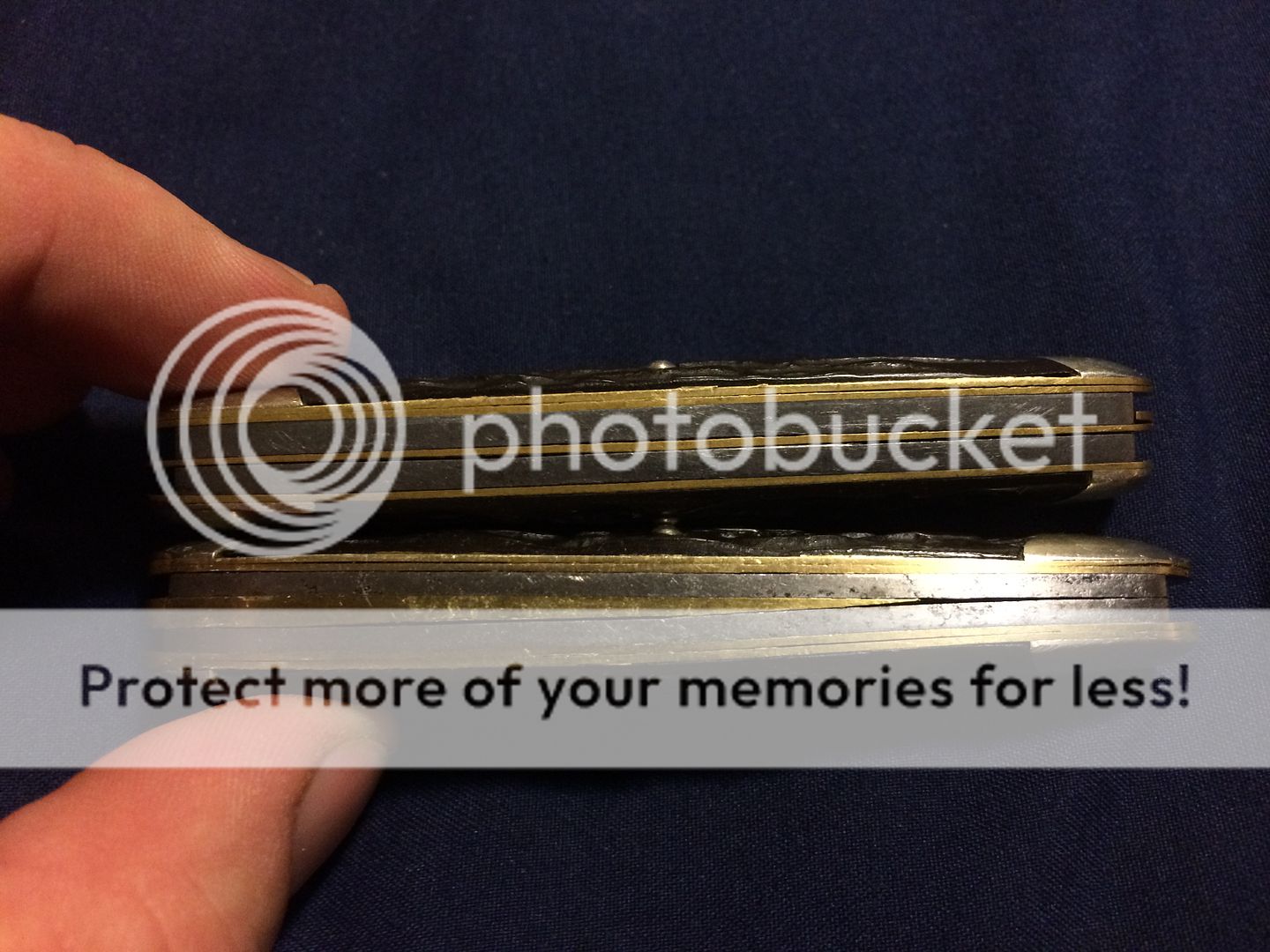
And I began to get an idea of the intricacies more, and a better understanding of those little features.
So I tried to make myself at home here. I studied, thought about what I liked and didn't, made comments as I thought would contribute and began to feel more and more a part if the group. (Even though somehow I caused Blues to think I didn't care for him- far from the truth!!) I bought a few, then a few more, then more, and more and.....
Not all is fine in traditional land though. Even though the knives have flair, soul or warmth, and definitely variety-many are of substandard construction coming from a modern folder perspective. Common among new slip joints are foremost an issue with sharpness/ in that the knives have little to no sharpness or edges of any kind in some cases. Of a shipment of nine new in box slip joints- not a single blade would nicely shave hair off of my arm. {http://www.bladeforums.com/forums/showthread.php/1153888-An-overview-of-nine-new-slip-joints}
Common are flat spots on edges, obtuse angles or poor grinds. To me, and others, this is unacceptable. From $15 Swiss Army knives to $500 Sebenzas other manufacturers make sharp knives, why is it not held as accountably in a segment of knife collecting where the collectors pride themselves on using their precious cutlery!
Blade play/gaps/sharpness are the areas that manufacturers are generally falling down on the job. I have a $100+ Queen Humpback whittler that I love that has spent months at Queen, because the main blade can wiggle so much that I can fit two business cards between the bolsters and the blade!! Should have never left the factory like that- shows extremely poor QC. A Northwoods stockman I purchased with synthetic tortoise scales were badly lifted in more than one spot!!
So why choose slip joints, with their limitations, and old man appearance? Choice/diversity, worry stone, history, warmth/character, unobtrusive/scary.... The reasons go on and on. For me, it's diversity of blades able to be chosen to suit any given task. A long master Wharncliffe, shorter secondary with belly, and a punch and I'm all set!! Others prefer the repeatability of a muskrat, and others still like two long blades as in a trapper. Then there are those that just want a single blade on their knife!!
My favourite slipjoint

And above all else, with the endless supply, variety and price point for slip joints that it is perfect for knife ADD sufferers like me! I have one focus to my collection- diversity!! Why do we need this much diversity? Because we are a diverse race, and our lives go through diverse changes. My knife choice at work in scrubs demands a less substantial knife than does my woods trekking days. And my use as an oilfield worker is much different than what I cut as a massage therapist!!
In the end, I think this is what the traditional knife world represents in my heart:

With all of these options just within one type of knife collecting I now just laugh when I hear- "what's so hard about making/designing one, it's just a knife!".......
I've found the traditional forum to be a great home base for my Bladeforums wanderings, but it hasn't been easy, much because of the great diversity in slipjoints, which is both daunting and a draw. What I have come to understand as a truth for me, is that understanding slipjoints is all a matter of perspective.
What do I mean by that? I'm not really sure to be honest- because the perspective changes from person to person and day to day!! Some are drawn to Slipjoints because of the heart- reminding us of grandpa/Mr. Van/dad. Some are drawn to the romance of a simpler time/romance of a good hard days work (often romanced by those who have never undertaken a day of back breaking labour!). Sometimes it is just the use of a good working tool, the need for a variety of blade shapes, or a better quality tool; or we need to replace a lost old friend. Or we are looking for a new direction to collect, or collect certain handle materials, or..........
Okay, so why does our perspective matter to this discussion? Because it sets us up for love (or not) with slip joints. I'll set things up with my personal experience to try and clarify what I mean.
I come from a strong knife friendly culture. At 37 years old now, my world was much different as a kid than it is now. We lived with my grandpa, mom, dad and myself on a poor small farm. I shared a room with grandpa, and we had most of our guns hanging on the wall, with the hunting knives in a gun cabinet. We had a drawer in the kitchen just for knives- dad was a butcher on and off, so knives were plentiful and a regular part of life.
Except slipjoints. Slipjoints were those little things at the bottom of purses, jewelry boxes or junk drawers. They were there, but nobody paid them much attention. We had knives in the tractor tool boxes, all over the house and usually carried a fixed blade on my belt. Or if nothing else- a buck 110 style folder; it was fun to lift a hay bale, let go with one hand and "spyderdrop" the blade open, flip it in my hand and cut the strings in one fluid motion! I was a rural mall ninja!! (Okay maybe not that far but I did try to have fun with less appealing tasks!!)
Imagine my surprise when I started finding this forum, lo those eight or so years ago. These people were suggesting that these little knives were useful?!? Especially as a replacement for a full sized knife! Saying my big knife was unnecessary?!?
That was the first time that perspective got in the way of understanding Slipjoints. For somebody on the outside looking in, this world can be quite daunting!!
I had never seen/noticed full sized trappers, pruners, folding hunters. The largest Slipjoints to my world were maybe 3" stockman patterns, nothing that could compare to a 4" bladed fixed blade.
The next factor I had to wrap my brain around was only listing closed length!! But I want to know how much cutting edge the knife has! Coming from the fixed blade/pocket clip world this seems to often be a stumbling point with people discovering this type of knife collecting! And with good reason- after all, each of these knives are the same length, but appear to have much different characteristics when looked at as a whole knife:
These two are the same length closed (4")imagine your surprise if you were expecting a wharncliffe length on the sheepsfoot!!
Both 4"
Then, the new person has to figure out how the different lengths quantify in the hand. Come on, there really isn't that much of a difference between a 3.25" & a 3.75" knife is there? Well once you understand slip joints, and how the length discrepancy actually doubles as you extract the blade, it's easy to see how a 1/4" difference is a big deal, but for the new person it is similar to understanding the difference between a 3/32" or 5/32" thick blade- it doesn't seem like much until it's in your hand!
This picture may help newcomers understand closed lengths a bit more:
But then again- closed length doesn't tell much about blade length either!! (And after inputting data on multiple slipjoint blade lengths in my spreadsheet I do understand why many don't give the blade length lists- it's annoying to write out, and physics tell us that with Slipjoints the blade can not be longer than the handle, so we can extrapolate).
To me, I had to break through a barrier in my thinking about slipjoints. I now break them into two groups- the under 3" group and over 3" group (roughly). To me, the under 3" group are the utility/better than nothing else blades. The little big cutters like the peanut, tuxedo, basically what others would call a "Sunday, go to meeting knife". The knife that you will have with you, small, unobtrusive, but usually quite limited. Food preparation is usually limited to peeling, maybe sectioning small things like apples. Cutting string, opening packages, cleaning fingernails are more the expected tasks. Light duty, which IMO is one reason why one doesn't find many small knives with a punch- pressed into work as opposed to made for it.
Then there is the 3"+ group. For me its closer to 3.5-4", but in reality it seems to me that the change is closer to 3"-3.5". This is where the blade is long enough for most tasks to be performed comfortably. The handles get proportionally larger, more hand filling, and blades get even more robust. Blade lengths within the knife may be more variable (stockman pattern) as there is more length to play with. Accessory tools built for work may be included (punches, cap lifters, saws)
, and the knives generally have a more solid feel. I find more utility based scales, versus fancier scales on the smaller knives (traditionally, in my collection I like fancy materials even on my workers)
An extreme example:
The newcomer to Slipjoints has also entered into a new lexicon-
cut and drawn swedges (which are also representative of long pulls and nail nicks in this picture...hmmmmm)
pinched/threaded and rat tailed bolsters:
long pulls and nail nicks:
Match strikers on pulls?!? Huh?
shields- oh the seemingly endless variety of shields!!
What about the blades- a new variety of terms with some crossover from other knife genres.
Clip
Spear/Pen:
Hawksbill/hooked/pruner
Spey
Coping
Wharncliffe
Sheepsfoot
Punches:
What about the other tools on knives- can openers, cap lifters,screwdrivers, nail files, saws......
What is that thing on the bottom!?!
(A modified coping blade that had a very bad chip taken out mid blade)- which is another can of worms- modifications!!!
Walk and talk (huh?? Knives can't move or say anything?!?), flush in all positions, cam vs half stop, shadow or barehead, coined/swedged....... The lexicon is vast to a beginner looking in.
But why are they so darn expensive? They don't have CPM steels, they are small- can't be hard to make right- they don't even have locks? Oh the things a neophyte learns (and the things I have yet to learn!!)
What is a crimped blade?
A catch bit?
Extended springs?
Do I even know if I'm using the right terms??
😝
What is this kind of spring/tang called, and why isn't it used any more?
Handle material: metal, bone and all of its engraved/jigged/scratted and dyed (or not) varieties, all of the different woods (cocobolo, ebony, rosewoods- then the more modern woods, ivory, pearl; synthetics like acrylic, celluloid, micarta, G10, glow in the dark!! Why do some people go after stag, and what makes good stag from bad stag.....
I then started looking at construction more. Split spring whittlers, crimped blades versus multiple springs, pen vs Jack, eureka versus serpentine versus cigar versus......
And I began to get an idea of the intricacies more, and a better understanding of those little features.
So I tried to make myself at home here. I studied, thought about what I liked and didn't, made comments as I thought would contribute and began to feel more and more a part if the group. (Even though somehow I caused Blues to think I didn't care for him- far from the truth!!) I bought a few, then a few more, then more, and more and.....
Not all is fine in traditional land though. Even though the knives have flair, soul or warmth, and definitely variety-many are of substandard construction coming from a modern folder perspective. Common among new slip joints are foremost an issue with sharpness/ in that the knives have little to no sharpness or edges of any kind in some cases. Of a shipment of nine new in box slip joints- not a single blade would nicely shave hair off of my arm. {http://www.bladeforums.com/forums/showthread.php/1153888-An-overview-of-nine-new-slip-joints}
Common are flat spots on edges, obtuse angles or poor grinds. To me, and others, this is unacceptable. From $15 Swiss Army knives to $500 Sebenzas other manufacturers make sharp knives, why is it not held as accountably in a segment of knife collecting where the collectors pride themselves on using their precious cutlery!
Blade play/gaps/sharpness are the areas that manufacturers are generally falling down on the job. I have a $100+ Queen Humpback whittler that I love that has spent months at Queen, because the main blade can wiggle so much that I can fit two business cards between the bolsters and the blade!! Should have never left the factory like that- shows extremely poor QC. A Northwoods stockman I purchased with synthetic tortoise scales were badly lifted in more than one spot!!
So why choose slip joints, with their limitations, and old man appearance? Choice/diversity, worry stone, history, warmth/character, unobtrusive/scary.... The reasons go on and on. For me, it's diversity of blades able to be chosen to suit any given task. A long master Wharncliffe, shorter secondary with belly, and a punch and I'm all set!! Others prefer the repeatability of a muskrat, and others still like two long blades as in a trapper. Then there are those that just want a single blade on their knife!!
My favourite slipjoint
And above all else, with the endless supply, variety and price point for slip joints that it is perfect for knife ADD sufferers like me! I have one focus to my collection- diversity!! Why do we need this much diversity? Because we are a diverse race, and our lives go through diverse changes. My knife choice at work in scrubs demands a less substantial knife than does my woods trekking days. And my use as an oilfield worker is much different than what I cut as a massage therapist!!
In the end, I think this is what the traditional knife world represents in my heart:
With all of these options just within one type of knife collecting I now just laugh when I hear- "what's so hard about making/designing one, it's just a knife!".......


 (and that's on a single blade knife


