

- Joined
- Dec 11, 2006
- Messages
- 1,659
I posted this on my blog, and normally I would not post something there, and then post it in the forum. But, I wanted to repost for 2 reasons:
1) It might be of interest to folks here and spark some dicussion
2) I would love to hear about your experiences on this topic and whether or not it coincides or is different what I currently "think I understand" If that makes any sense
Mostly, it was because of number 2.
But, it was written for my blog and not a forum post. So please keep that in mind in the way I wrote it.
I know there are folks out there that have been cooking and/or outdoor cooking longer than me, so I would love to hear what you have to say.
With that.....here is what I originally wrote.
-----------------------------------------------------------------
Cast Iron and Carbon Steel Seasoning Theories
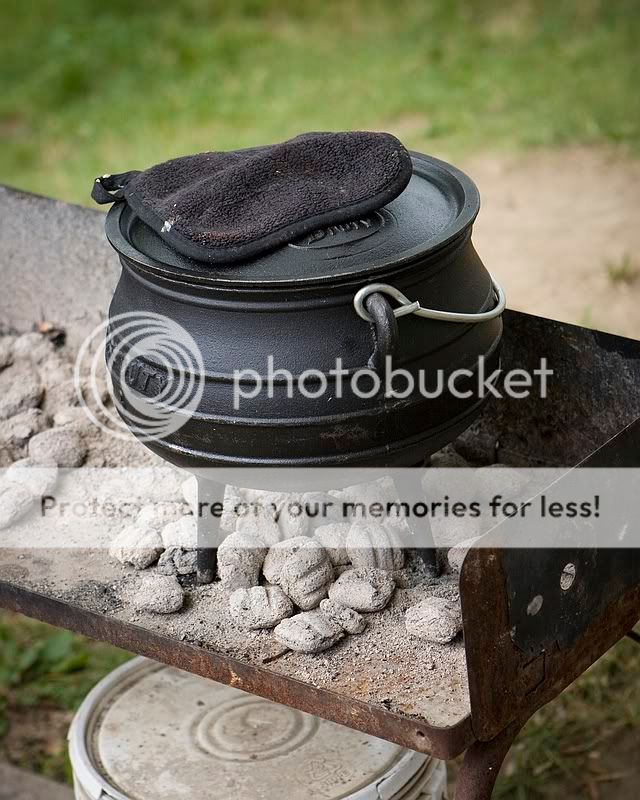
All of this began with a quest for a new camping skillet. I am a diehard cast iron fan. I currently have four 10” cast iron skillets, one 10” flat skillet, one deep “chicken fryer” skillet, an indoor stove top dutch oven, two outdoor dutch ovens (with legs and flanged lid). One of them is 10” and the other is 12”. I have a number 3 Potjie, and a monster number 6 Potjie. In case you don’t know what a Potjie is, it is like a cauldron with three large legs.
Obviously, I just love the stuff. Then, I discovered the carbon steel wok. No non-stick, non-conducting stainless steel, or anything silly like that. Good old fashion carbon steel. I love the wok, but must say I had some trouble getting it properly seasoned. Carbon steel generally follows the same methods of seasoning as cast iron, but can be a touch more difficult, and takes a longer amount of time to get it done properly.
I have been cooking on cast iron since I moved out on my own. Without really knowing “why” I was seasoning them the way I was, it all worked out just fine. Cast iron seems very forgiving in getting it seasoned, and as long as you avoid a couple of “no-no’s” it is really no big deal. Now that I understand the reasons behind doing certain things, seasoning carbon steel is a snap. Of course, it applies directly over to cast iron as well.
The carbon steel wok led me on a mission to get a very nice carbon steel skillet for camping. While cast iron is super tough, carbon steel just seems to have the ability to be beat up just a bit more. Such as in taking impacts, dropping etc. That is pure negligence, but stuff happens : ) And yes, I have broke 2 pieces of cast iron cookware in the past : )
Obviously if I am considering either cast iron or carbon steel skillet, it is not for backpacking : ) That doesn’t necessarily mean car camping either. I would be more than willing to afford the weight of carbon steel in my canoe camping, for instance. I have the space, and weight is not as super critical as backpacking. So, canoe camping is my main driver for such a skillet, but will still obviously be used for car camping, and as I quickly found out, nearly every day at the house too!
If you know me at all, such an easy purchase as a skillet is not taken lightly. I am not a big “gear junkie” when it comes to outdoor stuff and the few simple things that I really enjoy, I want them to be the best they can be. If I have to buy a lightweight non-stick pot for solo backing (and I do have that type of gear), I will sure do it. But, that doesn’t mean that I am either going to like it or get excited about it : ) I don’t get into gear that way, like a lot of other folks do.
The purchase of this skillet was no exception. I have been looking for “exactly” what I want for about a year and a half now. It started by seeing a “Greenfield Camp Skillet” in a cool store up north. You are probably familiar with these in the form of the “Big Daddy” version.
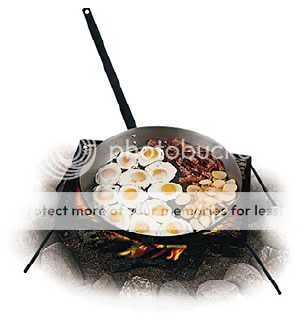
Obviously that is way ridiculous for what I want. But, less known is that they sell a smaller version.
The store had the smaller version, and for some reason it just seemed a touch too small. Also, I was fine with the “bolt on” handle, but not pumped about it. I guess it could be looked at as a good and bad thing. So, I did not buy it. Doing some research on it later via the internet, I found out that there are no sizes in between. Either gargantuan big, or a touch too small. I was kicking myself for not just buying it, as they are not readily available anywhere else I have looked (except the internet, of course).
I scoured the internet for the “perfect” skillet. I even bought one sight unseen that turned out miserable in person. I haven’t even used it, and don’t want to. Something finally inspired me to try searching some more, and I found a great answer!
Leave it to the French! De Buyer makes a wonderful collection of thick, carbon steel pans.

While these were not exactly intended for “woods” use, they were everything that I wanted. Carbon steel, heavy gauge, sloping sides, nice long handle for cooking over the fire, and did I mention carbon steel! Plus, they are available in 12 different sizes, ranging from 18cm in diameter up to 50cm in increments of 2cm! Perfect!
Yes, it is totally me to be the only grease covered, soot smeared, luddite woodsbum using fancy French skillets, for god’s sake! : )
I have to say, after washing them, seasoning them, and using them, they will still go camping, but also have a permanent place in my kitchen. I believe I like them even better than my beloved cast iron. They heat evenly, respond faster than cast iron, can sear at super high temperatures, and after properly seasoned, are as slick as can be!
All of the information just happens to be a prelude to what I actually wanted to talk about : ) Seasoning cookware. So, here we go.
Seasoning
I am sure you have all seen a dozen recipes for seasoning cast iron. They usually go something like “First thoroughly was with soap (the only time you should use soap.” Dry. Then coat with oil and bake at 400F until it stops smoking. Repeat.”
My problem is that I hate recipes! I don’t want to be told how to do something. I want to know why I am doing something, and why it works. That is also why I am a big fan of Alton Brown’s cookbook “I’m Just Here for the Food!” He hates recipes too! He claims that a recipe is like precise directions. Explicitly spelled out turns, exact distances, and very detailed instructions on how to get from A to B.. The problem is if one of those roads along your route is closed, you could be screwed! Instead, give me a map! Rather than follow a “recipe” exactly and being told what to do, I want to understand what I am doing and why. Much like have a map, rather than directions.
With that in mind, without talking about the specific process of seasoning, let’s talk about the theory behind what I believe needs to happen to get a pan to properly season. Remember, my feeling is that cast iron is extremely easy to do, and hard to screw up. When you move to carbon steel, doing it right is a little critical, else it will take you much longer to achieve a “seasoned” status : )
There are only a couple “key” things that I believe have to happen during the process:
1) The utensil must be free of dirty oils, and manufacturing oils before starting.
2) The utensil must be heated. It allows the pores in the metal to open up and accept new and clean oil, which will become the base for the newly seasoned utensil.
3) Clean oil needs to be absorbed into the open pores.
4) Excess oil needs to be removed.
That’s it! At least in my opinion and experience. I will get into the exact process that I have become most fond of using for this. But, before that, I want to talk about some “old school rules.” Stuff that is good info, but always had the old wives tale nostalgia around it, at least in my mind. With the details I provided above, I finally understand some of these things, and wanted to explain them. Here they are:
Don’t dry your skillet with a towel. Heat it up on the burner
Boil potatoes or potato peelings in a brand new skillet before seasoning
Never use soap for cleaning
Never use water for cleaning
Do not let you pan soak for extended periods
Avoid cooking acidic foods in a newly seasoned skillet
Let’s look at each of them in turn, and what I feel I have learned about them.
Don’t dry your skillet with a towel. Heat it up on the burner: I never did understand this one. I always thought “what’s the difference?” Is it just because you didn’t want to use a towel? A form of laziness perhaps? : ) But, I have come to find out there is value in the practice.
When you wash your skillet, you are supposed to be using only hot water (more on that later). The water will get rid of all the nasty bits of junk for you, but as you know, water will not necessarily cut and get rid of any oil that was present during cooking. The same oil which makes a skillet become better and better with age. So, why waste it!
That is the reasoning behind this advice. The hot water gets rid of the bad stuff. Oil from cooking can still remain behind. By heating the skillet you allow the pores in the metal to open and accept the oil. The skillet is now a touch better seasoned than before because of this practice. Theoretically.
Boil potatoes or potato peelings in a brand new skillet before seasoning: The first time I heard this one was in the directions when I acquired my Potjie’s from South Africa. I read through the seasoning recipe and the steps basically where:
- Thoroughly wash and rinse the inside.
- Cook quartered potatoes for 1 hour.
- Further steps I will elaborate on at this time.
I diligently followed the instructions. To be honest, I had no idea what the hell I was doing, and more importantly why! The thought in my head was that this boiling potato deal was doing more harm than good, and could not possibly be adding to building up an effective seasoning layer. Little did I know that I was absolutely right, but at the time, did not put much more thought into it.
It was after I acquired my carbon steel skillets that I figured out the true importance of doing this. These skillets too came with the instructions that the first step in seasoning should be to boil potato peelings for 15 minutes. It falls in line with step number 1 above: The utensil must be free of dirty oils, and manufacturing oils before starting. With my new skillets, I used dishsoap, plastic scratch pad, steel wool, and washed, rinsed, washed, rinsed, washed, rinsed…..well you get the idea. Clean, right? Well, not even close!
After boiling potato peelings for 15 minutes, the skillet had a nasty slurry of grey looking sand in the bottom : ( Once the skillet was heated, the pores were opened, and the starchy/water mixture was able to draw out oils and dirt that I was not capable of getting to through normal washing. I fully do not understand the science behind why the starch/water mixture did this, but the experience was enough to convince me of the need to do this. So much in fact, that I did this process twice on each skillet.
Never use soap for cleaning: My understanding that your seasoning is simply a continued layering of oil. The more you use your skillet, the more robust your seasoning layer becomes. Most dish soaps are intended to break down and remove oil. Therefore, I will personally avoid using soap all together, and always have.
If that seems gross to you from a sanitary standpoint, you can look at it the same way as your barbeque grill. You do not thoroughly disinfect your grill surface between every use, but yet you put your food directly on it. It does you no harm because the heat the grill (and in this case your skillet) achieve is WAY higher than the temperatures that bacteria can withstand. Even so, if you insist on using soap, I would use the most mild type that you can find, and in very small amounts.
Never use water for cleaning: I have seen people even be so paranoid that they have taken the “never use soap” rule even further to “never use water.” I have even heard it said that washing it water will cause your skillet to rust! Obviously, with the exception stated in the next tip, you should not be afraid of using water. In fact, if you had to be scared of water, you would cook nothing! Most foods have a very high water content, and if you could not contact water in your skillet, it would sit on the shelf forever : )
In summary, go ahead and use water for cleaning. To be more specific, use hot water.
Do not let your pan soak for extended periods: I just told you that water will not harm your precious skillet. Now, I am about to tell you that it will : ) Despite its harmless appearance, given enough time, water can pretty much dissolve anything! Meaning that, given enough time, water will eventually break down your precious oil rich seasoning layer. Cooking times are not necessarily long enough to do damage, and if it is, there is not much you can do about it (I will give you a tip later in restoring seasoning anyway).
With that in mind, leaving your skillet sit overnight, with water in it is a big no-no. If you cooked something up really crusty, and want to use water to loosen it up, 15 minutes is sufficient. All night long is a bit over kill.
Avoid acidic dishes for the first couple uses in your newly seasoned skillet: My answer to this one is going to be more speculation based on experience than actually understanding what is occurring.
But, my guess is the acidic nature of the food is very hard on your seasoning layer. I have witnessed this where a nicely seasoned dutch oven is set to cooking a chili for hours on end. Afterward, the oven looks less glossy, and not nearly as seasoned as before (again, there is a tip later for putting the shine back in your utensil).
My theory is that on a new utensil the seasoning layer is weaker than it will eventually be (until it gets built up further). So avoid doing things that are known to degrade it until then. Likewise, things requiring extended boiling are generally suggested to avoid as well.
Apparently I am too wordy, and will have to continue in another post!
1) It might be of interest to folks here and spark some dicussion
2) I would love to hear about your experiences on this topic and whether or not it coincides or is different what I currently "think I understand"
If that makes any sense Mostly, it was because of number 2.
But, it was written for my blog and not a forum post. So please keep that in mind in the way I wrote it.
I know there are folks out there that have been cooking and/or outdoor cooking longer than me, so I would love to hear what you have to say.
With that.....here is what I originally wrote.
-----------------------------------------------------------------
Cast Iron and Carbon Steel Seasoning Theories
All of this began with a quest for a new camping skillet. I am a diehard cast iron fan. I currently have four 10” cast iron skillets, one 10” flat skillet, one deep “chicken fryer” skillet, an indoor stove top dutch oven, two outdoor dutch ovens (with legs and flanged lid). One of them is 10” and the other is 12”. I have a number 3 Potjie, and a monster number 6 Potjie. In case you don’t know what a Potjie is, it is like a cauldron with three large legs.
Obviously, I just love the stuff. Then, I discovered the carbon steel wok. No non-stick, non-conducting stainless steel, or anything silly like that. Good old fashion carbon steel. I love the wok, but must say I had some trouble getting it properly seasoned. Carbon steel generally follows the same methods of seasoning as cast iron, but can be a touch more difficult, and takes a longer amount of time to get it done properly.
I have been cooking on cast iron since I moved out on my own. Without really knowing “why” I was seasoning them the way I was, it all worked out just fine. Cast iron seems very forgiving in getting it seasoned, and as long as you avoid a couple of “no-no’s” it is really no big deal. Now that I understand the reasons behind doing certain things, seasoning carbon steel is a snap. Of course, it applies directly over to cast iron as well.
The carbon steel wok led me on a mission to get a very nice carbon steel skillet for camping. While cast iron is super tough, carbon steel just seems to have the ability to be beat up just a bit more. Such as in taking impacts, dropping etc. That is pure negligence, but stuff happens : ) And yes, I have broke 2 pieces of cast iron cookware in the past : )
Obviously if I am considering either cast iron or carbon steel skillet, it is not for backpacking : ) That doesn’t necessarily mean car camping either. I would be more than willing to afford the weight of carbon steel in my canoe camping, for instance. I have the space, and weight is not as super critical as backpacking. So, canoe camping is my main driver for such a skillet, but will still obviously be used for car camping, and as I quickly found out, nearly every day at the house too!
If you know me at all, such an easy purchase as a skillet is not taken lightly. I am not a big “gear junkie” when it comes to outdoor stuff and the few simple things that I really enjoy, I want them to be the best they can be. If I have to buy a lightweight non-stick pot for solo backing (and I do have that type of gear), I will sure do it. But, that doesn’t mean that I am either going to like it or get excited about it : ) I don’t get into gear that way, like a lot of other folks do.
The purchase of this skillet was no exception. I have been looking for “exactly” what I want for about a year and a half now. It started by seeing a “Greenfield Camp Skillet” in a cool store up north. You are probably familiar with these in the form of the “Big Daddy” version.
Obviously that is way ridiculous for what I want. But, less known is that they sell a smaller version.
The store had the smaller version, and for some reason it just seemed a touch too small. Also, I was fine with the “bolt on” handle, but not pumped about it. I guess it could be looked at as a good and bad thing. So, I did not buy it. Doing some research on it later via the internet, I found out that there are no sizes in between. Either gargantuan big, or a touch too small. I was kicking myself for not just buying it, as they are not readily available anywhere else I have looked (except the internet, of course).
I scoured the internet for the “perfect” skillet. I even bought one sight unseen that turned out miserable in person. I haven’t even used it, and don’t want to. Something finally inspired me to try searching some more, and I found a great answer!
Leave it to the French! De Buyer makes a wonderful collection of thick, carbon steel pans.
While these were not exactly intended for “woods” use, they were everything that I wanted. Carbon steel, heavy gauge, sloping sides, nice long handle for cooking over the fire, and did I mention carbon steel! Plus, they are available in 12 different sizes, ranging from 18cm in diameter up to 50cm in increments of 2cm! Perfect!
Yes, it is totally me to be the only grease covered, soot smeared, luddite woodsbum using fancy French skillets, for god’s sake! : )
I have to say, after washing them, seasoning them, and using them, they will still go camping, but also have a permanent place in my kitchen. I believe I like them even better than my beloved cast iron. They heat evenly, respond faster than cast iron, can sear at super high temperatures, and after properly seasoned, are as slick as can be!
All of the information just happens to be a prelude to what I actually wanted to talk about : ) Seasoning cookware. So, here we go.
Seasoning
I am sure you have all seen a dozen recipes for seasoning cast iron. They usually go something like “First thoroughly was with soap (the only time you should use soap.” Dry. Then coat with oil and bake at 400F until it stops smoking. Repeat.”
My problem is that I hate recipes! I don’t want to be told how to do something. I want to know why I am doing something, and why it works. That is also why I am a big fan of Alton Brown’s cookbook “I’m Just Here for the Food!” He hates recipes too! He claims that a recipe is like precise directions. Explicitly spelled out turns, exact distances, and very detailed instructions on how to get from A to B.. The problem is if one of those roads along your route is closed, you could be screwed! Instead, give me a map! Rather than follow a “recipe” exactly and being told what to do, I want to understand what I am doing and why. Much like have a map, rather than directions.
With that in mind, without talking about the specific process of seasoning, let’s talk about the theory behind what I believe needs to happen to get a pan to properly season. Remember, my feeling is that cast iron is extremely easy to do, and hard to screw up. When you move to carbon steel, doing it right is a little critical, else it will take you much longer to achieve a “seasoned” status : )
There are only a couple “key” things that I believe have to happen during the process:
1) The utensil must be free of dirty oils, and manufacturing oils before starting.
2) The utensil must be heated. It allows the pores in the metal to open up and accept new and clean oil, which will become the base for the newly seasoned utensil.
3) Clean oil needs to be absorbed into the open pores.
4) Excess oil needs to be removed.
That’s it! At least in my opinion and experience. I will get into the exact process that I have become most fond of using for this. But, before that, I want to talk about some “old school rules.” Stuff that is good info, but always had the old wives tale nostalgia around it, at least in my mind. With the details I provided above, I finally understand some of these things, and wanted to explain them. Here they are:
Don’t dry your skillet with a towel. Heat it up on the burner
Boil potatoes or potato peelings in a brand new skillet before seasoning
Never use soap for cleaning
Never use water for cleaning
Do not let you pan soak for extended periods
Avoid cooking acidic foods in a newly seasoned skillet
Let’s look at each of them in turn, and what I feel I have learned about them.
Don’t dry your skillet with a towel. Heat it up on the burner: I never did understand this one. I always thought “what’s the difference?” Is it just because you didn’t want to use a towel? A form of laziness perhaps? : ) But, I have come to find out there is value in the practice.
When you wash your skillet, you are supposed to be using only hot water (more on that later). The water will get rid of all the nasty bits of junk for you, but as you know, water will not necessarily cut and get rid of any oil that was present during cooking. The same oil which makes a skillet become better and better with age. So, why waste it!
That is the reasoning behind this advice. The hot water gets rid of the bad stuff. Oil from cooking can still remain behind. By heating the skillet you allow the pores in the metal to open and accept the oil. The skillet is now a touch better seasoned than before because of this practice. Theoretically.
Boil potatoes or potato peelings in a brand new skillet before seasoning: The first time I heard this one was in the directions when I acquired my Potjie’s from South Africa. I read through the seasoning recipe and the steps basically where:
- Thoroughly wash and rinse the inside.
- Cook quartered potatoes for 1 hour.
- Further steps I will elaborate on at this time.
I diligently followed the instructions. To be honest, I had no idea what the hell I was doing, and more importantly why! The thought in my head was that this boiling potato deal was doing more harm than good, and could not possibly be adding to building up an effective seasoning layer. Little did I know that I was absolutely right, but at the time, did not put much more thought into it.
It was after I acquired my carbon steel skillets that I figured out the true importance of doing this. These skillets too came with the instructions that the first step in seasoning should be to boil potato peelings for 15 minutes. It falls in line with step number 1 above: The utensil must be free of dirty oils, and manufacturing oils before starting. With my new skillets, I used dishsoap, plastic scratch pad, steel wool, and washed, rinsed, washed, rinsed, washed, rinsed…..well you get the idea. Clean, right? Well, not even close!
After boiling potato peelings for 15 minutes, the skillet had a nasty slurry of grey looking sand in the bottom : ( Once the skillet was heated, the pores were opened, and the starchy/water mixture was able to draw out oils and dirt that I was not capable of getting to through normal washing. I fully do not understand the science behind why the starch/water mixture did this, but the experience was enough to convince me of the need to do this. So much in fact, that I did this process twice on each skillet.
Never use soap for cleaning: My understanding that your seasoning is simply a continued layering of oil. The more you use your skillet, the more robust your seasoning layer becomes. Most dish soaps are intended to break down and remove oil. Therefore, I will personally avoid using soap all together, and always have.
If that seems gross to you from a sanitary standpoint, you can look at it the same way as your barbeque grill. You do not thoroughly disinfect your grill surface between every use, but yet you put your food directly on it. It does you no harm because the heat the grill (and in this case your skillet) achieve is WAY higher than the temperatures that bacteria can withstand. Even so, if you insist on using soap, I would use the most mild type that you can find, and in very small amounts.
Never use water for cleaning: I have seen people even be so paranoid that they have taken the “never use soap” rule even further to “never use water.” I have even heard it said that washing it water will cause your skillet to rust! Obviously, with the exception stated in the next tip, you should not be afraid of using water. In fact, if you had to be scared of water, you would cook nothing! Most foods have a very high water content, and if you could not contact water in your skillet, it would sit on the shelf forever : )
In summary, go ahead and use water for cleaning. To be more specific, use hot water.
Do not let your pan soak for extended periods: I just told you that water will not harm your precious skillet. Now, I am about to tell you that it will : ) Despite its harmless appearance, given enough time, water can pretty much dissolve anything! Meaning that, given enough time, water will eventually break down your precious oil rich seasoning layer. Cooking times are not necessarily long enough to do damage, and if it is, there is not much you can do about it (I will give you a tip later in restoring seasoning anyway).
With that in mind, leaving your skillet sit overnight, with water in it is a big no-no. If you cooked something up really crusty, and want to use water to loosen it up, 15 minutes is sufficient. All night long is a bit over kill.
Avoid acidic dishes for the first couple uses in your newly seasoned skillet: My answer to this one is going to be more speculation based on experience than actually understanding what is occurring.
But, my guess is the acidic nature of the food is very hard on your seasoning layer. I have witnessed this where a nicely seasoned dutch oven is set to cooking a chili for hours on end. Afterward, the oven looks less glossy, and not nearly as seasoned as before (again, there is a tip later for putting the shine back in your utensil).
My theory is that on a new utensil the seasoning layer is weaker than it will eventually be (until it gets built up further). So avoid doing things that are known to degrade it until then. Likewise, things requiring extended boiling are generally suggested to avoid as well.
Apparently I am too wordy, and will have to continue in another post!
Last edited:


