A question for the machinists (or anyone else that may know)

Joined
Oct 27, 2010
Messages
8,721
As a new maker still working with a lot of hand tools, I have been looking for a way to do hollow grinds. I do have a 9" disc sander, but it doesn't help me with this anyways. So after some reading I came across scrapers. Seems to me that with the appropriate tip a shallow hollow grind could be achieved. Now I know that most scrapers are home made to each specific purpose, but I couldn't find what type of edge geometry should be used. Is it like a wood chisle? I have a small bar of 3/16" D2 that I think would work very well for this purpose, but would like to make it right.

Also, can a scraper be used post HT, say, like on thin stock? Should a hollow grind be done with a progression of different radii scrapers?

Oh, and I work mostly with 1080 and 1084 steel right now. Possibly O1 when I get approval from SWMBO to order more steel.


-Xander
 
Yes it "COULD BE" achieved, but why? Your talking about tripling (at best) the time it takes to file one out, by scraping. Scraping was reserved for pieces like machine ways that had to be w/i millionth's of and inch, over an extended length. or surface plates to gauge other precision tooling on. I get your gist though and i think maybe a shallowly curved file would be better suited to your needs. you would have to make it of course, and your 1080 would make a fine file. :) (However a wooden wheel belt grinder is just about the simplest (construction wise) tool you can make in your shop. I strongly urge you to think about that before trying to make a convex file!

Jason S. Carter
 
i think it would take quite some time to scrape a blade. a buddy does some scraping on a cast iron block and it is slow going.
 
Well I am thinking only for small blades, like 2" or so. I don't care how long it takes, but am interested in if it actually is a viable method. I know that a deep hollow will be out of reach realistically, but a shallow concave I believe could be achieved with only a bit of elbow grease and the determination of a stone wall. I would like to do one as a proof of concept.

That takes care of the "why" but now I solicit you more experianced ones to help me with the "what."


-Xander
 
the concept has been prooved. it sounds more like you want a knife you can say I made this using the most time consuming, strenuous, and mind numbing methods known to man. but hey I encourage you to learn a new skill. However scraping is generally 99% about making things flat, not hollowed. that said...

http://www.machinerepair.com/

www.schsm.org/SCRAPING.pdf

[video=youtube;AkYyWcflMy8]http://www.youtube.com/watch?v=AkYyWcflMy8[/video]

[video=youtube;ZTru-KEdaR8]http://www.youtube.com/watch?v=ZTru-KEdaR8[/video]

[video=youtube;Qe1DyIfaz4c]http://www.youtube.com/watch?v=Qe1DyIfaz4c&feature=related[/video]
 
Having worked as a machinist for a couple of years and working with some guys that were excellent machinist and tool and die makers I have to say the scrappers wouldn't be time efficient. Most of the scrappers I saw used were on machinery and shop equipment that was rebuilt by a factory certified machinist or specialist. They were used to flatten and true surfaces to factory specs, usually better than factory specification as these guys put their own fine touch on the equipment. Most of this was done to tolerances in the .0001 or better. Very very time consuming.
 
Xander, I fave to agree with everyone else. Its a mind numbing procedure. I have scraped many white metal bearings and machine casings. Its not fun at all. I would prefer to make a wooden wheel for your grinder and go from there. I think it was Mykel Morris that but up a post on here on how he hollow grinds on a wooden wheel.

Matt
 
Alpha knife supply sells radius blocks for hollow ground sanding or you could make your own .
 
You might look into a SEN. This is used like a one tooth file, not really a scraper. It peels steel off in ribbons and removes material pretty fast. Not as fast as grinding but a bit faster than draw filing. Don Fogg has a good WIP on using the SEN. IT could be shaped to accomplish a hollow grind. Tai Goo also uses various radiused stones to to do hollow grinding, they turn out great.
 
I don't know Xander, I thought hand sanding was monotonous work. That just looks painful, I have to agree with the others. If it is a case of "I just want to make something using the scaping method" go for it!
 
You might look into a SEN. This is used like a one tooth file, not really a scraper. It peels steel off in ribbons and removes material pretty fast. Not as fast as grinding but a bit faster than draw filing. Don Fogg has a good WIP on using the SEN. IT could be shaped to accomplish a hollow grind. Tai Goo also uses various radiused stones to to do hollow grinding, they turn out great.

Thanx Chuck! That is more along the lines of what I am looking for, I just wasn't sure of what I needed to search for. My buddy called me after he saw this thread to tell me about a maker he knew that used old grinding wheels broken into pieces and shaped on concrete to how he liked and did his hollows that way. I will search and research both methods and try them out.

I will report back with a knife when I figure out what I want to use.


-Xander
 
You might look into a SEN. This is used like a one tooth file, not really a scraper. It peels steel off in ribbons and removes material pretty fast. Not as fast as grinding but a bit faster than draw filing. Don Fogg has a good WIP on using the SEN. IT could be shaped to accomplish a hollow grind. Tai Goo also uses various radiused stones to to do hollow grinding, they turn out great.

First I forge the bevels hollow. Then use a flex shaft or Dremel type tool to clean the surface texture and pitting off. And lastly, smooth the surface with water stones.
 
What’s wrong with a Dremel?

Forging shallow hollow bevels isn’t as complicated or difficult as it sounds. I’ve see it a lot on old African iron blades. In that scenario all they used were stones, sand and leaves for clean up. I’ve seen some that had multiple hollow bevels, sort of faceted down to the edge, and that’s what got me interested. At first I thought a top and bottom spring die was needed, but it wasn’t, didn’t help and I don’t think the African smiths used them. All you need is a dome faced hammer and an anvil. Once you have the bevels pre-formed flat, you go in with the dome faced hammer and just do each side a little at a time, paying close attention to keeping the edge centered. The only trick is that each time you do one side, it flattens the stock against the anvil on the opposite side. However, once you get enough depth you can equalize it from both sides and avoid pushing the opposite side down flat against the anvil.
 
What’s wrong with a Dremel?

Forging shallow hollow bevels isn’t as complicated or difficult as it sounds. I’ve see it a lot on old African iron blades. In that scenario all they used were stones, sand and leaves for clean up. I’ve seen some that had multiple hollow bevels, sort of faceted down to the edge, and that’s what got me interested. At first I thought a top and bottom spring die was needed, but it wasn’t, didn’t help and I don’t think the African smiths used them. All you need is a dome faced hammer and an anvil. Once you have the bevels pre-formed flat, you go in with the dome faced hammer and just do each side a little at a time, paying close attention to keeping the edge centered. The only trick is that each time you do one side, it flattens the stock against the anvil on the opposite side. However, once you get enough depth you can equalize it from both sides and avoid pushing the opposite side down flat against the anvil.

Nothing wrong with a dremel.... I was merely laughing a the oft repeated question "can I make a knife with a dremel"...perhaps "see, you can make a knife with a dremel" would have been funnier?;)

In all seriousness. When you say dome shaped hammer, are you talking a hammer that's like a top fuller? Or, a ball peen that's been ground down/reshaped like some guys use to forge in an upset integral guard like Joe Keeslar does? Or, one of your cross piens"(I have one) :D
That's a cool thought to me, forging in hollow bevels... I'll stick to trying to get them flat for a bit first!

I personally like it when people try alternate methods. Whether they are traditional old African, Japanese etc.. Follow your muse and don't let anyone tell you how you have to make a knife. :)
 
Last edited:
It's round in cross section with a dome faced top, not like a straight or cross peen.
 
the concept has been prooved.
However scraping is generally 99% about making things flat, not hollowed. that said...

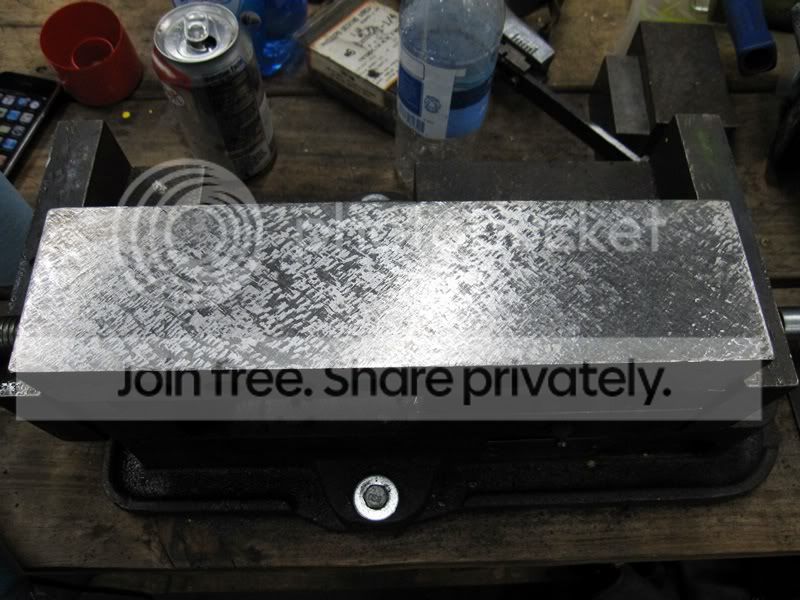
I've done a lot of scraping, both hand scraping and power scraping. This is a prismatic metrology block that I scraped flat and parallel to 50 micro-inches (seriously!)

IMG_4346.jpg


That said, most scraping is done on gray cast iron, which scrapes beautifully. Unhardened steel doesn't scrape well, and hardened steel (like on machine ways) is a royal PITA, even with a carbide blade on a Biax (power scraper).

Round scraping ("hollows") is often done on bronze or Babbit bearings, but overall, scraping is completely unsuited for knifemaking, IMHO. For one thing, scraping pass removes 2 - 5 tenths on soft gray cast iron. Removing several thou on steel, let alone hardened steel, would take you all afternoon.

I have considered scraping the flats of a blade, for decorative effect. It leaves a shimmering, quasi-holographic sheen. But the scrape marks also have incredible surface area, which is great for oil retention, but it starts rusting as soon as you've scraped it...
 
Last edited:
how bout a bench grinder? this will get you where you need to be in a hurry.. finish the rest out by hand...

I seen a really nice wet grinder at a pawn shop, old and a quality build, I was tempted to buy it and very well may go back he wants $50 I'm thinking 40 out the door:)
 
Thanx for all the info guys! Seems as though I was looking for a SEN rather than scraper, but in my lack of knowledge I referred to the wrong tool. So far from my reading and researching I have concluded that it could be done to create a shallow hollow. Now those of you who have used a SEN, what do you think about using it "upside down" much the same way as a scraper, I.e. with the ground bevel against the surface being worked. I will grind one out here in a few days to try it out.


-Xander
 
A sen is a totally different animal to the scrapers (and scraping techniques) used for leveling. It has a lot more in common with spokeshaves for woodworking - except that it does rather aggressive but quite controlled scraping of metal - as already mentioned, essentially a one toothed file (with a really large tooth). Great for sword shaping in general and also will cut in a fuller in a hurry. The old traditional Japanese knifemakers also used the sen extensively to finish shaping their blades (smoothing, flattening, removing forge marks, ...). Here you can see one in action (later on the page): Japanese Sen in action
 
Back
Top