Advice on salvaging a knife

Joined
May 26, 2019
Messages
30
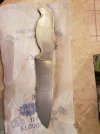
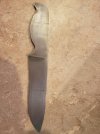
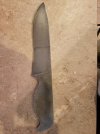
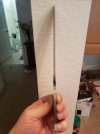
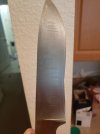
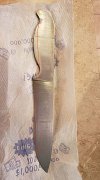
Ok, so I finally got around to grinding the bevels on a knife on my new 2x72. First time I used a grinder for bevels (previously hand filed them). I over heated the blade in a few spots and you can see the blade turned colors and also burnt the tip of the blade off. I was using a jig and on 1 side the angle changed a bit and now the bevel looks off. I also messed up the plunge lines.

So, can I salvage this blade? The spots that got hot, will those be affected in any way? This is pre heat treatment. I figured I could regrind the point back and try to fix the plunge lines and then use a 120 grit to smooth out the side where the angle changed.

Any advice?

I will post pics if that will help.

Thanks
 
Your hot spots should be fine after heat-treat. You may have to dump the jig and re-balance the bevels freehand. That takes some practice, but it's a good skill to have. And clearly you'll have to re-profile the tip.

We don't always end up making the knife we started... my most recent big snafu involved removing nearly 3/4" from the entire height of the 7" blade.
 
Try using fresh 50 grit belt, and medium speed.

Use light passes and let the belt do the cutting. Do not use a lot of pressure.

The duller the belt the more pressure and more heat due to friction.
 
When that happened to me I made sure to dunk into the water bucket more often. I don't wear gloves so i can feel the heat in the blade. If its too hot to touch its time to dunk. I do like my jig by the way and have burned the tip with too much pressure. So the advice about turn the grinder down is true and I make sure to not spend too much time on the tip end.

If you burned the tip it is probably a good idea to grind that part off. Grind any dark spots and if it looks good underneath then you are good to go. First time I burned the tip I ground it and found it still dark underneath and had to grind it right off.
 
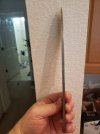
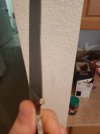
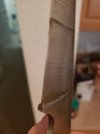
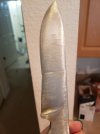
Here are some pics. I am going to put this in the scrap bin and start work on a new blade. Practice makes perfect.
 

Attachments

  • 20190627_142127_resized.jpg
    20190627_142127_resized.jpg
    225.4 KB · Views: 51
  • 20190627_142143_resized.jpg
    20190627_142143_resized.jpg
    339.8 KB · Views: 48
  • 20190627_142155_resized.jpg
    20190627_142155_resized.jpg
    344.3 KB · Views: 48
  • 20190627_142222_resized.jpg
    20190627_142222_resized.jpg
    161.7 KB · Views: 48
  • 20190627_142229_resized.jpg
    20190627_142229_resized.jpg
    158.8 KB · Views: 46
  • 20190627_142240_resized.jpg
    20190627_142240_resized.jpg
    130.2 KB · Views: 48
  • 20190627_142246_resized.jpg
    20190627_142246_resized.jpg
    91.3 KB · Views: 47
  • 20190627_142253_resized.jpg
    20190627_142253_resized.jpg
    153.6 KB · Views: 48
  • 20190627_142258_resized.jpg
    20190627_142258_resized.jpg
    120.5 KB · Views: 47
Yes, what everyone else has already said, fresh belts, less pressure and go slower.
 
Full page print.jpg

Pictures help. Still looks salvageable. I'd reduce some of the belly in the handle and just reduce the height of the blade a bit. Unless you want to grind a mini kukri. The 2" belt bump looks kind of deep but I think you have enough thickness to grind it out. If your grinder has a VFD, slower speeds will help.

Keep in mind that I drew a pretty long flat edge on the blade. As a beginner, it can be hard to keep it flat as its easy to grind a thin spot.

My grinding improved a lot when I started using a rest. I let the spine sit on the rest and use a finger to keep pressure on the blade. I grind post heat treat "AEB-L" so this also helps me to watch heat input. There are lots of videos of guys using push sticks. I like to place my finger where I want to remove material. As I draw the knife across the belt, I apply a bit more pressure when my finger hits that spot. I'll also use the edge of the belts but be careful as this is an easy way to dig a trench.

As for the 2" belt bump, I find it helps to approach the belt very slowly and I try to approach at different spots at different angles and keep the blade moving across the belt as I place the blade to it. This helps to prevent from digging a line 2" from the plunge line.

Walter Sorrells has a great video on fixing grinding mistakes and what causes them.
 
So, can I salvage this blade?

If you want to salvage don't forget what you can do...hand file and sand. Don't forget that everyone switches to finishing up by hand at some point in the process.

When learning to use power, don't forget that the only purpose of power is to speed up removal of material.
To maximize salvageable blades while learning, use the 2x72 to rough out the blade, and when you get to the point where speed gets dangerous, switch to hand finishing. As you make more blades, you'll find that your muscle control will improve so that you'll be able to go further into the process before having to slow down and do things by hand so that you don't screw up the blade.
 
GJpm91V.jpg
 
Definitely salvageable! Wisest advice I ever got from a maker..."Inside every 12 inch bowie knife is a 3 inch pairing knife." (or something to that effect.)
 
Did I read it wrong, I thought you said you said the blades are not heat treated. Thought you said pre heat treat. Pre heat treat you really can’t damage the steel on the grinder. After heat treating you can temper the areas that get to hot.
 
Yes this is pre heat treat. I have read on here "dont try to poilsh a turd" and that is why I was thinking to start over with a new blade. Thanks for the input. I will try and make some of the corrections you guys recommended and see what I can make of it.
 
Yes this is pre heat treat. I have read on here "dont try to poilsh a turd" and that is why I was thinking to start over with a new blade. Thanks for the input. I will try and make some of the corrections you guys recommended and see what I can make of it.

Absolutely do not do that. You still have a lot of meat to work with and as noted above, you may may end up with a knife a bit smaller than intended but what you learn will pay off in spades on your second knife. You can still make a nice knife from what you have. I'm sure i can speak to everyone here in that not every knife goes exactly as expected but you do learn with every knife. I have a custom im working on that im on my 3rd blank for because they just wernt quite right. Even if it ends up on the wall of shame you'll learn from it. I think one of the most impotent things is learning to correct mistakes. We all make them. Well i do a least.

Keep at it. I'd love to see how the finished product turn out.
 
I don’t get what the problem is. If the blade has not been heat treated then you can grind that thing till it’s just about red hot befor doing any damage. And if it does actually get red then it’s time to change the belt lol. There is no such thing as over heating steel if it’s befor it’s been heat treated. The reasion you want to be careful after heat treating is because the grinding heat will draw the hardness out of that area. Basically getting it to hot is tempering it in that spot.
 
Absolutely do not do that. You still have a lot of meat to work with and as noted above, you may may end up with a knife a bit smaller than intended but what you learn will pay off in spades on your second knife. You can still make a nice knife from what you have. I'm sure i can speak to everyone here in that not every knife goes exactly as expected but you do learn with every knife. I have a custom im working on that im on my 3rd blank for because they just wernt quite right. Even if it ends up on the wall of shame you'll learn from it. I think one of the most impotent things is learning to correct mistakes. We all make them. Well i do a least.

Keep at it. I'd love to see how the finished product turn out.


Re reading this, my comment didn't make much sense as I thought you were giving up. Keep going. As jt noted the heat treat isn't an issue and you still grind a nice blade out of that blank.
 
Back
Top