
Aitor SAK-clone blade steel?

Joined
Dec 26, 2012
Messages
63
Happy Holidays to all! Just popped the top on an Old Fezziwig Ale with the cap lifter on my "new" pseudo-SAK. The Aitor name caught my eye on the big auction site because I know their Castor gets a good deal of love 'round these parts. I must say I'm impressed with the quality of the implements (photos to come...): The punch awl is sharp, the scissors are good sized, the saw blade is well-cut, and everything has a great snap.

I'm not sure about the blade steel, though. It's stainless of some variety, but my first attempts at sharpening have left me with an odd sort of burr that won't go away. Any idea what might be happening, or what steel Aitor may have used on this? The plastic scales are stamped "POLICE" if that helps, and photos will be coming soon.
 
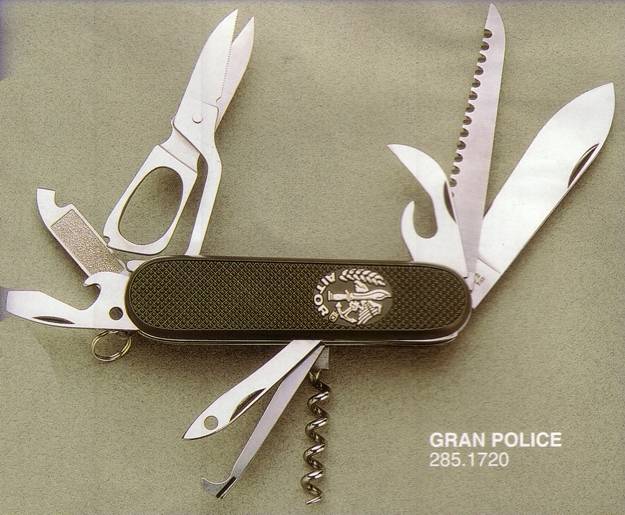
This knife?
aitor-penknife-gran-police.jpg


The steel is listed as X42 steel blade(INOX 46 CR13).

Found this:

http://www.bladeforums.com/forums/showthread.php/433216-X42-Steel

Hope it helps! :thumbup:
 
Happy Holidays to all! Just popped the top on an Old Fezziwig Ale with the cap lifter on my "new" pseudo-SAK. The Aitor name caught my eye on the big auction site because I know their Castor gets a good deal of love 'round these parts. I must say I'm impressed with the quality of the implements (photos to come...): The punch awl is sharp, the scissors are good sized, the saw blade is well-cut, and everything has a great snap.

I'm not sure about the blade steel, though. It's stainless of some variety, but my first attempts at sharpening have left me with an odd sort of burr that won't go away. Any idea what might be happening, or what steel Aitor may have used on this? The plastic scales are stamped "POLICE" if that helps, and photos will be coming soon.

Assuming X42Cr13 as mentioned, the carbon is pretty low (0.36 - 0.45%) and chromium is at typical levels for stainless (12-13.5%). Based on your description of the burr that's left after sharpening, that's about what I'd expect. Probably relatively low hardness as well, so I'd expect burrs to be pretty ductile & tenacious. Using very light pressure on relatively fine/EF grit abrasives is what I'd do with it. If using a rod-type ceramic sharpener like the Sharpmaker, use only the flats of the rods; the corners will focus too much pressure, and this steel will burr all the easier if so. Pressure exerted is what will make the most difference with burring on soft/ductile steels like this, so keep it very, very light. Setting a bevel can easily be done with nothing more coarse than a fine/EF grit in diamond, silicon carbide or aluminum oxide. I've used a fine/EF diamond hone with success on blades like this; diamond will work very fast. Any burrs which form should be very gently filed away (instead of trying to bend/break them off) with the finer stones and/or stropped with compound; black, white, green should all work well. Avoid over-stropping with compound, as steels like these are pretty easy to over-polish and remove all the bite from the edge. Most stropping could likely be done with green compound by itself, and/or bare leather. Black and white compounds are both more aggressive, and it's pretty easy to over-do it on steels such as this.

All the above is what I'd also recommend for the 'genuine' Victorinox or Wenger SAKs as well; the steels of these are in about the same ballpark, in terms of makeup and hardness.


David
 
Last edited:
Nice to see this. Aitor produced some of the German Army knives back in the 1980's. I have a couple and the steel on those knives seems to be similar to the stainless used by Victorinox and Wenger.
 
Thanks everyone for your replies! As promised, photos:


Regarding sharpening, I really appreciate David's advice. Another part of my problem, I think, is that the main blade has (I think) a chisel grind, and I was sharpening at too low of an angle (and on both sides). I'll give it another go, trying to preserve the existing grind, but I'll have to learn a different hand position to do it!
 
Back
Top