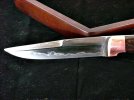
Hello Again - the real benefit is the way that this steel can be made shallow hardening and therefore respond to a differential heat treatment. Normalize x 3 or 4, with the last one being subcritical. One grain thick layer of clay on whole blade, shallow (1/16" - 1/8") layer of clay where you don't want hardening. Heat, soak (2 min is plenty) and even the temp out, quench in 120F water for 3 sec then into your favorite oil of if you want to play safe quench straight into Parks 50 or comparable fast oil. It has less Manganese than 1080 or 1084 and therefore responds to diff heat treat the best. That will be the major difference. Also, because of the less mang, it etches a little lighter than 1080 or 1084 in a p-weld billet. Barely enough to notice unless you put the two of them right together. If you like to make subtle pattern welding sometimes, this is perfect (it plus w2 give a steel that has the grain of traditional steels and can take a beautiful hamon, so the combo is ideal for japanese or chinese style blades).
Otherwise, there should be a very small increase in shock resist and a small decrease in edge holding compared to 1080 or 1084 (which is why I like it for swords). (edited - I now see that thegeek574 already explained part of this).
Knives, I start tempering at 350F and work up to around 385F (between 375 and 400 for me puts edge in RC 58-60 range). In my oven, with the way I soak and quench in water or parks 50 or both.
Hope this helps.
Kevin