All brass slipjoint and a place to buy reamers?

Brian.Evans

Registered Member
Joined
Aug 20, 2011
Messages
3,267
I have another question for the slippie makers. A person could do an all brass slipjoint, right? Just thick brass, brass pins, and the blade steel? It would look neat buffed up high enough that someone looking at it wouldn't see the pins.

Just something I had rolling around in my head. I am getting my bandsaw this weekend sometime and then as soon as my steel comes in, on with the slippie building!

Also, I test drilled some holes in brass liner plate last night. How tight are the pins supposed to fit? I can see the oblong holes though. Where do I get reamers? Drill undersized and ream up right?

Sorry for all the questions, but my other slip joint topic got a lot of answers here, two or three on Knifenetwork and ZERO on knifedogs. I guess I know where I'm staying. :)
 
I think Enco is a nice place to buy cutting tools like reamers.

It's a nicely organized website and order process, very smooth

- even as a Canadian I was happy
 
I just ordered from Enco and agree completely. Great place for what your looking for. And you can get a slightly larger reamer that will help with the slightly oversized rod. That or you can chuck the rod in a drill and sand it slightly smaller.
 
MSC Industrial Supply has a huge supply of drills and reamers.
 
Enco, I'll second the count's opinion. Dealing with Enco is a pleasure. My only possible gripe would be that being in CA I have to pay sales tax, but even then it's still worth it. I've always found what I need at Enco. Great service, great prices.
 
Which brings up another question; do I drill undersize and ream up or drill then ream the same size to round the hole? I will probably just sand the rod down after I drill the hole to get a smooth press fit. I don't want to amass a collection of 10 reamers and drill bits just to drill an 1/8" hole.
 
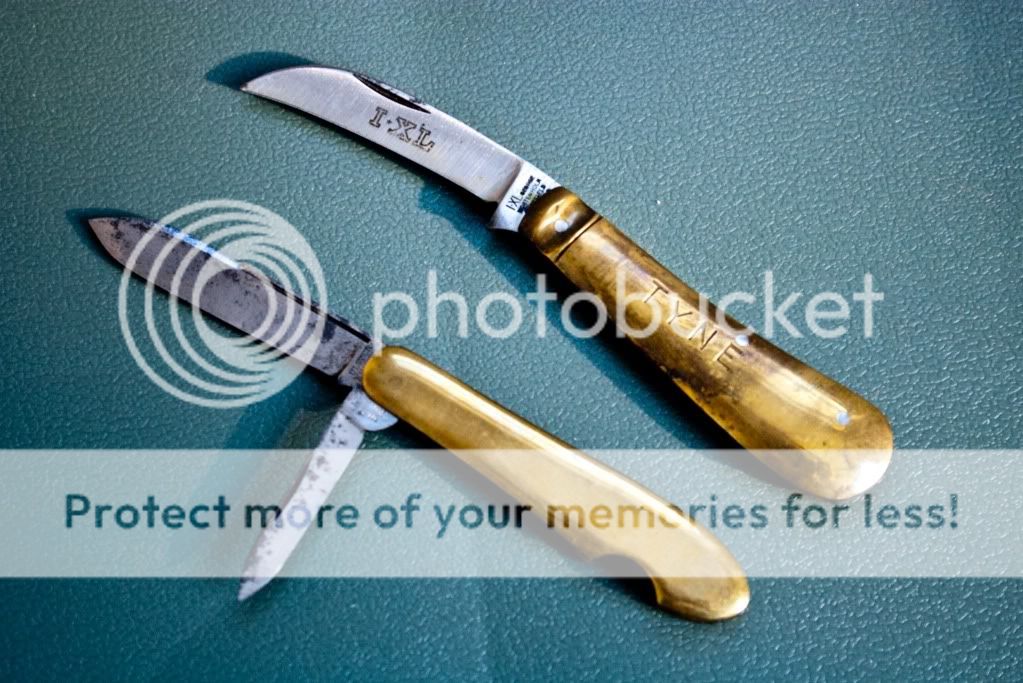
No reason not to make a slipjoint out of all brass. Here is a picture of two vintage slipjoints using brass frame construction. The Ulster (teardrop easy opening jack) has brass pins, the George Wostenholm (swayback pruner) uses steel pins.

IMGP9206_1023_edited-1.jpg


This is what I use for drilling my holes , both in the frame material and blade/spring steel. I started out by messing around with reamers and undersize drills. Waste of time in MHO. For starters I made sure I had a decent little drill press that ran true, with the table square with the quill. I then placed a hardened v-block upside down on the table(super glued) so I have a hard, perfectly flat surface with a hole that the drill bit can pass into when drilling. I purchase GOOD (stress good) quality SCREW MACHINE 3/32 bits in quantity. A screw machine drill bit is much shorter than a jobber drill bit. I use them like sanding belts, when they get dull, grab a new one. The old ones are cut at the shank and then used as assembly pins as I build the knife. After drilling a few hundred holes:eek::D you will learn your drill press and the material and get a very accurate hole sized right. The 3/32 pin stock you will be using is not sized accurate anyways. You want a nice fit on the bolsters/frame without it being a drive fit. If anything you want the fit to be looser on the blade tang. When you peen the pins you want the pin to swell and grab the sides of the bolsters and still let the blade pivot free. I use a two degree taper reamer(available form USA knife makers) to taper my holes in the bolster. I seldom if ever have a problem of seeing a pin in the bolsters.

Hope this helps, and good luck!
 
Ken, thanks for the information.

If you were to make a shadow pattern or an all brass like I have decided to do, would you personally still use the 2* taper reamer on the scale material/brass body?

Would you still use a straight reamer to smooth/true up the holes?
 
I do not use reamers at all for truing or smoothing the hole. The 2 degree taper reamer is used to open the hole for the pin material to be peened into. This is what keeps the pin from moving after it is dressed to the level of the bolster. I used to use this cutter but found the angle was to extreme and it was hard to hide the pin.
http://www.dremel.com/en-us/Accessories/Pages/ProductDetail.aspx?pid=125


This is the reamer I use to open the hole before peening.
http://www.usaknifemaker.com/index.php?main_page=product_info&cPath=98_32&products_id=1071

On your brass framed slipjoint I would drill a accurate 3/32 hole, build and fit the knife, and just before final assembly take my 2 degree reamer and ream from the outside down approximately 1/3 to 1/2 the bolsters thickness.
 
Ken, thank you so much for your help. Your knives are an inspiration.

If I could ask another question. With your shadow patterns, how do you do the counter sink for the large pivot pin? The reamer will work on bone and g-10 as well a metal right? Also, when a person pein a spring or pivot pin is it mostly done with the flat or pein side of the hammer? I've seen both ways. I use the pein side on my razors, but unsure for knives.

Thanks again! Tapered reamer here I come!
 
On Shadows I use 1/4 inch 416. I have the 3/32 hold drilled through the liner and Micarta. I leave the Micarta flat at this point, put it liner side down on my v-block then drill up to 1/4" in a few steps leaving micarta at the bottom of the hole. You do not want to break through to the liner. I took a standard 1/4" drill bit and re-ground it pretty flat. I then will finish up with the drill leaving maybe .020 of Micarta. You want the birdeye bushing to capture the Micarta also when the knife is peened together. After I epoxy the 416 in and it sets up I grind it down flush with the flat outside surface of the Micarta, flip it Micarta side down and drill through , slowly with lots of cutting oil with a 3/32 bit. I place it on my v-block so just a tiny bit of the tip comes through, flip it again and use that tiny spot like a center punch mark to finish drilling through. Whew, takes a lot more typing then doing it! LOL :D.

Yes, I use the same reamer for all materials.

I have a "tack" hammer that I use for peening all of my knives from day one. It has a rounded face. Just what I use, others may use a flat faced, or scored face. Not saying my is right or wrong. And this is a good time to stress, what works for me, is not the ONLY way to make slipjoints. You will find ways of doing things that are different. I have gotten lots of good advice from other makers , some of it works for me , others not.

If you check out my youtube channel ne6359 you can look at a few videos I have posted. When time permits I will do more.
I admire your willingness to build these difficult knives. Besides the mechanics of a slipjoint there are the aesthetics. I can not stress enough how important it is to look at as many old knives as possible, get them in your hand, study the lines, how they look.

Most of all, have fun!
 
Ken, I'd like to thank you again for your help. Details like that are very important to this new maker. I got my bandsaw today, so when I get the steel in I will start the cuttin' out. :)

It looks like an all brass slippie is going to e my first one, so no drilling for the birdseye bushing on the this one. Can I use an end mill chucked in a drill press to make the bottomed hole?

I wasn't sure a 3/32" pin was strong enough for the pivot until I looked at Alistair Phillips' page here: http://knives.mutantdiscovery.com/destruction.html

I may still go with an 1/8" just to make the pin look a bit larger without doing a bushing, but I have no qualms about the strength of a 3/32" pin now.
 
You can use an end mill in a drill press for making the holes for shadow washers in a drill press with no problems,works well.Set your depth stop and spin the endmill fairly fast.
Stan
 
Back
Top