- Joined
- Jun 6, 2010
- Messages
- 184
Preface
Note, this is a "re-post". This is an account of my first impressions of a knife which I recently acquired. My goal here is to describe a knife that you may have heard of or even seen online, but haven't had the opportunity to look at in detail. My personal observations, photos and short background on the designer/ manufacturer and their objectives will help one get a better idea of the knife and it's key attributes. I will follow up with a review once I have had the opportunity to actually work with the knife over a reasonable length of time. I'm more of an amateur collector than a full-time user and this means, among other things, I am judging a knife from an aesthetic - as well as from a functional and ergonomics point of view. Aesthetics includes the combination of materials chosen as well as the choice of form, grind style and finish. Last but not least ...enjoy!
Intro
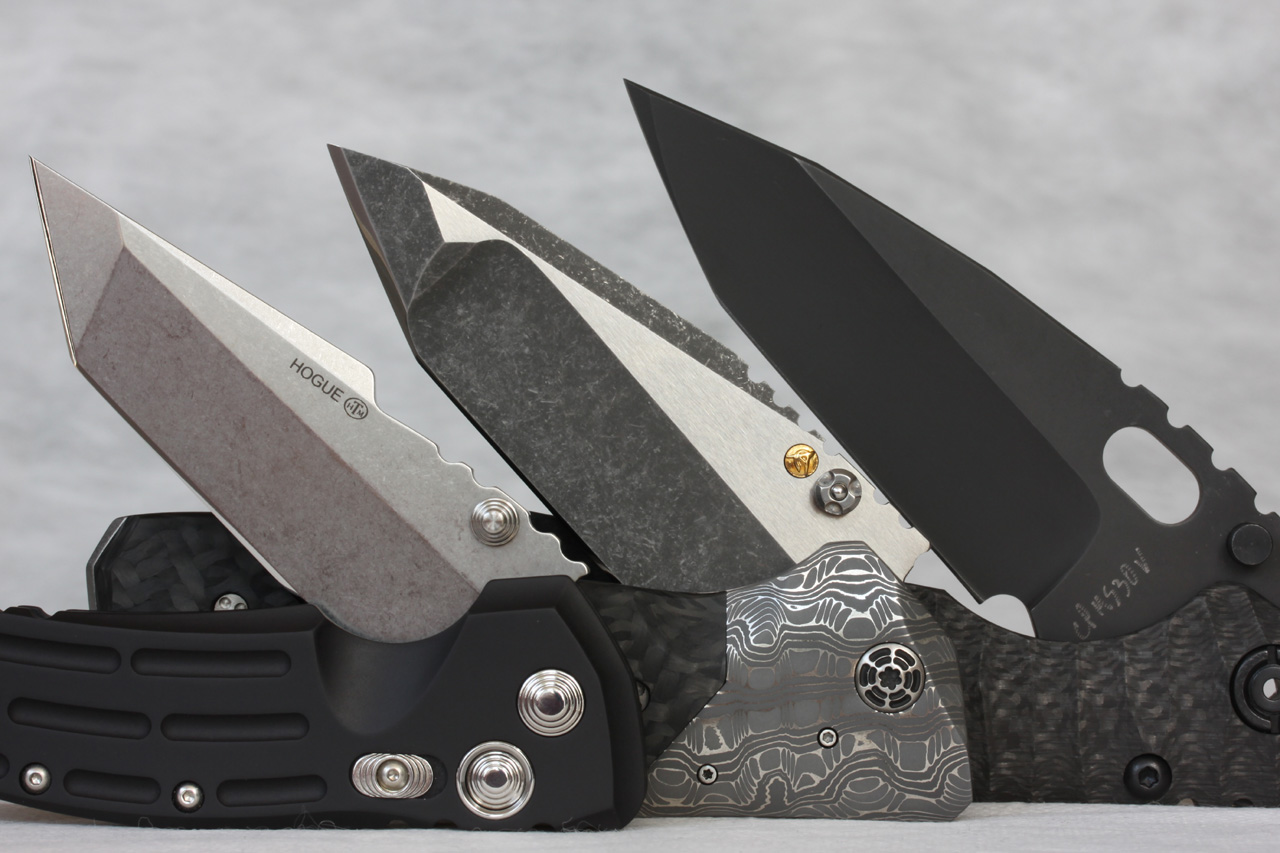
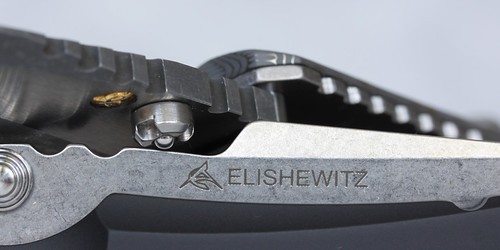
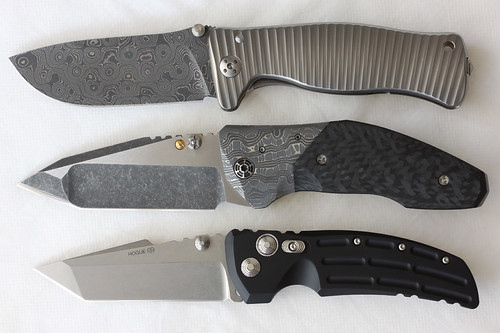
I've been a big fan of Allen Elishewitz through his collaborations with Benchmade and more recently, Hogue, but I knew little of his custom work until recently. What made me take personal interest in him was my recent acquisition of a Hogue EX-01. That production knife has everything going for it (imo) so I had to find out more about the man behind the design...
click-the-pics for hi-res goodness
There's always a first time...
With perhaps the exception of my dozen Swiss Army knives, I'm still considerably new to the performance cutlery scene. I have a few dozen production folders but until now, I've never had the pleasure of owning a custom knife. To be honest, I wasn't even sure what the fuss was all about. Past Tense. Big-time... So as I mentioned above, the EX-01 got me looking into Allen's professional past and some of his previous, as well as current-day custom work. Without a doubt my interest had peaked and I was toying with the idea of getting my first custom. Still not completely convinced, I met up with my good friend and fellow cutlery-junkie who happened to own two of Allen's famous Tank folders. That's when there was no doubt anymore that I had to have a custom and the first one had to come from Allen Elishewitz... !
Enter the Saboteur
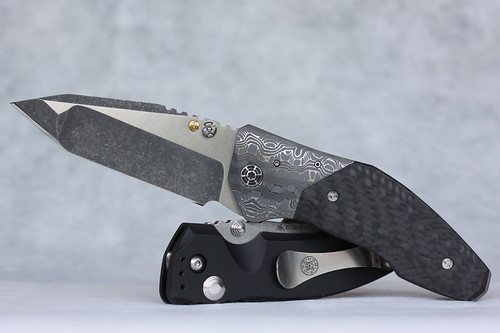
Allen is a designer that never rests upon his past laurels, always thinking about the next design. As such, there are a lot of styles to be admired, some of which are no longer in his line-up, some of which are so new that only Blade-Show attendees have had the pleasure. Those currently on offer include his classics, the Tank and Scout and Spatha, as well as some newer creations, the Saboteur, Jekyll and Hyde... . They are all fine examples of the art of custom cutlery but it was the Saboteur that really got my attention ... big-time!
Custom vs. Production
Is it really the "night & day" difference I've only heard and read about? Yes, yes it is. Let's start with the obvious; no two are alike. Even if the designer has a specific line of knives, he/she is always varying the materials used. Even if some combination of materials turns out to be so popular that the maker produces several, they are still unique. That's because every blade is hand-ground, every liner hand-cut, every bolster hand-shaped, every scale hand-buffed. This in itself makes a custom knife worlds apart from it's production-line cousin.
Killer Grind
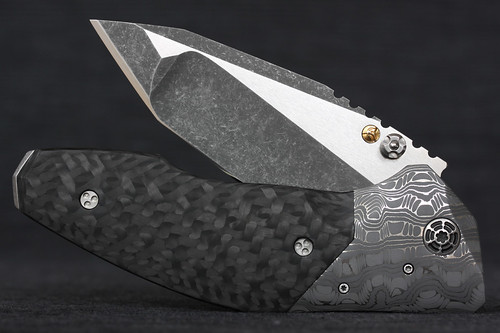
I love both the Tank and Scout grinds but imo, The Saboteur brings the best of both in one! It offers the straight-edge Tanto-tip well known from the Tank along with the Scout's long-swept swedge line. I think it is this very combination that makes the saboteur my favorite grind. Not only is it aesthetically very appealing, but more importantly, it's all form without any loss of function! I've seen some pretty amazing grinds, some that would probably even be a "nightmare" to pull off, but the function of such grinds is questionable, to say the least.
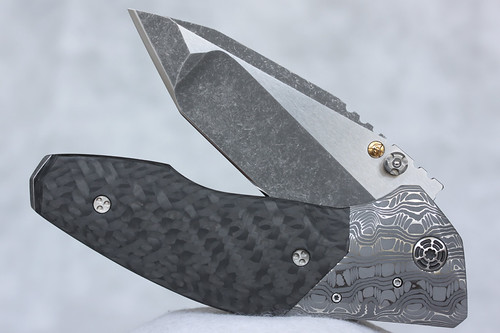
There is no such concern with the Saboteur (or the Scout and Tank, for that matter)! With a perfect combination of a hollow-ground main bevel leading to a long, straight and scary-sharp edge followed by a beefy flat-ground tanto tip - which, btw is just as scary-sharp as the rest of this blade!
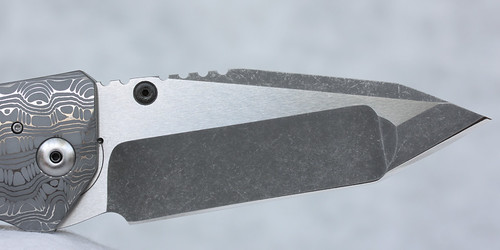
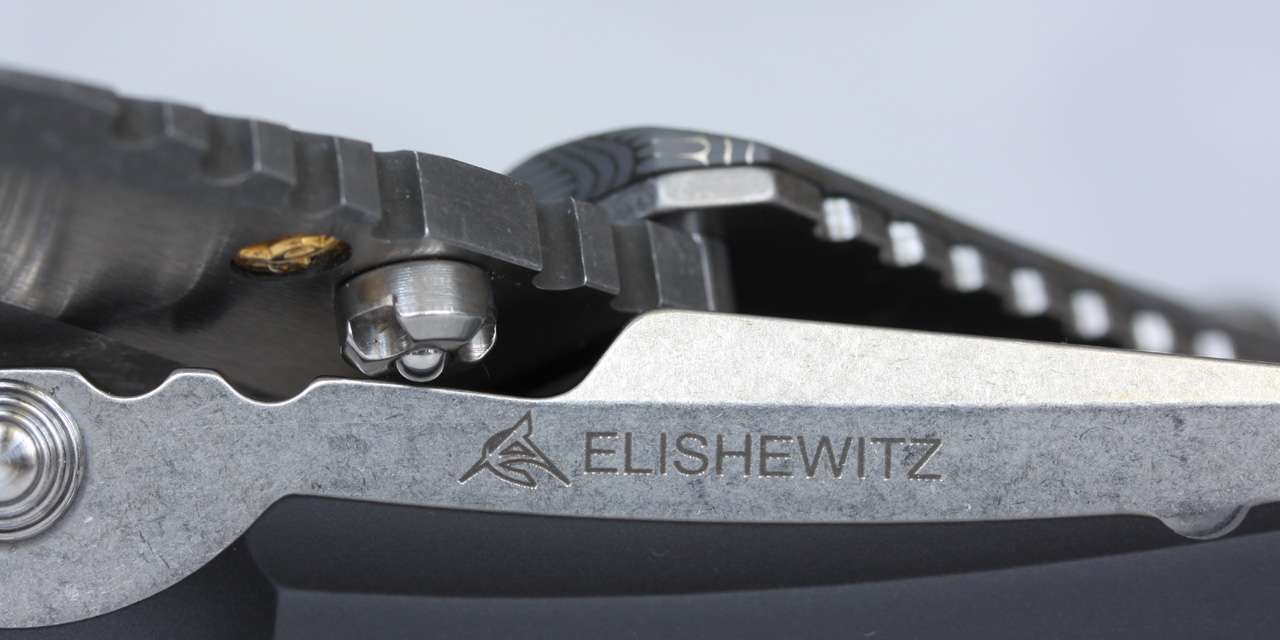
Along with the obvious function is Allen's attention to form; One will immediately notice the way the combination of stonewash grinds and satin flats really highlights the blade's geometry! This finish adds another dimension to the aesthetics of the knife and is even more essential with Damascus. As beautiful as a damascus pattern may be, it will most certainly shroud the intricacy of a blade's grinds and geometry! The stone-wash look is amazing in istelf; Allen uses some form of etching process to create a stonewash finish with a much higher contrast and definition than the typical production knife's finish.
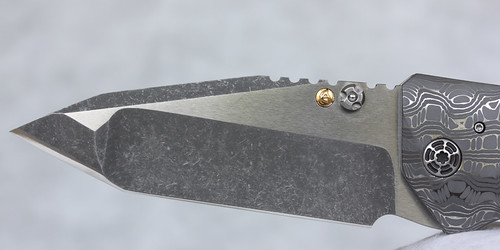
Shades of Grey...
If you review a portion of Allen's work, it becomes clear that he's definitely one to experiment, ranging from classic lines to the avant-garde (take his recent Jekyll-Hyde creations, for instance). This applies to both his grinds as well as his combination of materials and colors. I doubt there is anything Allen hasn't put into one of his knives, from classic and classy mother of pearl to cutting-edge Moku-Ti. Although I also enjoy both the left and right sides of the scale, I am partial to simple geometry and color-schemes. That said, this particular Saboteur has my name written all over it! It could have been a custom order but it was just the right mix of luck and (I'd like to think) Allen perhaps allowing his creative process to be subtly influenced by one humble admirer
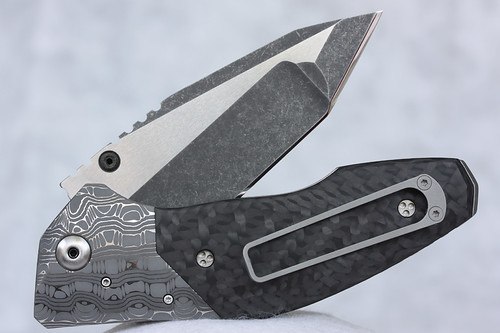
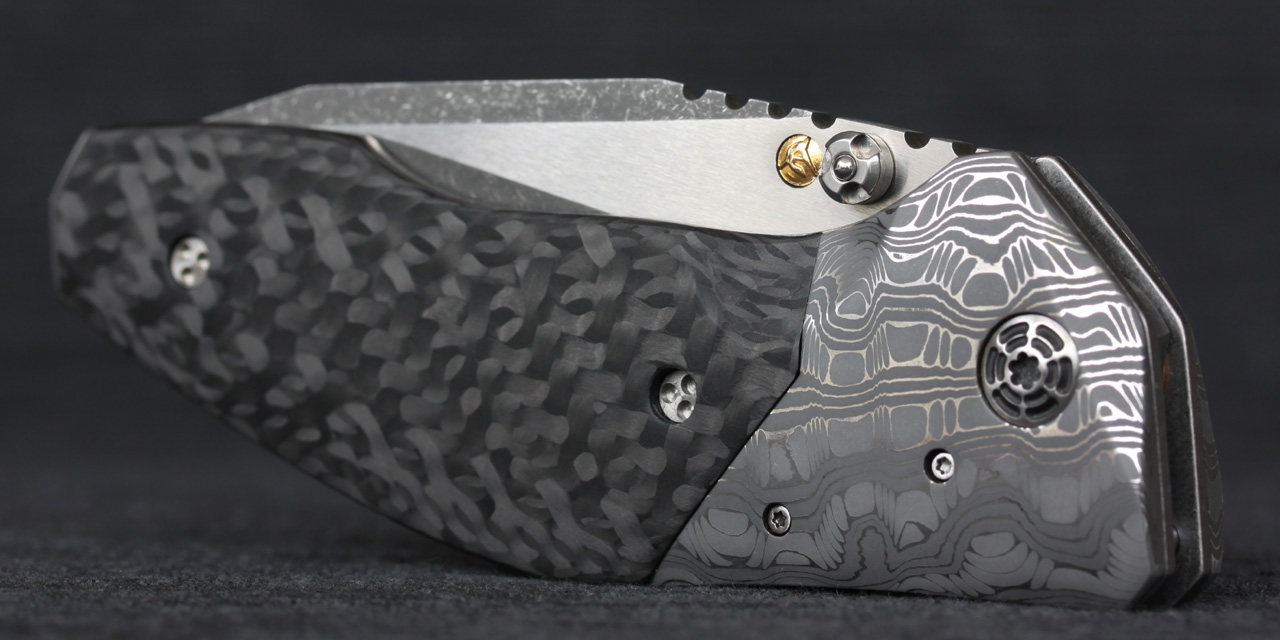
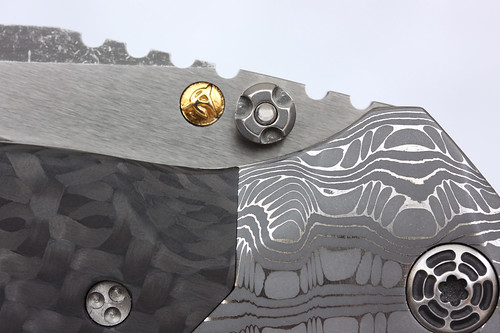
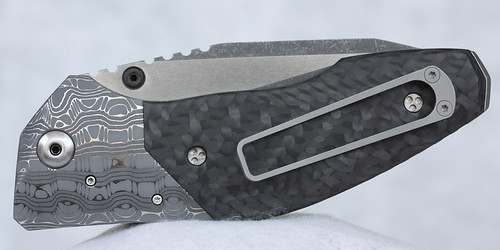
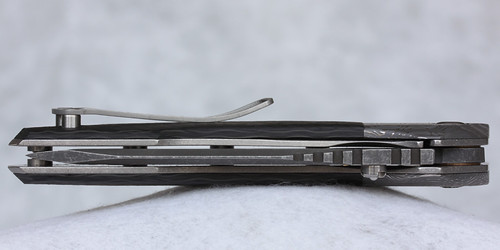
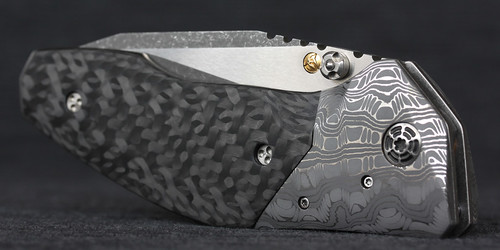
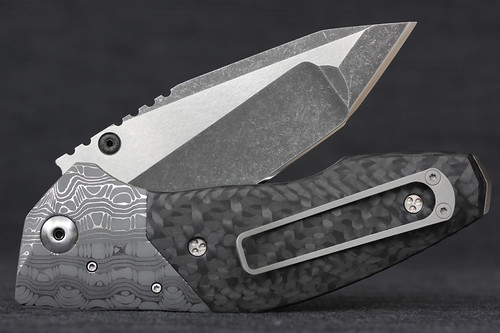
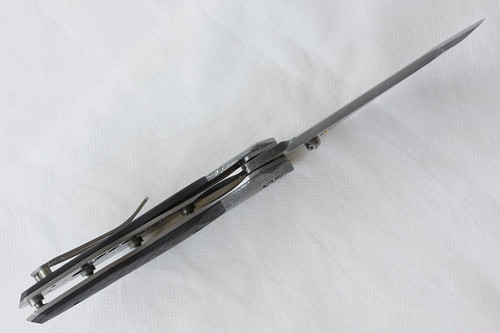
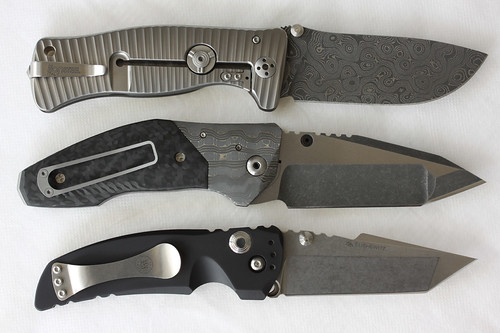
Starting from the tip, we have that fantastic mix of satin and stonewashed steel, followed by stunning bolsters made from Chad Nichols' sublime Iguana-patterned damascus. Note the subtle geometry that gives the bolsters some depth and character to them. The sleek carbon-fiber scales are mated in refreshingly non-standard angles and taper off just short of the titanium liners to provide a "concealed" but no less effective skull-cracker. On the back-side you will find a clip that again merges form and function without sacrificing one for the other. Add to that something from Allen's wide assortment of thumb studs, pivot-heads and scale screws and top it off with his signature gold-plated logo, which adds the final touch to this otherwise monochromatic landscape!
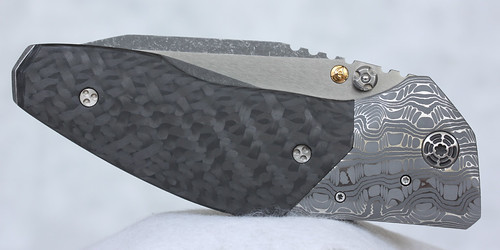
Don't let its good looks fool you
Once you get over the bling-effect, you will be damned impressed on how tough it's built!
Action: Right-hand Thumb-Stud
Length: Overall 21.5cm (8.45") / Closed: 11.5cm (4.5")
Weight: 200g (7.1oz)
Blade Type: double-ground Tanto, satin flats, stone-washed grinds
Length: 9.5cm (3.75")
Thickness: ~3.5mm (1.38")
Material: 154CM Stainless steel
Frame: Chad Nichols Iguana-patterned Damascus bolsters,
Carbon Fiber scales, beefy Ti liners & spacers (5)
Pocket Clip: Hollowed bead-blast Titanium (tip-up)
That's right, 200g of steel in your hand(s) solely designed to do one thing: cut-hack-slash-slice-pierce-clock-the-sh**-out-of something. Ok, maybe I cheated here - let's just call it a multi-purpose tool then, shall we... . Smooth, solid, secure, serious. The smooth action, solid feel and secure grip (in all basic positions) make for a serious tool. Silky-smooth action, absolutely no play, solid lockup and dead-centered blade. Holding the knife "laid back" or scrunched-up for controlled-cutting both feel natural and confident. Reverse grip is solid and the "concealed" skull-cracker rests comfortably in your thumb's recesses. Ample and functional Jimping along the top of the liners and blade spine reinforce the grip. The liner-lock is carved into/out of the liner in such a way that it can be easily disengaged but doesn't protrude and interfere with the handle's ergonomics (as is often the case with liner-locks).
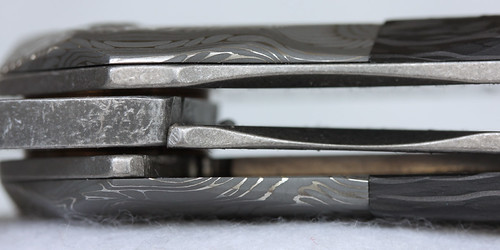
You can please all - some of the time...
...but you can't please all - all of the time. Perfection is for the Gods, but not for us mere mortals. Last time I checked, both Allen and I are members of the latter. For example, single-sided thumbstuds. I don't know that a "lefty" will miss it, considering the liner-lock is close to impossible to work left-handed. But even if it's simply a question of symmetry some prefer the standard double-thumbstud approach. The Saboteur has a minimalist-style choil. Since I tend to stick to the handle, it's not a topic, but ymmv. I love the three-prong screws, but those who insist on taking apart their knives like it was an M16 will be less thrilled. I am strictly tip-up so I lucked out, but those who like it down won't have that option. Talk about nit-picking, but Allen has left me little room for criticism...
Conclusion
Functional Art. That's how I would sum up Allen Elishewitz' Saboteur. It's also my idea of the perfect knife - one that looks like it belongs in a modern-arts museum but is designed to cut-hack-slash-slice-pierce-clock-the-sh**-out-of something. Many times over. As cool as this custom knife is, the fact that I got it directly from Allen makes it all the more special to me! Last but certainly not least: "behind every great man is a great woman". So in conclusion, I would like to thank Team Elishewitz for making my first custom knife a really memorable experience!


Note, this is a "re-post". This is an account of my first impressions of a knife which I recently acquired. My goal here is to describe a knife that you may have heard of or even seen online, but haven't had the opportunity to look at in detail. My personal observations, photos and short background on the designer/ manufacturer and their objectives will help one get a better idea of the knife and it's key attributes. I will follow up with a review once I have had the opportunity to actually work with the knife over a reasonable length of time. I'm more of an amateur collector than a full-time user and this means, among other things, I am judging a knife from an aesthetic - as well as from a functional and ergonomics point of view. Aesthetics includes the combination of materials chosen as well as the choice of form, grind style and finish. Last but not least ...enjoy!
Intro
I've been a big fan of Allen Elishewitz through his collaborations with Benchmade and more recently, Hogue, but I knew little of his custom work until recently. What made me take personal interest in him was my recent acquisition of a Hogue EX-01. That production knife has everything going for it (imo) so I had to find out more about the man behind the design...
click-the-pics for hi-res goodness
There's always a first time...
With perhaps the exception of my dozen Swiss Army knives, I'm still considerably new to the performance cutlery scene. I have a few dozen production folders but until now, I've never had the pleasure of owning a custom knife. To be honest, I wasn't even sure what the fuss was all about. Past Tense. Big-time...
So as I mentioned above, the EX-01 got me looking into Allen's professional past and some of his previous, as well as current-day custom work. Without a doubt my interest had peaked and I was toying with the idea of getting my first custom. Still not completely convinced, I met up with my good friend and fellow cutlery-junkie who happened to own two of Allen's famous Tank folders. That's when there was no doubt anymore that I had to have a custom and the first one had to come from Allen Elishewitz... !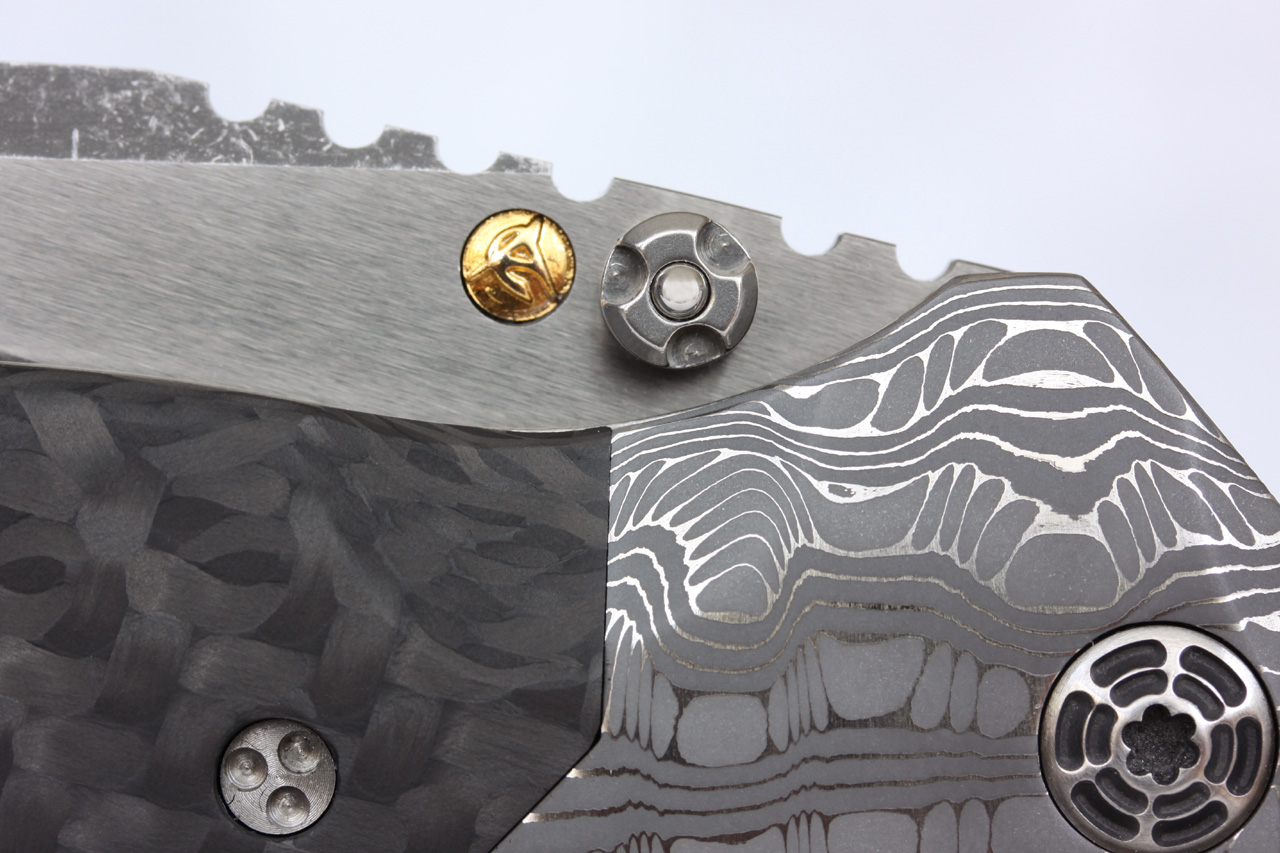
Enter the Saboteur
Allen is a designer that never rests upon his past laurels, always thinking about the next design. As such, there are a lot of styles to be admired, some of which are no longer in his line-up, some of which are so new that only Blade-Show attendees have had the pleasure. Those currently on offer include his classics, the Tank and Scout and Spatha, as well as some newer creations, the Saboteur, Jekyll and Hyde... . They are all fine examples of the art of custom cutlery but it was the Saboteur that really got my attention ... big-time!

Custom vs. Production
Is it really the "night & day" difference I've only heard and read about? Yes, yes it is. Let's start with the obvious; no two are alike. Even if the designer has a specific line of knives, he/she is always varying the materials used. Even if some combination of materials turns out to be so popular that the maker produces several, they are still unique. That's because every blade is hand-ground, every liner hand-cut, every bolster hand-shaped, every scale hand-buffed. This in itself makes a custom knife worlds apart from it's production-line cousin.

Killer Grind
I love both the Tank and Scout grinds but imo, The Saboteur brings the best of both in one! It offers the straight-edge Tanto-tip well known from the Tank along with the Scout's long-swept swedge line. I think it is this very combination that makes the saboteur my favorite grind. Not only is it aesthetically very appealing, but more importantly, it's all form without any loss of function! I've seen some pretty amazing grinds, some that would probably even be a "nightmare" to pull off, but the function of such grinds is questionable, to say the least.

There is no such concern with the Saboteur (or the Scout and Tank, for that matter)! With a perfect combination of a hollow-ground main bevel leading to a long, straight and scary-sharp edge followed by a beefy flat-ground tanto tip - which, btw is just as scary-sharp as the rest of this blade!

Along with the obvious function is Allen's attention to form; One will immediately notice the way the combination of stonewash grinds and satin flats really highlights the blade's geometry! This finish adds another dimension to the aesthetics of the knife and is even more essential with Damascus. As beautiful as a damascus pattern may be, it will most certainly shroud the intricacy of a blade's grinds and geometry! The stone-wash look is amazing in istelf; Allen uses some form of etching process to create a stonewash finish with a much higher contrast and definition than the typical production knife's finish.

Shades of Grey...
If you review a portion of Allen's work, it becomes clear that he's definitely one to experiment, ranging from classic lines to the avant-garde (take his recent Jekyll-Hyde creations, for instance). This applies to both his grinds as well as his combination of materials and colors. I doubt there is anything Allen hasn't put into one of his knives, from classic and classy mother of pearl to cutting-edge Moku-Ti. Although I also enjoy both the left and right sides of the scale, I am partial to simple geometry and color-schemes. That said, this particular Saboteur has my name written all over it! It could have been a custom order but it was just the right mix of luck and (I'd like to think) Allen perhaps allowing his creative process to be subtly influenced by one humble admirer

Starting from the tip, we have that fantastic mix of satin and stonewashed steel, followed by stunning bolsters made from Chad Nichols' sublime Iguana-patterned damascus. Note the subtle geometry that gives the bolsters some depth and character to them. The sleek carbon-fiber scales are mated in refreshingly non-standard angles and taper off just short of the titanium liners to provide a "concealed" but no less effective skull-cracker. On the back-side you will find a clip that again merges form and function without sacrificing one for the other. Add to that something from Allen's wide assortment of thumb studs, pivot-heads and scale screws and top it off with his signature gold-plated logo, which adds the final touch to this otherwise monochromatic landscape!

Don't let its good looks fool you
Once you get over the bling-effect, you will be damned impressed on how tough it's built!
Action: Right-hand Thumb-Stud
Length: Overall 21.5cm (8.45") / Closed: 11.5cm (4.5")
Weight: 200g (7.1oz)
Blade Type: double-ground Tanto, satin flats, stone-washed grinds
Length: 9.5cm (3.75")
Thickness: ~3.5mm (1.38")
Material: 154CM Stainless steel
Frame: Chad Nichols Iguana-patterned Damascus bolsters,
Carbon Fiber scales, beefy Ti liners & spacers (5)
Pocket Clip: Hollowed bead-blast Titanium (tip-up)
That's right, 200g of steel in your hand(s) solely designed to do one thing: cut-hack-slash-slice-pierce-clock-the-sh**-out-of something. Ok, maybe I cheated here - let's just call it a multi-purpose tool then, shall we... . Smooth, solid, secure, serious. The smooth action, solid feel and secure grip (in all basic positions) make for a serious tool. Silky-smooth action, absolutely no play, solid lockup and dead-centered blade. Holding the knife "laid back" or scrunched-up for controlled-cutting both feel natural and confident. Reverse grip is solid and the "concealed" skull-cracker rests comfortably in your thumb's recesses. Ample and functional Jimping along the top of the liners and blade spine reinforce the grip. The liner-lock is carved into/out of the liner in such a way that it can be easily disengaged but doesn't protrude and interfere with the handle's ergonomics (as is often the case with liner-locks).

You can please all - some of the time...
...but you can't please all - all of the time. Perfection is for the Gods, but not for us mere mortals. Last time I checked, both Allen and I are members of the latter. For example, single-sided thumbstuds. I don't know that a "lefty" will miss it, considering the liner-lock is close to impossible to work left-handed. But even if it's simply a question of symmetry some prefer the standard double-thumbstud approach. The Saboteur has a minimalist-style choil. Since I tend to stick to the handle, it's not a topic, but ymmv. I love the three-prong screws, but those who insist on taking apart their knives like it was an M16 will be less thrilled. I am strictly tip-up so I lucked out, but those who like it down won't have that option. Talk about nit-picking, but Allen has left me little room for criticism...

Conclusion
Functional Art. That's how I would sum up Allen Elishewitz' Saboteur. It's also my idea of the perfect knife - one that looks like it belongs in a modern-arts museum but is designed to cut-hack-slash-slice-pierce-clock-the-sh**-out-of something. Many times over. As cool as this custom knife is, the fact that I got it directly from Allen makes it all the more special to me! Last but certainly not least: "behind every great man is a great woman". So in conclusion, I would like to thank Team Elishewitz for making my first custom knife a really memorable experience!