

- Joined
- Jul 27, 2003
- Messages
- 5,686
I needed to photograph this for a friend who was here at my shop to watch me build one of these, so I thought I might share it with you guys.
This is one of my "Field Grade" knives, but don't let the title fool you - it's built every bit as solid as any knife from Andersen Forge.
When this is done - tomorrow some time - I will do a final photo and a little history of the materials used.
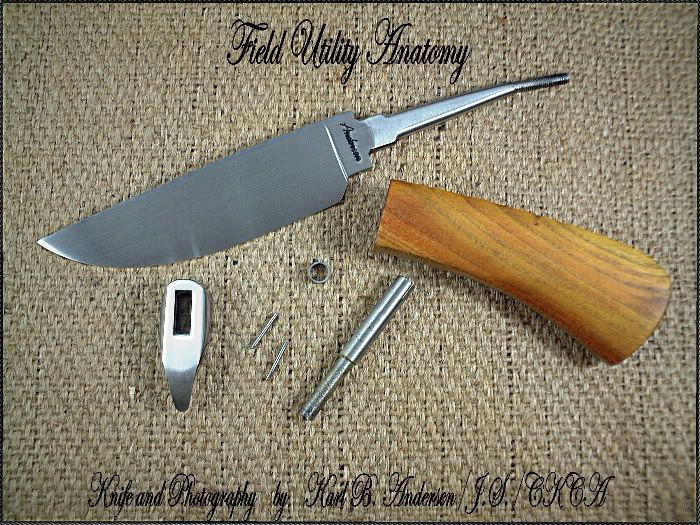
The blade was forged from 1 " square 5160 made in 1984.
The Osage was stabilized and cut from logs I acquired that were harvested in the mid-60s. I've had them for 15-16 years.
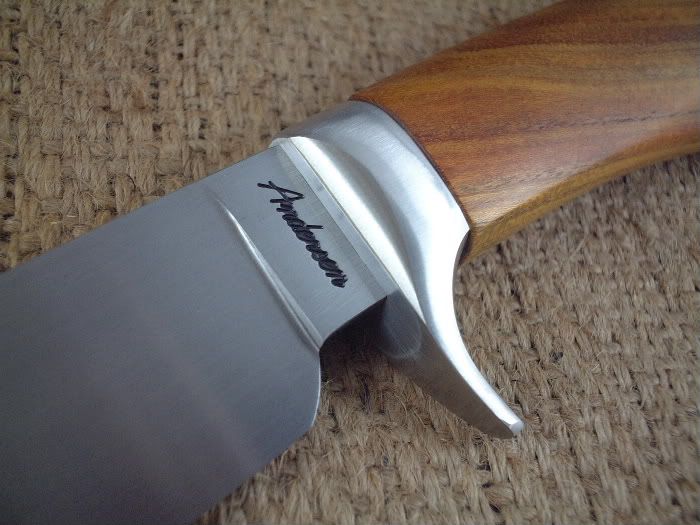
Stainless guard. (The light is playing some weird voodoo on the geometry there? Either that or my editing)
I wanted to show the full through-tang, and the handle pinned to the guard for lateral strength, as well as creative freedom during the construction, and the threaded finial.
What some folks never get to see is that 5/16" collar that the finial goes through.
That is seated in the bottom of the stepped hole so that throughout the construction of the knife, the "ledge" of the finial never grinds on wood, but is always metal-to-metal when assembled.
I go through such grain refinement and spherodizing steps on my steel, that when I seat the finial - again and again - I seat it with vise grips nearly as tight as I can do it by hand.
When I have to do a little bend in the tang, I literally have to put on my welding gloves, lock the tang in the vise and grab the blade and leeeeeeeaaaaaaaan backwards to get it to bend.
That 5160 is flat friggin' bad ass tough when treated correctly.
When the assembly is done, you can drive over one of these knives with your truck.
Just thought you guys might enjoy another picture here on this Sunday afternoon!
This is one of my "Field Grade" knives, but don't let the title fool you - it's built every bit as solid as any knife from Andersen Forge.
When this is done - tomorrow some time - I will do a final photo and a little history of the materials used.
The blade was forged from 1 " square 5160 made in 1984.
The Osage was stabilized and cut from logs I acquired that were harvested in the mid-60s. I've had them for 15-16 years.
Stainless guard. (The light is playing some weird voodoo on the geometry there? Either that or my editing)
I wanted to show the full through-tang, and the handle pinned to the guard for lateral strength, as well as creative freedom during the construction, and the threaded finial.
What some folks never get to see is that 5/16" collar that the finial goes through.
That is seated in the bottom of the stepped hole so that throughout the construction of the knife, the "ledge" of the finial never grinds on wood, but is always metal-to-metal when assembled.
I go through such grain refinement and spherodizing steps on my steel, that when I seat the finial - again and again - I seat it with vise grips nearly as tight as I can do it by hand.
When I have to do a little bend in the tang, I literally have to put on my welding gloves, lock the tang in the vise and grab the blade and leeeeeeeaaaaaaaan backwards to get it to bend.
That 5160 is flat friggin' bad ass tough when treated correctly.
When the assembly is done, you can drive over one of these knives with your truck.
Just thought you guys might enjoy another picture here on this Sunday afternoon!



 . My favorite of your knives so far. :thumbup:


