

- Joined
- Oct 29, 2006
- Messages
- 2,912
A short history of the steel.
A long time ago, I used to work in forestry. I saw most of this beautiful province I call home and one of the nicest places I worked was the Queen Charlotte Islands.. now called Haida Gwaii.
I was on a cut block one day and found the remnants of the repairs to what I believe was a skidder. If you don't know, that's like a loader but bigger and it's purpose is to drag logs to the landing. Anyway, there were bearings on the ground and I grabbed 4 of them. They were about 1 3/4" diameter so 4 were enough extra weight.
I had these in a box for about 10 years and used 3 of them in a woodworking project which eventually got scrapped and I still remember tossing the bearings thinking, on one hand, I should keep them but on the other, well after 10 years I really don't need to keep them.
So... 5 more years later and one left; this summer I found it again. Being a bearing I figure it would make a good knife, but also being a scrap from a cut block I don't really know what it's made of. Oh well, I thought, I will try 'cause if it holds an edge then it'll be worth it as a personal knife with a link to my own history.
So I forged it down to a billet by hand. It took a lot of work pounding this with a 5 lb hammer but I did get it there. Of course being a bearing I decided to try and better my Ed Fowler inspired design of before.
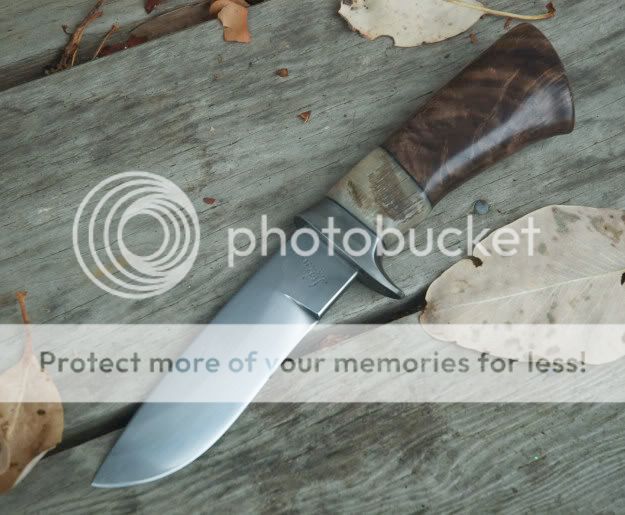
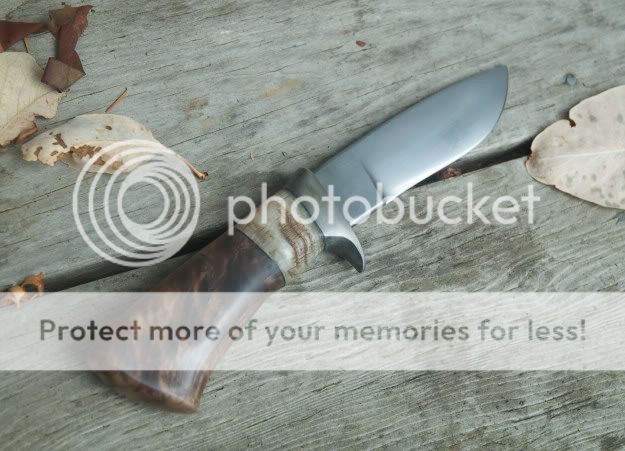
In that spirit I cut a piece of sheep horn to use as a spacer. I only had one horn and it would've only worked as a left handed handle so I opted to make a spacer. The walnut is a scrap from my present work and I thought the banding matched the horn well.
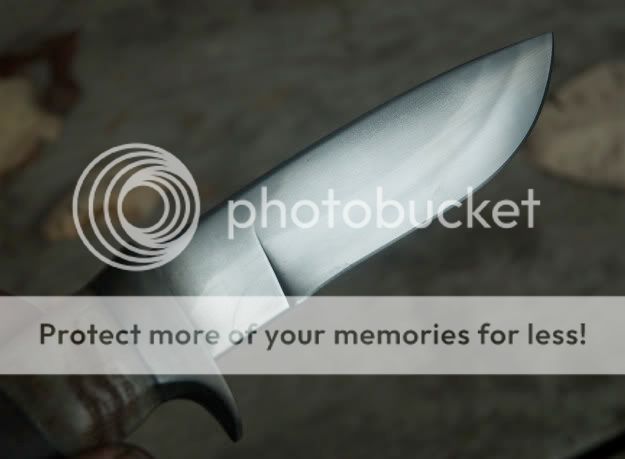
The blade is fully convex ground with a strong distal taper and a little over 3/16" at the guard. A stout and sturdy knife for sure.
The handle was designed with comfort in mind and though wide, suits my large hand very well. The blade is about 4 7/8" from ricasso to tip and the OAL is about 9 1/2".
The steel was forged and heat treated as closely as possible to the process in Ed's dvds. I pounded on the edge and sides only, triple heat treated and triple tempered.
You can see the banding in the blade.
Edge flex was very good with no chipping but flexed very well. Rope cut test I quit at just over 100 cuts with little effect to the edge.
Here's some pics.
Thanks for looking and thanks for reading.
-Stuart
A long time ago, I used to work in forestry. I saw most of this beautiful province I call home and one of the nicest places I worked was the Queen Charlotte Islands.. now called Haida Gwaii.
I was on a cut block one day and found the remnants of the repairs to what I believe was a skidder. If you don't know, that's like a loader but bigger and it's purpose is to drag logs to the landing. Anyway, there were bearings on the ground and I grabbed 4 of them. They were about 1 3/4" diameter so 4 were enough extra weight.
I had these in a box for about 10 years and used 3 of them in a woodworking project which eventually got scrapped and I still remember tossing the bearings thinking, on one hand, I should keep them but on the other, well after 10 years I really don't need to keep them.
So... 5 more years later and one left; this summer I found it again. Being a bearing I figure it would make a good knife, but also being a scrap from a cut block I don't really know what it's made of. Oh well, I thought, I will try 'cause if it holds an edge then it'll be worth it as a personal knife with a link to my own history.
So I forged it down to a billet by hand. It took a lot of work pounding this with a 5 lb hammer but I did get it there. Of course being a bearing I decided to try and better my Ed Fowler inspired design of before.
In that spirit I cut a piece of sheep horn to use as a spacer. I only had one horn and it would've only worked as a left handed handle so I opted to make a spacer. The walnut is a scrap from my present work and I thought the banding matched the horn well.
The blade is fully convex ground with a strong distal taper and a little over 3/16" at the guard. A stout and sturdy knife for sure.
The handle was designed with comfort in mind and though wide, suits my large hand very well. The blade is about 4 7/8" from ricasso to tip and the OAL is about 9 1/2".
The steel was forged and heat treated as closely as possible to the process in Ed's dvds. I pounded on the edge and sides only, triple heat treated and triple tempered.
You can see the banding in the blade.
Edge flex was very good with no chipping but flexed very well. Rope cut test I quit at just over 100 cuts with little effect to the edge.
Here's some pics.
Thanks for looking and thanks for reading.
-Stuart


