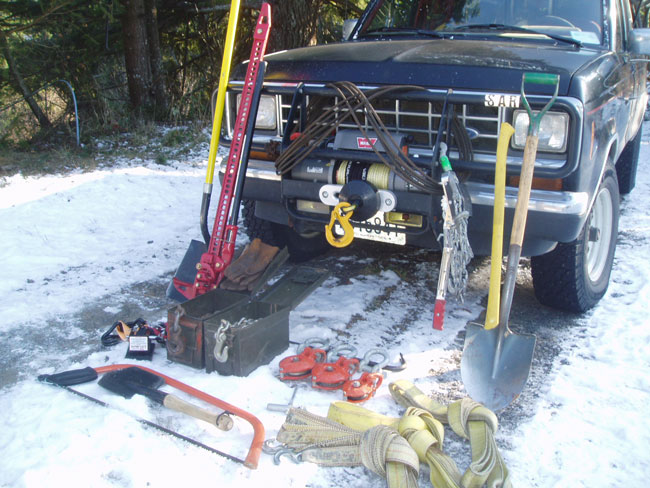
anti stuck in the mud tool

j_d

Joined
Jan 14, 2006
Messages
283
i was finially able to get out to the woods and do some camping last week. it had been a while and i was getting a little cabin fever. a short drive from the house i have access to 170 ac that used to be an old farm but is now all grown up. to make a long story short i was able to drive the 4x4 back in a ways and we set up a comfortable leanto camp in a stand of pines and settled in for the night. the ground was already fairly wet and it poured over night. no big deal, we stayed dry and being in a leanto in a thunderstorm is an experience. we had to leave the next morning and the ground was soupy. my tires are needing replaced but things were going well until i came to the first dip in the grown up pasture. it was now a small creek. i was able make it through but got stuck in the next one. it quickly became obvious that due to the soup and uphill trail on a curve i wasnt going anywhere. we grabbed what we needed and hiked to the road where we were picked up by a relative. i went back the next day with a buddy and his jeep and we spent some time plowing the trail. the jeep was great at getting its self around but only moved me a few feet before it slicked up the soup under it. after about 2 hrs of trying we figured it wasnt happening. plan b was get another relative with a tracked excavator back there to pull me out but he was out of town. plan c was a 6 ton come-along. it cost about $30 from a local home improvement place. i also used two tow straps. my brother and i spent a couple of hrs. hooking it to small trees (appx. 4 in. in diameter) and were able to get the truck out. one working the wench and the other driving the truck. we had to reposition the come-along about 5x's but as soon as we got the truck to the flat mud we were good to go. it was a learning experience. i was suprised how well even the small trees in wet soil worked as a tie off, i was afraid they might just uproot. i also learned that those tow straps have a lot of stretch in them. we lost about half of our possible forward progress just taking the stretch out of the straps. im going to try and get some cable and fashion some loops/hooks on it to get rid of the stretch. anyway im keeping the come-along in the truck and i believe any off road vehicle or bov should have one in it. you never know when you might need to self rescue/recover.
jd
 
lots of folks swear by a hi lift jack, they are a staple of the western off road folks, they are 48 or 60 inches, available in most farm stores and will not only pull your vehicle but lift your vehicle. a length of chain is a necesity in the out back, i have a choker made from some 5/16 cable that also has been very usefull for lifting, pulling things. keep a couple of tow chains about 50 feet, and a tow strap that will give you 75 feet of reach or so, get grab hooks on both ends of the chain and a couple of shackles to work with and you can get out of as lot of trouble.

alex
 
My high lift has saved my behind more than once,I don't go in the woods without it.Just be sure if your on public land that you have a strap or some padding for the cable when you go around the tree,most places frown on marking up the trees.:thumbup:
 
ive used a high lift to lift but never to pull. do you chain one end of the lift to a tree and the other to the vehicle to use it to pull? please explain how you pull with the lift.
jd
 
When we used to go out and about in my Pinzgauer and before that in my LandCruisers we carried handmade 'traction matts' and these worked quite well for the Pinzgauers especially. Many carry Tidy Cat cat litter or sand and gravel in bags.

What the traction matt is basically is a six or so foot long 12" wide device we used to built out of scrap wood and a single piece of 5/4 thick horse stall matt like sold in farm supply stores. These rubber matts were literally bolted to the boards. And the boards were put on in singles meaning you had a bunch of 12" x 6" or even 4" and 6" or anything inbetween in size and secured to the matt. The bolts used were long. We bought lag bolts in 5/8" diameter in galvanized and the 8" or longer ones so they would spike down into the snow, ice or mud and stick better. You also need a high lift jack with these matts and at least one good shovel.

What we did with the Pinzgauers was jack up whatever wheel we could access easiest. Since the Pinz had four wheel lockers you could get traction to all wheels and if you could get all four wheels stuck just getting traction to one wheel would be enough to pull you out so we'd select the wheel that seemed to be the best one and get down into it and lift it up far enough to get the matt under the tire. Then with the very end of the matt firmly under the tire we'd have six feet of drive to hopefully use the matt and the heads of the screws purposely stuck up at varying heights and we'd put the wheel down and make an attempt to drive. Usually the matt would slide a little so you don't gun it but you usually can get enough bite to pull it forward and if you are lucky you can get some momentum and make pretty good movement forward getting out of the bad spot. If not you still usually made some progress and then had to do it again or again and again depending on circumstances.

STR
 
I carry a hi-lift and a lug-all come a long...check out lug-all for high quallity come a longs.
 
thanks guys, thats some really good info. it had never occured to me to used a jack to pull.
jd
 
get on the horn and call for a SKYHOOK! :D

buddy of mine in the CDN Forces got a tank stuck in the mud during a training exercise. He was green at the time, so the Instructor had some fun with him. How do i get this tank out? buddy asked. Instructor: aw just radio in for a skyhook. Buddy gets on the radio and calls for a skyhook. 15 minutes later the mother of all lifting helicopters thump thump thumps onto the scen and drops a hook down. Buddy hooks up the tank and the chopper lifts it clear of the sticky mudhole. Chopper leaves and buddy drives on. About half an hour later the radio lights up with the base commander screaming at buddy. Apparently when you call for a skyhook it costs about $300,000 to get the special lifting chopper deployed..... :D:D:D:D:D

The instructor bought the base commander several rare bottles of whisky and steak dinners for a year. :D
 
My "Unstuck-kit" is a heavy duty come-a-long with a snatch block and log chains in an ammo can with a couple of extra hooks, cold-shuts, and clevis pins, both straight and twist. The chains are a twelve foot choker and a twenty foot tow chain. With this combo, I can get unstuck most of the time with no help. The come-a-long even doubled with the snatch block has a twelve foot pull. Rigged single line, it has a twentyfour foot pull, though not as much leverage (harder to crank). Most modern trucks don't have bumpers sturdy enough to lift the truck with a high-lift jack. The only problem with using a jack to pull a stuck truck is that it's max reach is about 48" and it requires a lot of resetting. I hate using cables because they tend to fray and cut my hands. And when they break, they are dangerous. A stretch strap is great to have though for towing and tugging if you have another vehicle to pull with. Just not for wenching.

Codger
 
I got a 'come along' hand winch that really saved my behind on several occasions also and it is preferred if there is a good tree handy to wrap a nylon logging strap around. I've purchased several of these from various places over the years and the best one I ever purchased came from CoolCruisers of Texas. http://www.coolcruisers.com/

http://coolfj40.stores.yahoo.net/wincom80heav.html

LandCruisers are some heavy vehicles. If the one they sell can pull one of those tubs out of the muck it should work for a large variety of other vehicles also. Sure enough when I got it everything about the hand winch they sell is heavier duty from the components to the double ratchet system to the thickess of both the frame and cable used to the bolt sizes in it. Its bigger looking and more quality built than some I have here that are rated the same.

Oh and by the way. Even if you don't want anything from these guys its worth browsing the site for all the pretty gals. These guys post some really cool calanders every year. You can't argue with their tastes in beauty much either. :D I still get those even though I have not had a LandCruiser for years.

STR
 
Looks like Cool Cruisers stopped selling it for some reason. Amazon has two left and a better price though. These are darn handy to have I can testify to that. I kid you not its paid for itself 40 times when I owned my Cruisers alone and although my Pinzgauer was harder to get stuck in the same terrain due to 14" min. ground clearance and four wheel lockers front and rear when I needed it I did manage to bury it a time or three and this come along or my traction matte and the other tools mentioned were all I ever needed. I've never owned a motorized winch on any four wheel drive I've ever had.

http://www.amazon.com/Hand-Winch-Double-Gear-Color/dp/B000CNIG92

Here are somemore. http://www.sunnytools.com/hand-puller.htm

STR
 
+1 for Hi-Lift...!

A valuable accessory for it is the Lift-Mate , lets you directly jack up the wheel, not the frame/bumper.
Makes putting on tire chains easy, among other things...

There's a winch on my Cascade Mt. Beater, and the steel cable has been replace with winch rope
- What a difference that makes (Steel cable has many problems, as previous posts have noted.)!!

RecoveryGear.jpg


That along with some winch line extentions, cable, chains, straps, a come-along, snatch-blocks and shackles
makes for a handy "Anti-Stuck-in-the-Mud (or snow, or...)" toolbox.

Mostly it about not getting stuck in the first place (not always an option) :D !!

Vary your sources, practice your methods.
 
There is an eastern and western way of four wheeling. Here in the east it is mud and snow and out west it is sand and rock. Usually when I was stuck in the mud a high-lift jack was not much use, even with a base board. The jack went up and sunk down about the same rate. Nylon tow straps (snatch straps as they were called) worked great as long as you had someone to tow you out. I once has to change a shear pin on my PTO wench while it was under muddy water. A nylon choker strap is also necessary to put around trees to make it easier to hook up.
 
I'm almost wholly ignorant of such things, but something in the original post caused me concern... if the "tow straps" being used were stretching that much, and one had let go, would that not have allowed the elasticity of the other strap to launch the come-along with a hell of a lot of force? This was my initial worry... then I did some googling, and the first site I found specified that "tow straps" aren't supposed to stretch much, whereas "recovery straps" do. (the former being polyester, perhaps, and the latter nylon) So now I'm confused about that.

I guess the point I was wanting to make is that any time you put that much energy into a system, make damn sure that the elastic material is the weakest link, and that if it lets go it won't turn anything attached to it into a projectile. Better yet for using a come-along, use non-elastic straps!
 
If you have a winch with steel wire, some wet hessian (burlap) draped over it will suck up the energy of a taut cable snapping. Back in the day, I saw an MLVW (M35) cab cut down the center of the windshield by a snapped cable. Anyone in the center seat would have been a mess. Check cables often, because the strands rust from the inside out. Apparently neither of these apply to synthetic, but I haven't used it to know personally.

For traction, I've got a couple expanded steel stair treads. Tie them to the bumper with some light line and you don't have to go back into the muck to retrieve them but the line will snap if they hang up as they're being dragged out.

Like everything else we do outdoors, practice makes perfect...Hooking up with your local 4X4 club is a great way to learn, plus that's typically the only way to find decent trails to run thanks to the land use debate (at least here).

I didn't know that about tow vs recovery straps, but it makes sense. Some straps appear to have more 'bounce' than others. Thx
 
My Warn winch keeps my lil' YJ and I out out alot of trouble, along with a Handi-man jack, and a real shovel. (none of them little camp shovels for me when the Jeeps handling the extra wieght, thank you very much!)

Rigging is one of those things that are kinda like drill bits....you'll never regret having too much of it. My biggest pet peeve when it comes to rigging is safety, safety, safety. It's scary how much folks get by with poor rigging techniques and products.

Here's an example: we all run off and get winches on our trucks, which is fine and dandy. but the hook on the end of it is downright dangerous., and usually have about a one ton rating. why they put one ton hooks, often without safety latches on the ends of 8-9K lb rated winches I'll never know. Do yerself a favor and immediately replace forementioned hook with at least a 2.5 ton hook, and or a decent 7/8- 1" shackle. It's much safer to use a little 3'x2" choker and a shackle than most hooks out there.

Go to an industrial supply place (or a darn good hardware store) for your rigging. There's alot more to be said for the 20,000 lb plus rated lifting slings available than the Mickey Mouse unstuck kits available at Wal-Mart, Schmucks, etc. For Goodness sake, spend the extra money on the good stuff. Not to be too dramatic, but people get dead real quick when these things break.

While on that topic: Buy American when buying your rigging. This isn't a statement of chest thumping jingoism, but rather one of practicality and safety. BP and Conoco Phillips have both eleminated chinese rigging from the entire North Slope due to an extraordinary amount of breakage, and the related safety concerns brought forth, especially in cold weather. a real quick way to tell if the manufacturers orignin is not in plain sight is that the lettering will usually be embossed on quality US made products, and stamped in on the inferior imported stuff.

Once you buy the best snatchblocks, cables, shackles, slings, etc. you need to examine it before every use. Any cuts, frays, or red thread showing means to throw said sling away, or cut it up and use it as a softener. Metal should be likewise tossed when signs of wear, tear, anf fatigue become apparent.

While on the topic of softeners...carry plenty...use them in copious quantity.

and whatever you do...never, never, never hook onto a ball style trailer hitch, no matter which end you're on. Here in Alaska (where we've ALL gotten stuck a time or two and should know better!) it's scary how many people want to hook up to a ball hitch. They have a real bad tendency to snap off under load and become deadly projectiles. a 2" steel projectile is a decidedly bad thing under such circumstances. If you happen to have a reciever hitch these are a real good idea:

http://www.quadratec.com/products/warn/92121_00.htm

I'll hush up now, and save the rest for some other time :D Many apologies if I come across as being too preachy, or redundant. It's just that most off road recovery situations I've come across have left alot to be desired as far as safety goes, and I hate the thought of folks getting badly injured or celestially challenged while havin' fun out there.
 
Back
Top