I straighten Red Deer antler regularly. It's definitely a labor intensive endeavour - a mixture of art and science. Like Javan, I studied all the old information I could find..... the basics are there. Working with antler and horn is just like every other artisanal skill - the more you do it, the more you learn, the better you get, and the more you understand the material and what it is you read about. The Sheffield horn workers were processing tons of antlers. Individual horn workers spent whole lifetimes cutting, boiling and straightening horn and antlers.
Here in Yucatan Mexico, there are three types of deer antler available - Red Deer, White Tail Deer and the tiny Yucatecan Deer, which has been hunted almost to extinction. Deer meat has been a Mayan staple for thousands of years, and is enjoyed today in traditional dishes like Dzik de Venado. Out in the pueblos, local men still hunt for the Yucatecan deer – usually at night, with a flashlight and an ancient, small caliber single-shot rifle. The antlers are very, very small, single spikes. Though, like the Sambar stag’s, they’re very hard, with almost no pith. Friends of friends occasionally bring me the antlers, usually still attached to a section of the skull. Working very carefully, I can sometimes get a single set of scales from a pair of antlers – enough for one very small knife.
Mostly I work with the antlers of Red Deer (Cervus elaphus) raised on a government ranch in Tzucacab, two hours south of Merida. Twenty years ago a herd of a thousand red deer were imported from New Zealand and distributed around the country, where they have thrived. The ranched meat takes some of the pressure off of the local deer (although most of the local deer are taken by subsistence hunters who can’t afford to buy the ranch raised meat anyway). Ranch workers collect and sell the horns. The skins are tanned and sold as well.
The Red Deer antlers present many challenges – they have a lot of pith and they grow in twists and curves. At first I had a lot of waste – trying to cut straight pieces out of the curves. Most pieces were either too thick in the center, or too thick at the ends, so I lost a lot of the antlers surface texture while trying to even out the thickness by grinding alone.
But, by studying how the old Sheffield horn workers manipulated antler, I’ve learned how to process them more efficiently, and get more beautiful handles. 19th century cutlers often hafted their exhibition knives with stag horn from the European Red Deer – the same species being raised in Yucatan.
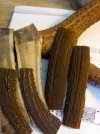
To better utilize the antler, I first cut it in sections, then split it with the curve, parallel to the outer surface, and then grind away most of the porous pith from the inside. I’m left with thin, twisted and curved pieces, each of uniform thickness – some curving inwards, some outwards, some in both directions. I put them into a kettle of boiling water for a couple of hours to soften. Then I take them out, twist and bend them straight, and clamp them between boards to stay flat while they dry; then thin and flatten them further, working from the back, until they’re of the correct dimensions. I often repeat this process several times, continually thinning, boiling, twisting and bending. I’m sure the very skilled and efficient Sheffield horn workers were able to attain the same results with a single boil, straighten and dry process, in a fraction of the time it takes me.
An additional refinement in the processing of the Red Deer antlers came with Logwood (Haematoxylum campechianum). The Spanish first cut the Logwood trees of Campeche (to the west of Yucatan) in the 16th century and sent the wood by ship back to Europe, where it was used in dyes for fabric and in inks and paints. The Sheffield horn and bone workers used it, too. They added Logwood chips to the boiling water used to soften the antlers for straightening. The natural pigments from the wood darkened the otherwise pale Red Deer antlers. Now I do the same. Today, though, in Campeche, Logwood is very difficult to find, as the Spanish, and later the Mexicans, cut it almost to extinction. Fortunately it also still grows in Central America and on some Caribbean islands, where it was introduced. I planted a Logwood tree a few years ago to replace what I've used.
I recently tried processing some Sambar Stag the same way. I split the stag rolls lengthwise in thirds; thinned, boiled and pressed. The process worked the same as Red Deer, although the Sambar is noticeably denser and harder and more resistant to force. Like the Red Deer, the thinner the material the easier to bend.
You can see on the best quality old Sheffield folding knives, just how thin the horn scales were that they worked with. The cutlers had the “luxury” of working with what seemed at the time to be an unlimited supply of large old antlers, prepared for them by very skilled horn workers.
Saludos
J
JDWARE KNIVES
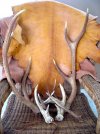
Before ( the large antlers are Red Deer) :
View attachment 887441
View attachment 887450
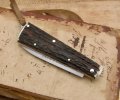
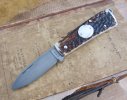
After:
View attachment 887442
View attachment 887443