Stone is and imperial weight unit. It is still used to some degree in the Commonwealth nations, but has pretty much been replaced by metric. One stone is about 14 pounds . Eight stone makes a hundred weight. In days past, there was a standard stone set kept in most towns that was tested against the royal unit stone set ,kept in London ( and other places). A town's stones could be easily checked, and twenty-seven pounds was not an unreasonable weight to transport about. A weight set of standards consisted of :
1-stone
1- half stone
1 - three pounder
1 - two pounder
1 - one pounder
With this set of standards any weight up to "one stone-thirteen" ( 27#) could be accurately weighed. Heavier weights could be made up by multiples of the stone standard.
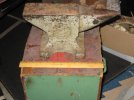
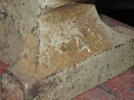
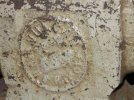
Most Anvils were marked in this way:
Hundred weight - quarter hundredweight- pounds
Hundredweight = 112 pounds
quarter hundredweight = 28 pounds
pound = one pound
. Thus 3-3-7 = 427 pounds (336+84+7 )
Smaller anvils were marked in stone and pounds, often just in stone.
Thus 4-3 = 59 pounds ( 4X14 + 3 = 59) ,or, 4 = 56 pounds ( 4X14=56)
Once in a while you will see one marked with four numbers. This is hundred weight- quarter weight-stone-pound. This is not common.
The reason for marking anvils the way they did was the weights used to measure the anvil on a large balance beam scale. A weight set would be :
3 - hundredweight weights
3 - quarter hundredweight weights
1 - stone weight weight
1 - half-stone weight
1 - three pound weight
1 - two pound weight
1 - one pound weight
This would weigh an anvil up to 447 pounds. All the weights could be moved to the balance by hand.
You would mark the big weights as they were counted and add up the small weights in you head. Calculators were not available, and fingers and toes stopped at twenty,so there was seldom any marking higher than twenty used for the final number ( even if it was actually between 21 and 27). Often the last number is only a single digit ( which meant the weigher didn't need to take his shoes off). Counting/adding to ten was easy, but most people could not add up totals in the hundreds accurately ( if at all) so the 3-3-7 system worked well.
Sadly, with the reliance on calculators and computers today, the average sales clerk can't add up the total , or make change, any better than the illiterate smith's apprentice five hundred years ago could. I can't tell you how many times I have handed the clerk six cents in coin after they have already entered the twenty dollar bill I handed them for a $16.06 sale and they had no idea what to give me because the register says :"Change Due - $3.94".
Don't even get me started on how confusing the old British monetary system was. Suffice to say that it was derived for the same reasons as anvil marking, using, pounds-shillings-pence, For example, 327 pence ( today 3.27), was: one, seven, and threepence.
Stacy Elliott Apelt, FSA,Scot