Any of you guys using a router to round over your scales? I need some advice.

Joined
Dec 5, 2009
Messages
1,528
I know there are several makers out there who use a router to round over their scales. In fact, I recently watched a youtube video on the subject but can't remember who the maker was off the top of my head. Those of you who do, I have a couple questions.

First, how do you decide what size roundover bit you need to do the job properly? Do you base the bit size on the scale thickness?

Second, will changing the pilot bearing on the bits to different sizes give you different results?

I really like the symmetrical and very clean look that using a router will give you, I would just like to know the proper way to get there.

Thanks folks!

Craig Collier
 
First, how do you decide what size roundover bit you need to do the job properly? Do you base the bit size on the scale thickness?

Second, will changing the pilot bearing on the bits to different sizes give you different results?
Craig Collier

My input as a trim carpenter not a bladesmith is bits are sized by radius. Changing the bearing will either produce an indented flat cut or larger will offset the radius and you will get a sharper transition on one surface. I would use roundovers with flush bearings as they come but too large of a radius on a thin scale and your wood wont ride on the bearing causing disaster to your scale when it digs in. Use a practice piece of the same thickness first.
 
From the video, the scales are done 1 at a time and the knife tang is what rides against the bearing. I was thinking the roundover bit size was in reference to the stock size used, ie: a 1/4" roundover bit would make a perfect radius on 1/4" stock.
 
On the rare occasion that I do use a router for scales, I typically match the router bit's radius to the thickness of the scale.

As for the bearing, I make sue it's flush with the corner of the bit, and i'll either let it ride on the tang of the blade after the scales have been attached, or I'll use pins or double sided tape to hole the scales together, letting the bearing ride on the upper scale while the lower is being cut. Keep in mind that if you do it this way, you may need to lower the bit so that you're not cutting the full radius. Otherwise, you'll tend to "snipe" the second scale when you flip them over, as the bearing is no longer riding on the flat edge of a scale, but on a radius.
 
The type of bit used for this is called a "quarter round" or "round over" bit.

http://www.amanatool.com/bits-fv/49492.html

That should take you directly to the quarter round bits that Amana makes. These are expensive bits, normally used by professionals. This is the only maker I know of that makes round over bits in sizes between 1/8" and 1/4".

Freud also makes good bits, and here is a link to their set of three round over/bead bits. http://www.rockler.com/product.cfm?page=10328&rrt=1

As you can see, putting a smaller bearing on a quarter round bit turns it into a bead bit. You probably wouldn't ever use a bead bit on handles.

The only sizes I use are 1/8 and 3/16" radius bits on knife handles.

I use a kind of mini-router called a "laminate trimmer". You can easily hold the laminate trimmer in one hand, and the handle in the other.

Yes, a 1/4" radius bit does make a perfectly rounded profile on 1/4" thick material, but there isn't anything for the bearing to ride against, so you would normally use a router table with a fence to accomplish this.

I think it's better to use a smaller bit than the thickness of your handle material, because it's best to keep some flat area on the spine and edge sides of the handle.

It's also easier to use, and a very light sanding is all that is needed to blend the radius into the flat.
 
Last edited:
Thanks. I found a small router/laminate trimmer at HF for under $30, it's received very good reviews considering it's a HF power tool. Thinking about getting it and a set of roundover bits, Skil makes some carbide tipped roundovers that Lowe's sells. A 3 pack of 1/4, 3/8 and 1/2. For 1/8, they sell a single bit.
 
grizzled gizzard posted good info. I have a couple of Freud's and I had to experiment for the right size, but I think 3/16" was the one I like. I prefer a table versus holding a scale in one hand and a router in another, so I made one that works nicely for knives. I don't know if you want to make a table, but it cost me about $20 in materials and you need a plunge router, I think it is a safer option for an un-safe operation. I don't know if it's true, but when I was a kid I was told routers are among the most dangerous wood-working tools. I treat them as though they are. Table saws have to be up there as well...

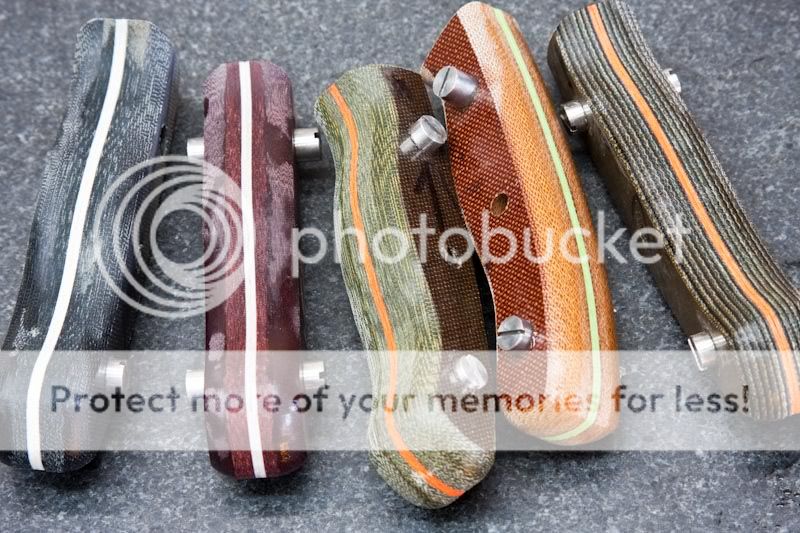
Here is the table with a Micarta top and closet rod uprights. Also, are some scales I practiced on. These particular scales did not need to be routed as I was going to hand shape them anyway, but it gave me experience for some textured G-10 I will be using. You definitely want to test on scrap with whatever you use.

IMG_2000.jpg

IMG_2001.jpg

IMG_2003.jpg
 
Back
Top