
-
The BladeForums.com 2024 Traditional Knife is available! Price is $250 ea (shipped within CONUS).
Order here: https://www.bladeforums.com/help/2024-traditional/
You are using an out of date browser. It may not display this or other websites correctly.
You should upgrade or use an alternative browser.
You should upgrade or use an alternative browser.
Anyone carry a GEC Cotton Sampler?
- Thread starter akadave2
- Start date

arizonaranchman
Gold Member
- Joined
- Jan 1, 2012
- Messages
- 4,422
Definitely the most unique of all the blades GEC offers. I'm interested in following this thread...

- Joined
- Jun 10, 2011
- Messages
- 242
I own one and have used it regularly for some time. It is very well beat up now ha, I'll take some cell pics.
My personal opinion: This is an excellent knife. I am a sucker for cotton samplers. Love em all!! Other than horseman's knives, this is my favorite pattern. I did however grind down the top of the swedge to be more curved, then re-ground the backside bevel to point. I also convexed it, and then satin finished the blade after I got it, its pretty beat up now tho.
To be totally honest, I just love the way this pattern looks. I don't ever choke up on the edge, not even totally sure if thats what the flattened ricasso area is even for. But I Love em!
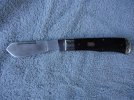
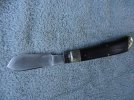
Take care - Casey
My personal opinion: This is an excellent knife. I am a sucker for cotton samplers. Love em all!! Other than horseman's knives, this is my favorite pattern. I did however grind down the top of the swedge to be more curved, then re-ground the backside bevel to point. I also convexed it, and then satin finished the blade after I got it, its pretty beat up now tho.
To be totally honest, I just love the way this pattern looks. I don't ever choke up on the edge, not even totally sure if thats what the flattened ricasso area is even for. But I Love em!
Take care - Casey


- Joined
- Mar 1, 2012
- Messages
- 2,554
I've handled these before and think they're purty kewl. Bob from old hundred suggested it would make a fine skinner. I'd have to agree.
The ebony version with the brass/gold accents is stunning in person. Too nice to use stunning.
The ebony version with the brass/gold accents is stunning in person. Too nice to use stunning.
- Joined
- Oct 8, 2006
- Messages
- 2,097
Fair warning, Ive never sampled cotton in my life. As best I understand, this is how it works.
Stab your knife into a bale of cotton. Use the broad tip to scoop out a sample. Trap your sample between thumb and ricasso. Pull the cotton as though you were spinning it. The way the sample stretches, and the number of times you can wrap it around the ricasso, tell you about the quality of the bale.
Stab your knife into a bale of cotton. Use the broad tip to scoop out a sample. Trap your sample between thumb and ricasso. Pull the cotton as though you were spinning it. The way the sample stretches, and the number of times you can wrap it around the ricasso, tell you about the quality of the bale.

bonky
Gold Member
- Joined
- Jul 1, 2009
- Messages
- 1,004
Fair warning, I’ve never sampled cotton in my life. As best I understand, this is how it works.
Stab your knife into a bale of cotton. Use the broad tip to scoop out a sample. Trap your sample between thumb and ricasso. Pull the cotton as though you were spinning it. The way the sample stretches, and the number of times you can wrap it around the ricasso, tell you about the quality of the bale.
My experience with sampling is nill, although as a kid I had some limited experience with producing and selling it. Cotton was already on it's way out as a big crop when I was in my early teens, but I did get in on a few crops and learned how it is grown in the US. The hard part is growing it.
The fun part, for me, was harvesting it. Before I was old enough to be trusted with operating heavy machinery, I was paid to "tromp cotton" in the cotton trailer. The cotton is dumped from the cotton-picker into a trailer with tall meshwork sides (about 6~8 feet high) and my job was to jump around in it to compact it as tightly as possible before the next load was dumped. I'm sure I wasn't the first or last kid who thought that was the best paying gig ever, for the first day or two anyway

The filled trailers were taken to the cotton-gin, where the raw cotton was cleaned and compacted into bales. It was baled twice: into "rough bales", and then later into "finished bales". The difference between the two was the degree to which it had been cleaned, and more importantly, to which it had been compacted. The rough bales weighed about as much as the finished, but took up not quite twice as much space. A finished bale is roughly 2.5 feet wide and high, and around 4.5 feet long, weighing in at 500 lbs or more. It's compacted to nearly thirty pounds per cubic foot, and believe me, that's pretty darned tight.
I never saw any sampling take place, but as a kid my interests were on other things at the time. However, I did run around with friends in the warehouse where the bales were stored, and can tell you from experience that cutting into a rough bale was a daunting task. Like attempting to stab baled, compacted cardboard, it took a lot of effort and multiple attempts to get a knife worked into it, and once we did, it was hard to pull any of it out.
I can't imagine how anyone could sample a finished baled without power tools. That cotton was so tight, it was comparable to mdf (slight exaggeration for effect
 ). Farmers before the advent of modern machinery were definitely made of stern stuff, and this is just one example that might show it.


- Joined
- Jun 21, 2008
- Messages
- 7,923
I gifted one to a friend. He carries it daily. Seems to be the perfect size for EDC. The blade has more than enough belly for hunting/skinning. I bought it for him simply because it's a unique knife for an extraordinary software dev.
Oooh Im a software Dev!!! Lets be friends! Lol! Great story and great friend!

JB in SC
Gold Member
- Joined
- May 19, 2001
- Messages
- 5,273
Maybe bales weren't as tight as they are now. Now days, samples must be obtained fairly deep from the bale to avoid contamination. I never spent much time in the cotton lab when I was working in the mill, but the bale was sampled prior to the opening process. It's an old pattern for sure, fixed and folders were made. I just don't see staple length being checked at the bale, more likely used to obtain a sample to be tested (there are many tests used in grading cotton).
I remember seeing hawksbill type fixed blades hanging near scales at a local gin back in the fifties. This same question came up few years ago and I thought what I saw may have been samplers. But I now doubt they were used for actual sampling, as sampling has been done mechanically for many years. I worked in the textile business for 35 years and had never heard of one until the Case-Bose collaboration was introduced.
I remember seeing hawksbill type fixed blades hanging near scales at a local gin back in the fifties. This same question came up few years ago and I thought what I saw may have been samplers. But I now doubt they were used for actual sampling, as sampling has been done mechanically for many years. I worked in the textile business for 35 years and had never heard of one until the Case-Bose collaboration was introduced.

- Joined
- Oct 8, 2006
- Messages
- 2,097
I stumbled onto a 1960 USDA document, Mechanical Sampling of Cotton. http://archive.org/stream/mechanicalsampli412coop/mechanicalsampli412coop_djvu.txt The summary begins:
DURING THE PAST 5 YEARS MECHANICAL DEVICES FOR SAMPLING COTTON BALES DURING GINNING HAVE BEEN INSTALLED IN APPROXIMATELY 153 UNITED STATES GINS. OVER 90 PERCENT OF THE MECHANICAL SAMPLERS ARE IN TEXAS AND CALIFORNIA. ABOUT TWO-THIRDS OF THEM WERE INSTALLED DURING 1959 . NEARLY THREE-FOURTHS OF THE TOTAL ARE IN LARGE-VOLUME GINS OWNED COOPERATIVELY BY FARMERS.
THE MECHANICAL METHOD OF SAMPLING, ORIGINALLY DEVELOPED BY RESEARCHERS OF THE U. S. DEPARTMENT OF AGRICULTURE, WAS DESIGNED PRIMARILY TO OVERCOME THE MAIN SHORTCOMINGS OF THE CONVENTIONAL METHOD OF CUTTING THE BALE. THESE SHORTCOMINGS ARE THE LIMITED PROPORTION OF THE INDIVIDUAL BALE REPRESENTED BY CUT SAMPLES, THE RAGGED APPEARANCE AND SURFACE CONTAMINATION OF THE BALES, AND OTHER DISADVANTAGES ATTRIBUTABLE TO CUTTING HOLES IN TWO SIDES OF THE BALE.
I learned two things from this:
Mechanical sampling is recent. It only got going in the 1950s.
Hand sampling involved cutting two plugs of cotton out of a given bale.
A cotton sampler knife seems well designed for that.
DURING THE PAST 5 YEARS MECHANICAL DEVICES FOR SAMPLING COTTON BALES DURING GINNING HAVE BEEN INSTALLED IN APPROXIMATELY 153 UNITED STATES GINS. OVER 90 PERCENT OF THE MECHANICAL SAMPLERS ARE IN TEXAS AND CALIFORNIA. ABOUT TWO-THIRDS OF THEM WERE INSTALLED DURING 1959 . NEARLY THREE-FOURTHS OF THE TOTAL ARE IN LARGE-VOLUME GINS OWNED COOPERATIVELY BY FARMERS.
THE MECHANICAL METHOD OF SAMPLING, ORIGINALLY DEVELOPED BY RESEARCHERS OF THE U. S. DEPARTMENT OF AGRICULTURE, WAS DESIGNED PRIMARILY TO OVERCOME THE MAIN SHORTCOMINGS OF THE CONVENTIONAL METHOD OF CUTTING THE BALE. THESE SHORTCOMINGS ARE THE LIMITED PROPORTION OF THE INDIVIDUAL BALE REPRESENTED BY CUT SAMPLES, THE RAGGED APPEARANCE AND SURFACE CONTAMINATION OF THE BALES, AND OTHER DISADVANTAGES ATTRIBUTABLE TO CUTTING HOLES IN TWO SIDES OF THE BALE.
I learned two things from this:
Mechanical sampling is recent. It only got going in the 1950s.
Hand sampling involved cutting two plugs of cotton out of a given bale.
A cotton sampler knife seems well designed for that.