Anyone else notice CRK glass blast differences or inconsistencies?

coolhand68

Gold Member
Joined
Mar 12, 2006
Messages
1,381
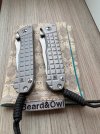
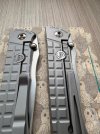
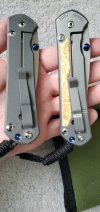
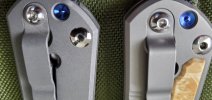
I have two identical Zaans that are both glass blasted. One from May ‘25 the other from Oct ‘25. The one on the left has a darker and duller finish, while the one on the right is brighter and glossier. I’ve noticed these sample differences among other examples online as well. The difference doesn’t show up as well in photos but is very noticeable in hand. Not a big deal but I do prefer the finish on the right.

IMG_6711.jpegIMG_6712.jpeg
 
I have nothing useful to add, but I will say that the difference is definitely noticeable in your photos.

I’m not a knifemaker and don’t even know much more than the average Joe about knifemaking, but I wonder if the difference might have to do with the media used to do the blasting. Like, if you use this brand or this type you get this finish, but if you use another brand/type you get a different finish. Pure speculation on my part. 🤷‍♂️
 
I have nothing useful to add, but I will say that the difference is definitely noticeable in your photos.

I’m not a knifemaker and don’t even know much more than the average Joe about knifemaking, but I wonder if the difference might have to do with the media used to do the blasting. Like, if you use this brand or this type you get this finish, but if you use another brand/type you get a different finish. Pure speculation on my part. 🤷‍♂️
I don't have anything to add to this thread but just wanted to say that I love your avatar. 👍🏼😎
 
The blasting media will 100% affect the appearance of the finished item. The finer the media the smoother the finish. Do you have one that you know was sandblasted to compare?
 
I prefer the one on the left myself.

Wish somebody offered this service, I've got a couple stainless handles I'd like to add some grip too.
 
The OPS comparison photos are very good at showing comparative results.

I worked for twenty years in a high precision aerospace machining and grinding shop. We had two glass bead blast cabinets that were used regularly to remove heat treat discoloration and/or clean-up surface finishes to meet blueprint requirements. My experience using them taught me that the factors that impact the resulting look are:

1) Starting surface finish
2) Nozzle size of the blaster
3) Distance of the part from the blaster nozzle
4) Time duration under the blaster
5) Condition of the blast media

Glass bead blasting is best used to lightly remove discoloration and/or knock the shine off of a fine surface finish. It is not meant for aggressive material removal like media such as aluminum oxide. If I wanted to achieve results like the softer / brighter knife on the right, I would make sure that the starting surface finish was very smooth, use a smaller nozzle, keep more distance from the nozzle, and minimize the time under the nozzle to reach the softer finish and stop. Conversely, if I wanted the more aggressive darker non-reflective finish, I would use a larger nozzle, hold the part closer, and blast it for longer.

That’s my experience for what it is worth.

Phil
 
Last edited:
The OPS comparison photos are very good at showing comparative results.

I worked for twenty years in a high precision aerospace machining and grinding shop. We had two glass bead blast cabinets that were used regularly to remove heat treat discoloration and/or clean-up surface finishes to meet blueprint requirements. My experience using them taught me that the factors that impact the resulting look are:

1) Starting surface finish
2) Nozzle size of the blaster
3) Distance of the part from the blaster nozzle
4) Time duration under the blaster
5) Condition of the blast media

Glass bead blasting is best used to lightly remove discoloration and/or knock the shine off of a fine surface finish. It is not meant for aggressive material removal but like media such as aluminum oxide. If I wanted to achieve results like the softer / brighter knife on the right, I would make sure that the starting surface finish was very smooth, use a smaller nozzle, keep more distance from the nozzle, and minimize the time under the nozzle to reach the softer finish and stop. Conversely, if I wanted the more aggressive darker non-reflective finish, I would use a larger nozzle, hold the part closer, and blast it for longer.

That’s my experience for what it worth.

Phil

Thank you for explaining this, makes sense now.
 
I don't have anything to add to this thread but just wanted to say that I love your avatar. 👍🏼😎
Thanks! I wish I could take credit for creating it, but it’s just something I pulled off the internet. It 100% represents “my brand” though: black cats and knives are my only real “hobbies.” I currently have three of the former and dozens of the latter.
 
Thanks! I wish I could take credit for creating it, but it’s just something I pulled off the internet. It 100% represents “my brand” though: black cats and knives are my only real “hobbies.” I currently have three of the former and dozens of the latter.

Show a pic of your inkblots!
 
I think CRK uses glass shard for blasting compared to bead.

I have glass beaded my Inkosi and the finish is WAY brighter than what CRK puts out with their glass.

I could be wrong.
 
I think CRK uses glass shard for blasting compared to bead.

I have glass beaded my Inkosi and the finish is WAY brighter than what CRK puts out with their glass.

I could be wrong.
Thats where the freshness of the media comes into play, glass beads break down into glass shards and become more aggressive...especially if you run the pressure too high. That's why Zirblast is so nice, the little zirconium oxide spheres are almost impossible to shatter so the finish they leave doesn't change over time.
 
Thats where the freshness of the media comes into play, glass beads break down into glass shards and become more aggressive...especially if you run the pressure too high. That's why Zirblast is so nice, the little zirconium oxide spheres are almost impossible to shatter so the finish they leave doesn't change over time.
There is a lot of variables on top of this, mesh size, air pressure, distance, travel speed.

We change our media weekly.

Glass bead I don’t blast above 60 psi and I use glass with an equivalent grit size to 240grit.
 
Some could have been wiped down with WD-40, while others weren't. I don't know if they still do that.

When I got a glass-blasted knife back from the spa, the handles were completely dry, appeared light, and picked up fingerprints easily.

I wiped it down with WD-40, which darkened it more to my liking while also allowing fingerprints to blend in.
 
Back
Top