AO failure? Anyone experienced one?

Joined
Jan 31, 2009
Messages
3,292
Hey all

When talking about storing folders some people are in favour of storing AO's in a opened position thus avoiding any unnecessary tension on the torsion bar. The logic behind this being that the torsion bar will keep its "spring".

I can see the point in this but has anyone in real-life experienced that their AO's have lost some of their assist? I mean maybe after some years the torsion bar wouldnt push the blade entirely out, or maybe there wasnt enough power for the lock to fully engage or any other problem that might have been caused by having the folder in stored in a closed position?

I cant see the point in buying an AO folder if they require special long-term storage. Are people being too cautious or are there examples of failures/ loss of assist?

Regards and thanks in advance for your input.
 
The Springs on my Buck Rush wore out kinda quick. I traded that one off though. Torsion bars should be more resilient then the coil springs anyways.
 
Ideally, AO knives, as well as autos, should function properly for a long time, though at some point, they will give up the ghost. Torsion bars, coil springs, and of course omega springs (Axis lock/Arc lock/Ultra lock) will all eventually fail. How quickly they fail seems to depend on proper heat treat of the original part, lubrication and maintenance, and the number of opening/closings. From what I've read and experienced, torsion bars seem to go out first, next would be omega springs, and last would be coil springs. It's one of the reasons I now avoid Axis type locks, autos and AOs.

Regards,
3G
 
If the knife and spring are well-designed, the forces should be well below any yield strengths and the spring should be able to undergo many thousands of cycles before any significant changes. I doubt that storing such a knife in the open position would help at all.

A coil spring might exhibit less deformation per length of steel than a torsion bar or leaf spring used for a similar purpose, but the torsion bar might be thicker- it all depends on the design.
 
An assisted opener of good design and reasonable quality should not need any special storage requirements. I would treat them just as I would treat any other knife; keep them free from moisture and sufficiently oiled (and sharp, of course!). Under normal conditions, I don't believe that you will wear out the mechanism simply by storing the knife either open or closed.

It has been my experience that assisted openers do wear out with USE (ie opening and closing the knife). Over the course of perhaps six months I wore out three assisted openers (2 Sogs, 1 Kershaw). I am not condemning either of those brands. Each knife that wore out was a quality knife; I just play with some of my knives a lot :o (while watching TV, surfing bladeforums, etc.) So if you are the type to constantly flick open and close your knives, an assisted opener may not be the knife for you. Cheers.
 
Last edited:
I have a few AOs in my collection but do not bother to store them that way. The torsion bars can break eventually as well although even my most heavily used one has not. It does not appear to have slowed as far as opening comparing it to the exact same knife I have stored as backup. All very scientific, I know. ;)

In any case, fixing one involves contacting the manufacturer for a replacement torsion bar (with my current collection all free of charge) and the removal and reinstallation of a handle scale and broken bar. New bar goes in pretty easy and the the scale is replaced. I know this only from pimping one of them.

If that is not something someone wants in their life then there is a chance that at least some AO's are not a good choice for them. From my limited experience it is not something that happens often with the particular models I own. More of that hard science. :p
 
I own and use quite a few AO knives from Kershaw and the ZT line which use the Speed Safe Torsion bar system, I have always stored them with the blade closed and have noticed no "loss of assist" in any of them. With Kershaw's excellent warranty and customer service a broken torsion bar is really no big deal.
 
Keeping them stored closed should be no problem. All Auto, AO, or any type of spring mechanism folding knife may be stored closed NIB for years before they are sold. I have bought Kershaw AO knives that were NIB on the shelf for 4 years before being used with no problem. All of the manufacturers are aware of this and build accordingly. But even with that being true I store all of my EDC knives, Auto, AO and non-assisted, open in a knife block made to accommodate folders.
 
Thanks alot for your replies. Now forgive me if my following question is stupid but bear in my mind i havent seen the insides of an AO'er.

I thought the torsion bar was an integrated part, something that couldnt be replaced. Now if the torsion bar breaks or is removed are you still able to use the thumbstud/flipper/etc to open the knife? Will it still open as a regular folder?
 
Thanks alot for your replies. Now forgive me if my following question is stupid but bear in my mind i havent seen the insides of an AO'er.

I thought the torsion bar was an integrated part, something that couldnt be replaced. Now if the torsion bar breaks or is removed are you still able to use the thumbstud/flipper/etc to open the knife? Will it still open as a regular folder?

Yes. Some good reading: http://www.kershawknives.com/knifetech.php?feature_id=1&brand=kershaw
 
Thanks alot for your replies. Now forgive me if my following question is stupid but bear in my mind i havent seen the insides of an AO'er.

I thought the torsion bar was an integrated part, something that couldnt be replaced. Now if the torsion bar breaks or is removed are you still able to use the thumbstud/flipper/etc to open the knife? Will it still open as a regular folder?

The torsion bars in Kershaw knives are not integral to the frame of the knife. They can be obtained free of charge from Kershaw and are quite easy to replace if you are a do-it-yourself kind of person.
 
i have a kershaw scallion that bit the bullet after about 6 months of not being used... kinda hesitant to get kershaw again
 
I've broken a couple of torsion bars in my Leek by compulsively opening it many 1000s of times. :o As others have mentioned, the springs are available free from Kershaw. They are a piece of cake to replace because the Leek is a very simple and elegent design. :thumbup:
 
I had a Kershaw Spec Bump. It was rather vigorous when it was new. I carried it for two years on and off. The action seemed to slow way down in the end, but I don't know if it was due to a weakened torsion bar, or crud in the works. With that said, it failed-torsion bar snapped. It snapped while it was clipped to my jeans.

Thumbs up to Kershaw though. They sent a new one out to replace it.

Springs of all types fail. I don't know how much I opened and closed it, but it was in the thousands. I always stored it closed. It stands to reason that if you store it open there is little in the way tension on this type of spring, so I would assume it might last longer.

You just have to decide if you want to potentially deal with it. With torsion bars though, they won't stay closed (the button lock on the Kershaw will keep it open though), so you don't have an option of using it non AO.
 
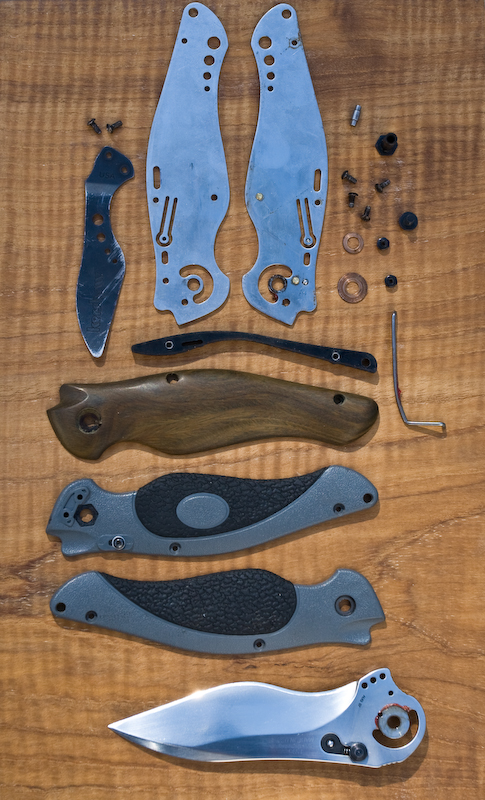
Here's a Speed Bump disassembled. The torsion bar's on the right.
2711410175_ac2004b770_o.jpg


I did manage to break the bar on this knife. I was opening and closing it idly for about an hour. Repeated stress like that can break the bar. Two days later I had replacement parts at my door. It only takes a couple of minutes to put the new one in.
 
In my experience, you can open an assisted knife until you're black and blue in the face before the torsion bar breaks. FWIW I have a flipper and when I flip it, it actually hits the thumb stud that acts as a stop pin with less force than when I thumb open it using the studs. This is just how I have my pivot set up. I have it as tight as possible without causing friction. Should the torsion bar break, they are easily replaced by most manufacturers, and free of charge most often.
 
I doubt it. I mean I'm sure there's some issues, but they must be neglible. Otherwise we'd have tons of reports of knives breaking down over the winter months. Not everyone lives down south.
 
Back
Top