Applied Patina and tempering

Joined
Feb 19, 2011
Messages
47
I am going to try the blue/bleach patina on a frontier style blade (rough with hamons visible above the bevel) with scandi grind for bevel, which I also want to retain the "blue" patina on.
I am not sure at which point I should perform the blue/bleach process...can someone shed some light on this? Im confused as to how you would "see" the steel to temper the blade...so do I wait until after tempering?
 
The way you describe it, I feel that you would have to blue it at the very end, as the scandi bevel will have the blue ground off as soon as it is sharpened.
 
I'm no experienced knife maker, I feel like I'm not getting something...

Do you just go to sharpening after temper? I always have plenty grinding to do.

I go as far as shaping the handle with temporary pins in then doing the patina before glue up.

I hope this helps.
 
Last edited:
What Wick said - in fact I often pre-age a bit before fit up but then final age the whole package when all put together since that's how things age "naturally"

You can also "zone age" the blade i.e. masking off the parts you don't want to age or want to age less - I use clear lacquer since it cleans up easily.
Here's an example - with three different levels of aging done by masking off the various sections and then aging it four different times to get heavy to light aging:
wild-goo-2010-28-01.jpg


You can also get various effect by using a rag soaked in the bleach and wrapping it around the blade so it touches some places and not others - once wrapped place it in a plastic bag and let steep - note the bare spots where the cloth did not touch:
mf-001.jpg


IMO - the best way to get the look of a naturally aged piece rather than an accelerated one, whether it be metal or wood or leather, is to look at older pieces and not just antiques which tend to look too old at times unless that's the look you want, then use the various methods to imitate that look. When possible I like to keep a piece around for a while and hang it out in the sun and wind or just in the corner of the shop - the extra time really helps to bring it all together and mellow the look rather than having it look raw - that's how the best do it as well as the professional arti-fakers. Overall the best look comes from a multi-faceted approach rather than a simple step 1, 2, 3 and done in a hurry.
 
Just an addition to Wild Rose's post:
Whatever method you use, let it sit for several weeks, or longer, after the knife is finished. There may be changes in the look, and sometimes there is a rust pit that appears where some of the chemicals have soaked deep into a pore or up under a bolster. If you don't wait and make sure the final aging is done, you can have a bad experience with a customer.
 
Stacy and Wild Rose have it right... "multi-faceted" is the perfect word to describe it. Something I also do to protect and preserve deeply pitted areas of steel/wood/bone is to apply some thinned out UV rated epoxy like West Systems Special Coating. Paint it on and wipe it off with a rag and toothbrush. The small amount that remains ends up in all the right "hard to clean" places. I find it makes the look POP at times, like wetting a rock to reveal its true colours. Of course, I try to avoid the "wet" glossy look.

Rick
 
Applying a forge finish is one thing, but, applying a forge finish on a hamon bearing blade is another. I can't quite figure out how it's done. If you put a forge finish on the flats, then clay it up and Ht, it seems the clay would be very difficult to get out of the forge finished areas. Have any of you guys done a forge finish with hamon? I see it done on quite a few Japanese style knives.

Dave
 
Applying a forge finish is one thing, but, applying a forge finish on a hamon bearing blade is another. I can't quite figure out how it's done. If you put a forge finish on the flats, then clay it up and Ht, it seems the clay would be very difficult to get out of the forge finished areas. Have any of you guys done a forge finish with hamon? I see it done on quite a few Japanese style knives.

Dave

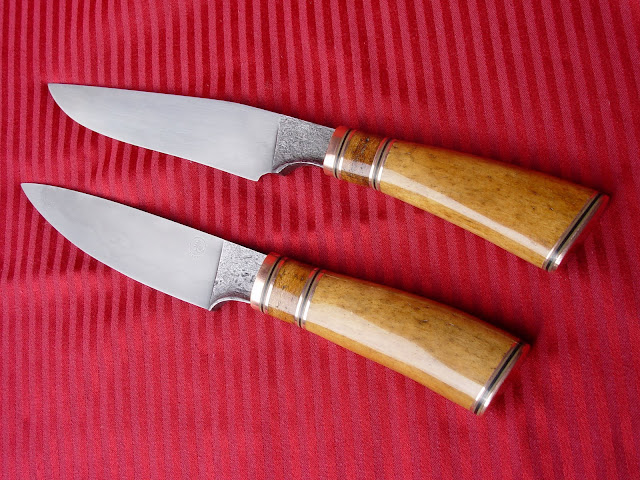
I just soak the blade in vinegar after the clayed heat treat; the clay soaks out. These were done in that manner.
DSC00919.JPG
 
Thanks for the great info guys, just to make sure because there was also some great patina methods mixed in also...Best time to blue/bleach will be just AFTER tempering and before final sharpening?
 
Thanks Fred,

and here I was thinking of wire brushes, etc. Never thought of such a simple solution right under my nose. Lol. Those look like nifty little users. I like what you did there.

Dave
 
Back
Top