
-
The BladeForums.com 2024 Traditional Knife is available! Price is $250 ea (shipped within CONUS).
Order here: https://www.bladeforums.com/help/2024-traditional/
You are using an out of date browser. It may not display this or other websites correctly.
You should upgrade or use an alternative browser.
You should upgrade or use an alternative browser.
Are barlows stronger?
- Thread starter Timothy75
- Start date
Perhaps - though you have to separate the original barlow designs from the modern versions (which often have little resemblance). In any bolster/scale design, the weak point is at the bolster-scale transition -- at the transition, the only structural element is the liner (and the spring, but we'll ignore that for the moment since all slipjoints share that).
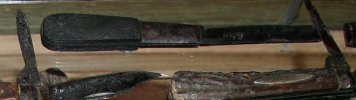
Below is a barlow from the Steamboat Arabia dig (sunk 1856):

This is how the original barlows looked -- they had a relatively thin forged integral iron bolster/liner. This was pure iron - rather soft. So for strength they gave it a very long bolster - in this case well over 1/3 the length of the handle. When using this design, much of the force will be applied to the bolster region - it goes a long way toward approximating what you'd get if you made the whole scale out of iron and avoids most of the stress at the bolster-scale transition that you'd get with a short bolster.
In truth, things are not quite this simple, since having the spring sandwiched in there strengthens and supports the whole structure - but yes, it's a bit stronger to have a really long bolster than a short bolster, everything else being equal.
-- Dwight
Below is a barlow from the Steamboat Arabia dig (sunk 1856):
This is how the original barlows looked -- they had a relatively thin forged integral iron bolster/liner. This was pure iron - rather soft. So for strength they gave it a very long bolster - in this case well over 1/3 the length of the handle. When using this design, much of the force will be applied to the bolster region - it goes a long way toward approximating what you'd get if you made the whole scale out of iron and avoids most of the stress at the bolster-scale transition that you'd get with a short bolster.
In truth, things are not quite this simple, since having the spring sandwiched in there strengthens and supports the whole structure - but yes, it's a bit stronger to have a really long bolster than a short bolster, everything else being equal.
-- Dwight
Attachments
Last edited:

comoha
Gold Member
- Joined
- Jan 12, 2006
- Messages
- 6,233
Good points Dwight. :thumbup:
I guess my reply was influenced by the looking at my 2009 BFC Barlow, which must be nearly 40% of the handle length being bolster. That knife probably does not represent the majority of barlows when it comes to bolster size.
I guess my reply was influenced by the looking at my 2009 BFC Barlow, which must be nearly 40% of the handle length being bolster. That knife probably does not represent the majority of barlows when it comes to bolster size.

- Joined
- Dec 23, 2008
- Messages
- 566
Zerogee,
Thanks for the great photo and great explination!! That's very informative.
Thanks for the great photo and great explination!! That's very informative.

- Joined
- Jul 30, 2006
- Messages
- 44,529
To add to zerogee's excellent reply:
One should also remember that today's bolsters are attached to the frame, so enlarging them doesn't add all that much to the strength. However, the bolsters of the original Barlows were an integral part of the forged frame. So, if those were bigger, then the knife was stronger.
One should also remember that today's bolsters are attached to the frame, so enlarging them doesn't add all that much to the strength. However, the bolsters of the original Barlows were an integral part of the forged frame. So, if those were bigger, then the knife was stronger.
To add to zerogee's excellent reply:
One should also remember that today's bolsters are attached to the frame, so enlarging them doesn't add all that much to the strength. However, the bolsters of the original Barlows were an integral part of the forged frame. So, if those were bigger, then the knife was stronger.
Very good point -- in fact, the typical production slipjoint has bolsters that are "tommy'ed" on (if I remember the term correctly). The bolsters are typically shaped with a die that forms a round extrusion/pin on the back side of each bolster - a "tommy pin" - these are fitted to similar holes stamped or drilled into the liners and then the tommy pin is riveted to the liners, attaching the bolsters, no muss, no fuss.
An interesting aside -- I've done a fair amount of taking junker antique knives apart to look at their construction details and to save them as patterns. In all of them, the tommy pin hole in the liners was separate from the pivot pin hole -- except for Case. In the Case Tested era (perhaps before) Case actually grew some brains and made the tommy pin hole coincident with the pivot pin hole (there is no pivot pin hole in the liners - it's thru the center (more or less) of the large riveted tommy pin, and thus the bolsters. This allowed Case to greatly enlarge the tommy pin (since they didn't have to avoid the pivot pin) and also allows the actual construction at the pivot to be the bolsters directly in contact with the tang around the pivot pin area - the liners no longer figure into the equation for the pivot area strength.
-- Dwight
The pin acts like a riveted joint which are good at resisting shear forces but are not good at tension loads, i.e. lateral forces. The length of the bolster will not reduce the force on or strengthen the pin to resist lateral forces. To do that you would have to start using screws or bolts which most modern folders use. To nominally strengthen the joint to tension you would have to increase the friction between the components, i.e. hammer the pin till it makes the joint static, increase the diameter of the head of the pin,etc