- Joined
- May 10, 2013
- Messages
- 547
I posted this as a question because I do not know a lot about this topic, hope that others can school me.
Typically one major challenge in assembling a multiblade slipjoint (more than two blades) is the adjustment of the blade so that they fall past each other with minimal to no blade rub. Solutions to this include aggressive crinking of the blades, and/or enlarging the space for blade fall by making the blade cavity wider.
This last has been accomplished by adding a cut down liner (similar to the center scale) to the side of the knife with the multiple blades. For example, on a three bladed stockman pattern, the additional liner will be added to the side that has the sheepfoot and spay blades, to provide additional space. Crinking is still required but the extra space leaves more room for error so to speak.
The added side liner seems to be a recent development for example I have Queen made Moore Maker stockman knives made prior to 2009 that have no side liner, but the same patterns made in recent years will have the side liner.
Another method used by knife companies to increase the blade cavity space is to increase the thickness of the center liner Case has done this in recent years on the 18 medium stockman pattern.
Of course a third method is to redesign the knife so that it has one backspring per blade (like the Buck 300 series and the post-1993 Case 47 pattern).
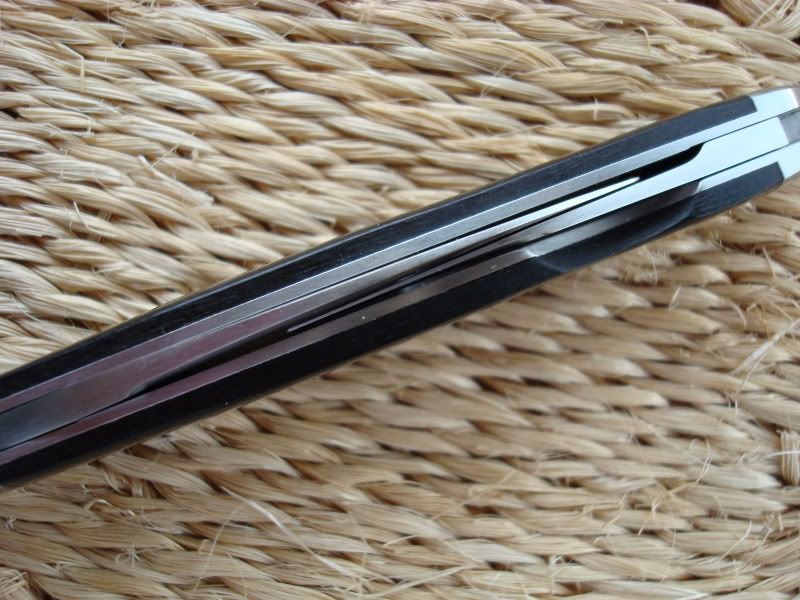
I have heard the term "Asymmetrical Grinding" used, and my understanding of it is as follows. When two blades of a traditional slipjoint are arranged so that they will fall past each other, the blade grinds can be offset slightly, with the grinds angled off center a bit so that there is less chances that the edge of one blade will hit the back of the opposing blade. The most classic example for us traditional knife fans would be the sheepfoot and spay blades on a stockman pattern.
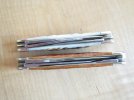
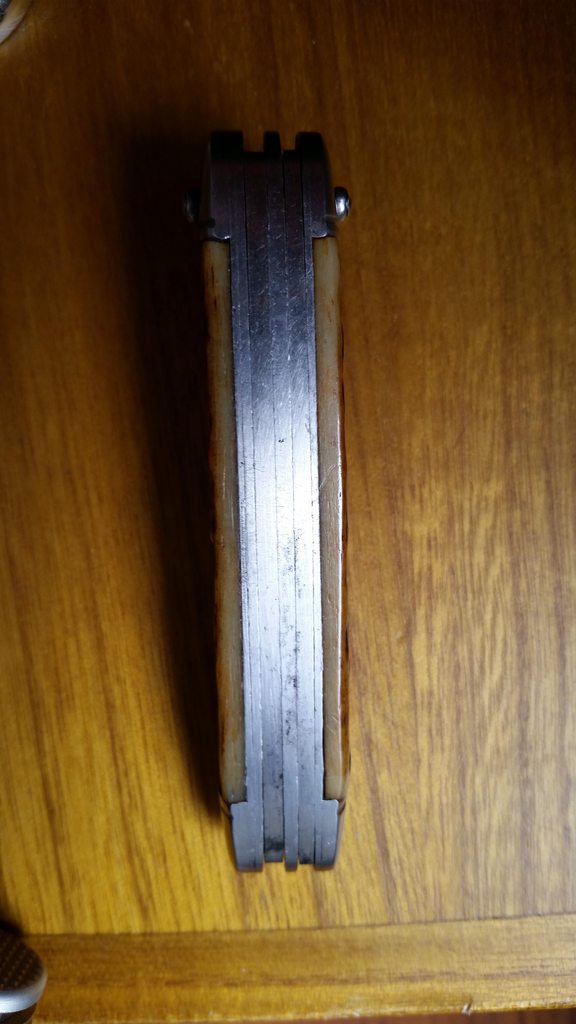
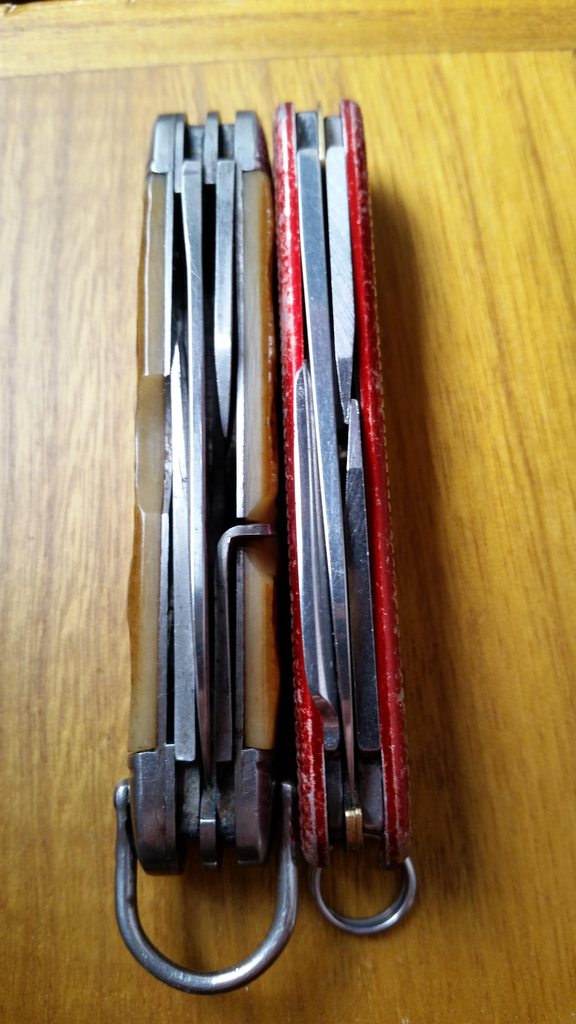
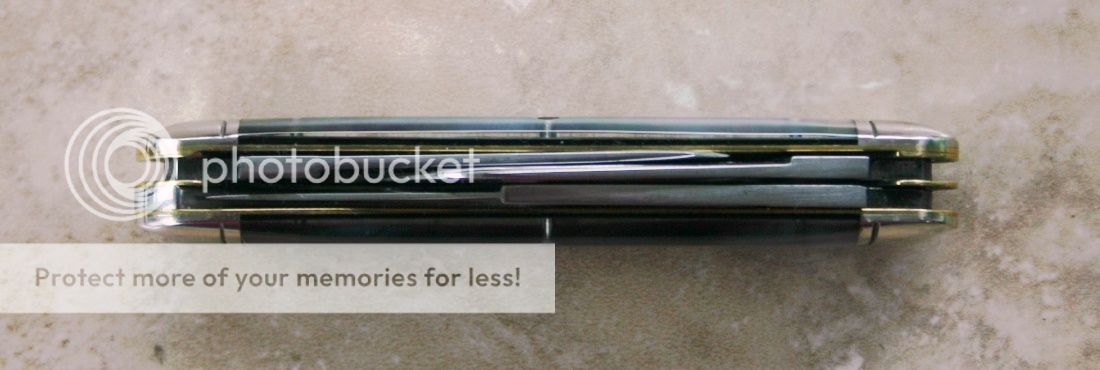
This idea is hard to describe - maybe the attached photo helps. these are two recent production Case stockman pattern knives - top is a 6318 and the bottom is a TB6339.
Note that the 6318 has thinner blade stock than the 39, but the 18 also has a thicker center liner and yet there is a very noticeable bend o the sheepfoot blade due to crinking.
The 39 pattern, with thicker blade stock, has a thinner center liner yet there is no noticeable bend in the sheepfoot blade. However it does appear that the sheepfoot and spay blades are slightly offset ground.
It would seem that if I am right about this (and how else to explain the differences in the two knives?) then the use of asymmetrical grinding would seem to be the most elegant and simplest method to solve the blade fall problem the knife can have thick blade stock while maintaining an overall narrower blade cavity and therefore slimmer in the pocket.
I have collected and studied traditional pocket knives for over 40 years, and all of the older stockman patterns that I have seen and owned (pre 1970) have had the thicker blade stock, thinner center liner, yet with perfect blade fall and while the blades may have been crinked, there was never any noticeable bend in any blade. This applies to older Case, Remington, New York Knife, Winchester, really all of the quality brands.
Im just throwing this out here to see if others are more knowledgeable than I am about asymmetrical grinding and why it is not more widely used. If Im correct, I wonder why Case for example would use it on the 39 pattern but not on the 18.
And perhaps people can report in on their GEC and Canal street stock knives as to the level of visible blade crinks and the use of side liners and asymmetrical grinds.
Typically one major challenge in assembling a multiblade slipjoint (more than two blades) is the adjustment of the blade so that they fall past each other with minimal to no blade rub. Solutions to this include aggressive crinking of the blades, and/or enlarging the space for blade fall by making the blade cavity wider.
This last has been accomplished by adding a cut down liner (similar to the center scale) to the side of the knife with the multiple blades. For example, on a three bladed stockman pattern, the additional liner will be added to the side that has the sheepfoot and spay blades, to provide additional space. Crinking is still required but the extra space leaves more room for error so to speak.
The added side liner seems to be a recent development for example I have Queen made Moore Maker stockman knives made prior to 2009 that have no side liner, but the same patterns made in recent years will have the side liner.
Another method used by knife companies to increase the blade cavity space is to increase the thickness of the center liner Case has done this in recent years on the 18 medium stockman pattern.
Of course a third method is to redesign the knife so that it has one backspring per blade (like the Buck 300 series and the post-1993 Case 47 pattern).
I have heard the term "Asymmetrical Grinding" used, and my understanding of it is as follows. When two blades of a traditional slipjoint are arranged so that they will fall past each other, the blade grinds can be offset slightly, with the grinds angled off center a bit so that there is less chances that the edge of one blade will hit the back of the opposing blade. The most classic example for us traditional knife fans would be the sheepfoot and spay blades on a stockman pattern.
This idea is hard to describe - maybe the attached photo helps. these are two recent production Case stockman pattern knives - top is a 6318 and the bottom is a TB6339.
Note that the 6318 has thinner blade stock than the 39, but the 18 also has a thicker center liner and yet there is a very noticeable bend o the sheepfoot blade due to crinking.
The 39 pattern, with thicker blade stock, has a thinner center liner yet there is no noticeable bend in the sheepfoot blade. However it does appear that the sheepfoot and spay blades are slightly offset ground.
It would seem that if I am right about this (and how else to explain the differences in the two knives?) then the use of asymmetrical grinding would seem to be the most elegant and simplest method to solve the blade fall problem the knife can have thick blade stock while maintaining an overall narrower blade cavity and therefore slimmer in the pocket.
I have collected and studied traditional pocket knives for over 40 years, and all of the older stockman patterns that I have seen and owned (pre 1970) have had the thicker blade stock, thinner center liner, yet with perfect blade fall and while the blades may have been crinked, there was never any noticeable bend in any blade. This applies to older Case, Remington, New York Knife, Winchester, really all of the quality brands.
Im just throwing this out here to see if others are more knowledgeable than I am about asymmetrical grinding and why it is not more widely used. If Im correct, I wonder why Case for example would use it on the 39 pattern but not on the 18.
And perhaps people can report in on their GEC and Canal street stock knives as to the level of visible blade crinks and the use of side liners and asymmetrical grinds.