
ATS34 corrosion resistance

Joined
Dec 13, 2005
Messages
170
I made this knife about a year ago and my wife grabbed this camp knife for her kitchen. Its worked out great until she put it in the dish washer the other night. As you can see the dishwasher caused significant rust on the blade which is ATS34. Up till the dishwasher incident, the blade didnt even stain. This really surprises me, has anyone else seen ATS34 rust like this?

Also, the vulcanized rubber liners "grew". I read on this forum before that it is better to use g10 liners because they are more water resistant, now i have proof.
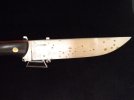
 

Attachments

  • DSCN0337.jpg
    DSCN0337.jpg
    34.6 KB · Views: 178
I'd be willing to bet that this corrosion was caused by the dishwashing detergent, not the water itself. It can be fairly nasty stuff.

Personally, I would take some metal polish to it, coat it with some food-grade oil - and remind the wife to hand wash it! :rolleyes:

TedP
 
Dishwashers are one of the worst places for a knife. You'd be better off burying it in your yard overnight than running it through a wash cycle :(

And yeah, vulcanized liner material sucks. :thumbdn:
 
Interesting. I made hundreds of steak knives using ATS34 - and against my instructions, they went through a commercial dishwasher several times a day for 4 years before I got them back for refinishing. The handles were rough from being tossed into bus tubs and bounced around in the dishwasher - but there was no rust. Any information on heat treat?

Rob!
 
Interesting. I made hundreds of steak knives using ATS34 - and against my instructions, they went through a commercial dishwasher several times a day for 4 years before I got them back for refinishing. The handles were rough from being tossed into bus tubs and bounced around in the dishwasher - but there was no rust. Any information on heat treat?

Rob!

My wife just informed me that she has put that knife thru the dishwasher dozens of times, but this is the first time it rusted, that is different information than she gave to me this morning ... She said she just switched to "gel packs" for the detergent, perhaps they are more caustic ??

Anyway I looked up the heat treat for that knife in my log book.

1975 degrees for 30 minutes, plate quench, 12 hour LN cryo soak and 2 - 900 degree 2 hour tempers.

I got that steel from admiral.
 
Does the dishwashing detergent have citrus in it? Several stainless cookware brands will not warranty their products if you use lemon or orange citrus detergent.

Added - the high heat tempering also lowers the stain resistance a bit as well.
 
Your wife doesn't know better?

Don,

I think that she knows better, but at the end of a long day i think she she just does what is easy...

You would think after thirty years of regular beatings she would know better, but no, she just keeps beating me and doing her own thing :)
 
Don,

I think that she knows better, but at the end of a long day i think she she just does what is easy...

You would think after thirty years of regular beatings she would know better, but no, she just keeps beating me and doing her own thing :)

Haha, that's good!

We don't have a dishwasher, so I gotta blame the wife for something else.:cool:
 
When I made a lot of straight blades I used to neutralize the acid
after soldering in TSP water overnite. Big difference in ats and 440c
in the morning. In any normal use abuse never had a problem but
it will rust quicker than 440c
Ken.
 
If I'm not mistaken, that high tempering temperature reduces corrosion resistance in ATS34 substantially too.

In many stainless steels you get much better corrosion resistance with the lower set of tempering ranges.

Going off of memory here, I'm pretty sure you temper ATS34 at 350-400 depending upon initial hardness to maximize corrosion resistance.
 
HItachi doesn't say much about ATS34, but given it is the same alloy as 154CM, we can look at Crucible's description.

154 CM has better corrosion
resistance, better wear resistance and better
hot-hardness than 440C. For knifemakers, it
offers better edge retention than 440C. It also
has higher attainable hardness and better​
through hardening characteristics than 440C.

We temper it in the low range, but Paul Bos generally used the high range, so I'm sure not going to criticize it. :o

Maybe you could heat teat and polish up a variety of coupons and do some dishwasher experiments - in the name of science of course. :D

Rob!
 
Does the dishwashing detergent have citrus in it? Several stainless cookware brands will not warranty their products if you use lemon or orange citrus detergent.

There is no citrus listed on the ingredients list.

Rob,

I am going to try to find the time to conduct that corrosion test. As i heat treat i will include a piece of steel that i can use for the test.

Thank you all for the input,
-John
 
My experience has also been that ATS-34 has lower corrosion resistance than 440C, despite what Crucible claims. I believe that this is due to the ease of putting a much finer finish on 440C and all of that extra chromium at the surface. In coastal North Carolina, blasted ATS-34 will rust just sitting in the shop for an extended period of time. 440C seems to hold up much better with the same finish.

John - from the photo, it looks like you put a nice finish on the blade, but do you know how high you took it?

Perhaps passivating it would be helpful.
 
Rob,

I am going to try to find the time to conduct that corrosion test. As i heat treat i will include a piece of steel that i can use for the test.

Thank you all for the input,
-John

Let me know if you need some steel. I'm sure I have some shorts that would serve as coupons.

Rob!
 
My experience has also been that ATS-34 has lower corrosion resistance than 440C, despite what Crucible claims. I believe that this is due to the ease of putting a much finer finish on 440C and all of that extra chromium at the surface. In coastal North Carolina, blasted ATS-34 will rust just sitting in the shop for an extended period of time. 440C seems to hold up much better with the same finish.

John - from the photo, it looks like you put a nice finish on the blade, but do you know how high you took it?

Perhaps passivating it would be helpful.

AcridSaint, I hand sanded that blade to 280 grit. I had to look up passivating because i did not know about the process. It looks very interesting, can you point me to more information on the process?


Rob, thanks for the offer!!


-John
 
John - I've never passivated my knives since it's more of a commercial thing. I'd guess that a run through some FC would get you most of the way there for a home version.

I think a higher hand sand would also help out. The higher the finish, the more stain resistant, in my experience.
 
Back
Top