Attempted first laminated billet today

Joined
Apr 14, 2011
Messages
168
Well, as the title says, I tried my first laminated billet today... Nothing fancy, really. Just some mild steel with 1084 sandwiched in the middle.

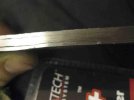
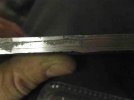
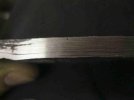
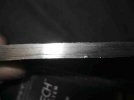
I'm trying to figure out if my forge weld was good, or if it's likely that the billet will de-lam as I continue to forge it to shape. I ground the edges to show the three layers and the weld so you guys can tell me what you see... good, bad, or ugly. Billet is about 1/4" x 1 3/4" x 8".

I didn't tack this billet together... held it together with carbon steel wire from HF, WD-40 between the layers (ground flat and free of scale, pre-weld). Unfortunately I don't have any welding equipment. It's on my wish list, right behind a HT kiln and a KMG.

Anyway, feedback would be appreciated. I don't know what I'm looking for, really, so I have no clue whether this was a success. Thanks in advance, guys. :)
IMG_1662.jpgIMG_1663.jpgIMG_1658.jpgIMG_1657.jpg
 
The black gaps indicate bad welds or more likely no welds.
If using a hydro carbon solvent you'll want to weld the sides of the billet at 1 inch increments as well as across both ends.
Hydro carbon solvents work by forming a carbon jacket or canister around the billet; any movement during heating will cause the jacket to break, result being the introduction of oxygen.
Try shorter stock; 4 or 5 inches works well.

Don't give up on the hydrocarbon solvent; its only a matter of perfecting your technique.

Fred
 
If the weld is properly done, you will not see any black lines. Maybe you can pick up the layers if the knife is ground on the edge and you catch it in the right light, but it is more of a faint line that just catches the light differently. I use borax for my forge flux. I read the whole "Fluxless weld thing using kerosene or WD40" but it seemed very specific and nit picky. If you use borax, you just heat it up to red or orange, and then sprinkle the borax on it, then put it back in the forge until it is bubbling, then weld away. It is a bit more messy, but it works well. I mean no offense to those who use hydrocarbon for welding, I just find flux easier.
 
Thanks, guys. You confirmed what I was thinking. I had seen pictures of others' laminated billets and there weren't any black lines, so I had a feeling that wasn't right. Next time, I'll probably just have the welder at work tack the billets together for me with rebar handles and give that a go. Couldn't seem to find any borax today, so I decided to try the WD40 route. Borax seems to be the more common choice for fluxing and if I can find some, I'll be using that.

I'm considering cutting some cross sections from this billet and grinding it a bit to see if the bad welds extend through the billet or if it's only the outer edges or what.

Are there are good tutorials out there for laminated billets/san mai? I ran across one for stainless san mai that was canister welded, but that's a little more complicated than what I'm shooting for. I think the next go-round will probably be 15n20 with a 1084 core, rather than mild steel for the outer layers.
 
I've seen people dip in kerosene and then sprinkle on borax .. the kerosene helps the borax stick .. but I didn't realize you can use kerosene/wd40 etc to weld with as well. He made his billet for his journeyman abs test and 3 knives from it and passed.. so it must work, but I've never tried it personally.
 
I've seen people dip in kerosene and then sprinkle on borax .. the kerosene helps the borax stick .. but I didn't realize you can use kerosene/wd40 etc to weld with as well. He made his billet for his journeyman abs test and 3 knives from it and passed.. so it must work, but I've never tried it personally.

Yeah, I remember watching a YouTube video that Kyle Royer put up not long ago about making his MS knife... he used kerosene and borax as well. I don't know why, but grocery stores around here don't seem to carry borax anymore. I might have to trek out to the farrier's supply and pick some up. I know they have it.

Regardless, I'm not sure it would have given better results considering that the billet wasn't welded together at all. Next time, I'll rectify that and have everything better prepped before I go at it with the hammer. Good learning experience though.
 
If the weld is properly done, you will not see any black lines. Maybe you can pick up the layers if the knife is ground on the edge and you catch it in the right light, but it is more of a faint line that just catches the light differently. I use borax for my forge flux. I read the whole "Fluxless weld thing using kerosene or WD40" but it seemed very specific and nit picky. If you use borax, you just heat it up to red or orange, and then sprinkle the borax on it, then put it back in the forge until it is bubbling, then weld away. It is a bit more messy, but it works well. I mean no offense to those who use hydrocarbon for welding, I just find flux easier.

What is meant by the term nit picky; tending to raise petty objections? You have stated an oxymoron by being both very specific and petty at the same time.
No offense taken by the way.
 
Yeah, I remember watching a YouTube video that Kyle Royer put up not long ago about making his MS knife... he used kerosene and borax as well. I don't know why, but grocery stores around here don't seem to carry borax anymore. I might have to trek out to the farrier's supply and pick some up. I know they have it.

Regardless, I'm not sure it would have given better results considering that the billet wasn't welded together at all. Next time, I'll rectify that and have everything better prepped before I go at it with the hammer. Good learning experience though.
Ya that was the video i watched as well (linked from some forum post here) of Kyle Royer. The name had flown the brain-coop :P
 
Using Borax or hydrocarbon solvents are two entirely different processes. Borax accomplishes the omission of oxygen by coating the surface of each piece of steel in the billet whereas hydrocarbon solvent omits the oxygen by forming a canister around the outside of the billet while leaving the surface of each piece of steel clean.

Free
 
In the video, Kyle used HCs (WD40 and diesel fuel) just to make the borax stick to cold billets, rather than have to wait til red heat to flux.
Be sure to check what your forge is doing- if you're using propane, you won't get good welds til you set it so there's a little (can be faint) tongue of flame coming out the door- otherwise it's got too much oxygen, which cruds up your surfaces.
Pete, just search BladeForums for any kind of tutorial you can imagine and some you can't- there's a wealth of info here.
Andy G.
 
Andy, I definitely think you're right about the forge atmosphere. I do use propane and it was shooting flames out in a major way, creating scale like nobody's business.
 
What is meant by the term nit picky; tending to raise petty objections? You have stated an oxymoron by being both very specific and petty at the same time.
No offense taken by the way.
I did not mean to be petty. I read the process of using kerosene, and afterwards I decided to just stick with borax. I just need to clean up my press dies more often, but I was pretty sure I would have a more difficult time nailing the proper weld with kerosene. I know it works and many people make much better damascus than I can using it, but it just seemed to me like the process involved was more specific and a bit more time consuming. Frankly, I decided to stick with the borax because it works for me and I figured if it works, why change it. For all who use kerosene or WD 40, my hats off to you. I am pretty sure I would screw up a weld using that method.
 
Hi Pete,

First let me start with your billet. Like Fred and Matt both pointed out your attempt to weld here appears it has failed. Now since I can not tell what you billet prep looked like prior to attempting to weld and also do not know your skill level so I am just going to mention a few things that may help. If your new to forge welding I would suggest sticking with anhydrous borax (Don't use 20 mule team it will cause you trouble as it will foam up and you will use 3 times as much) especially since you have no way of welding up your billet ends for prepping to forge weld. Another thing to look at is to make sure your forge gets hot enough. Most failures I see with new guys is they are impatient and don't wait for their billets to get to temp or they are not aware their forge is not running hot enough. I hear a lot of guys say weld it when the flux starts to bubble but I have seen failures by guys doing this. What I look for is I want the billet the same color as the liner of the forge when it is running at full temp and when you roll it over there should be no shadows. Going by color can be tricky as a billet in a dark shop can be bright yellow but in outside light it maybe just orange in color. Like Fred said if your going to go with the hydrocarbons your billet layers need to be tight and not move. Me I am not stuck on one way or another I use different methods for different jobs you just need to consistent and practice to perfect your method.

I did a WIP for a customer that maybe of some help to you.

http://www.bladeforums.com/forums/showthread.php/831326-1095-amp-Wrought-Iron-San-Mai-WIP-(Picture-Heavy)

Hope that helps some.
 
Mike, thanks for the feedback. I'll describe the billet prep as best I can. In hindsight, I probably should have taken a picture to post. I ground the mill scale off of each side of all three pieces with a disc grinder @ 120 grit. I then sprayed all surfaces of the billet with WD-40, then tightly wrapped it from top to bottom with carbon steel wire.

The forge was preheated to welding temp for about 10 minutes prior to inserting the billet. Two burner forge running at 10 psi. I waited for the forge interior and the billet to match color, then attempted to set the weld. The carbon steel wire was melting away in certain spots.

I had actually read your WIP a while back, which is part of what inspired me to give this a try. However, I was too anxious to get going and didn't have anyone available to tack the ends of the billet together. Again, hindsight, but I should have gotten it welded together and made sure I had the borax flux on hand. Rookie move.

I did some more grinding on the outer edges of the failed billet with a 36 grit belt to hog off some material. It seems that the weld is properly set or close to it as I get nearer to the center. I think I took about 1/4" off each side with the belt. Since I'm pretty well chalking this up as a failed attempt, I'm going to tool around with the billet some more and examine it. I may even forge it a bit to see if it delaminates, etc, one I've gotten it to blade-like shape.

You guys think it's worth messing with any further, or add it to the scrap bucket?

Thanks to everyone who's responded so far. :)
 
You could try to weld it up better with some Borax... a trick I tried from Jim Hrisoulas' "Pattern Welding" was to make a supersaturate solution of Borax into boiling water, and soak the billet in that, then let it dry out. It helps Flux get into tiny flaws and cracks in the piece. Then try to weld it up. It worked for me with some fairly scrungy cable.

Probably more worth your time to just start with new pieces, borax and tack welds though.
 
My experience is with stock removal not forging, but I've read some...


Using 1084 and mild the carbon content will be reduced as the carbon migrates from the high to the low.
You may be able to use pure nickel foil on either side of the 1084 to stop that - it looks pretty too.

I understand that this may be just a cheap practise piece, but the carbon content may be low when you are done.


As I understand it, the welding temperatures of high carbon and low carbon mild are different.
The mild steel takes a higher temperature to weld.
So if you are using the colours you have seen in video and person, that may throw you off in this piece.
 
Back
Top