
-
The BladeForums.com 2024 Traditional Knife is available! Price is $250 ea (shipped within CONUS).
Order here: https://www.bladeforums.com/help/2024-traditional/
You are using an out of date browser. It may not display this or other websites correctly.
You should upgrade or use an alternative browser.
You should upgrade or use an alternative browser.
Balisongs and Caviar
- Thread starter Gollnick
- Start date

- Joined
- May 19, 2003
- Messages
- 1,848
Living large in America!

- Joined
- Jan 6, 2001
- Messages
- 4,399
Yea, but do they offer a Happy Meal? 
(now that I've thought about it - that _IS_ a Happy Meal!!!)
(now that I've thought about it - that _IS_ a Happy Meal!!!)

Gollnick
Musical Director
- Joined
- Mar 22, 1999
- Messages
- 29,258
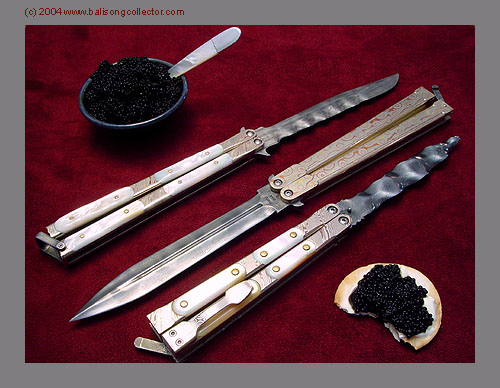
For the picture, I used an inexpensive domestic caviar. It's still nice stuff, though. The two major sources of caviar in the world have long been Russia and Iran. With the fall of the Soviet Union, the Russian mafia took over the caviar trade there. They basically did away with the quality controls that the Soviet government had imposed and they over-fished the resource. So, the quality of Russian caviar has gone way down and if you buy it you're supporting the Russian Mafia. Iranian caviar? Obviously, I don't want to buy anything Iranian. Besides, theirs has always been second-rate. But, in recent years, a domestic, American caviar industry has sprung up using farmed fish. It's domestic, it's legal, it's sustainable. And, best of all, it's less expensive. In fact, many experts now consider American caviar the best in the world.
What does it taste like? We'll different types taste differently. It's all somewhat salted, so it's a bit salty. But when the little eggs break individually in your mouth, they errupt with a very intense seafood flavor. It can be very good.
If you look at the high-resolution versions of some of the pictures in the exhibit, you can see that the little eggs are starting to collapse. They aren't round anymore. Caviar is normally served on ice. It needs to be kept very cold or the little eggs collapse. I do my photography with studio hot lights. They're not called "hot" lights for no reason. It gets very hot under the lights. In fact, I have to wear a sweat band on my forehead so that I don't drip sweat onto the set.
So, knowing that the caviar would be under the heat, I didn't want to waste any good stuff.
What does it taste like? We'll different types taste differently. It's all somewhat salted, so it's a bit salty. But when the little eggs break individually in your mouth, they errupt with a very intense seafood flavor. It can be very good.
If you look at the high-resolution versions of some of the pictures in the exhibit, you can see that the little eggs are starting to collapse. They aren't round anymore. Caviar is normally served on ice. It needs to be kept very cold or the little eggs collapse. I do my photography with studio hot lights. They're not called "hot" lights for no reason. It gets very hot under the lights. In fact, I have to wear a sweat band on my forehead so that I don't drip sweat onto the set.
So, knowing that the caviar would be under the heat, I didn't want to waste any good stuff.
- Joined
- Jan 6, 2001
- Messages
- 4,399
Oops! I didn't realize that YOU had taken that photo, Chuck.  (Guess I should have followed the bouncing links!)
NICE!

(Reminds me of a caviar story of my own: many years ago, I consulted for a week with a friend of mine who worked as a cruise director for one of the premiere ships in the Caribbean. When I left the ship, the manager who was in charge of provisions said he'd like to give me a small "bonus" for giving him some valuable suggestions. But, he added, "Sorry, but you'll actually have to pay for it, after I get approval from the line's head office."
He received approval - and I received a 3 POUND red and gold tin of Beluga caviar for $75.
(Guess I should have followed the bouncing links!)NICE!
(Reminds me of a caviar story of my own: many years ago, I consulted for a week with a friend of mine who worked as a cruise director for one of the premiere ships in the Caribbean. When I left the ship, the manager who was in charge of provisions said he'd like to give me a small "bonus" for giving him some valuable suggestions. But, he added, "Sorry, but you'll actually have to pay for it, after I get approval from the line's head office."
He received approval - and I received a 3 POUND red and gold tin of Beluga caviar for $75.

- Joined
- Dec 30, 2002
- Messages
- 1,242
Well, I tried some caviar today. I work at a grocery store and bought some today at work to try. I got Romanoff Black Lump Fish caviar, two ounces was $5 and change. Not Sevruga, but close enough for me .
I carefully pinched about 5-6 little eggs and put them in my mouth. I let them sit there for a few seconds, then chewed them up. You were right, it is a bit salty and when they burst, they do create an intense seafood flavor. The only problem was that it wasn't very good, at least not in my opinion. It didn't taste bad, but I didn't think it was particularly good either. I'm sure the more expensive stuff is better. I've got the little jar sitting in the refrigerator at work, I'll see if I can get one of my friends to eat the whole jar at once.
. I carefully pinched about 5-6 little eggs and put them in my mouth. I let them sit there for a few seconds, then chewed them up. You were right, it is a bit salty and when they burst, they do create an intense seafood flavor. The only problem was that it wasn't very good, at least not in my opinion. It didn't taste bad, but I didn't think it was particularly good either. I'm sure the more expensive stuff is better. I've got the little jar sitting in the refrigerator at work, I'll see if I can get one of my friends to eat the whole jar at once
.
- Joined
- Aug 31, 1999
- Messages
- 716
Caviar aside, those are some really good looking knives. I like how each knife has different design elements. I also like the depth you captured in the image with the blades open. That bottom blade just jumps out. Thanks!

- Joined
- Apr 17, 2003
- Messages
- 5,283
I love the double edged bali there...and I'm not one for caviar
oh and BTW Mokume-Gane isnt as rare as your site makes it out to be, there are many people I know and can think of that make it in large billets for tsuba, and other japanese sword fittings. There are japanese metal techniques I would call rare, but Mokume-Gane is not one of them (me and my GF talked of getting Mokume-Gane wedding bands when we finally get hitched). But none the less brilliant knives with beautiful handle work....
oh and BTW Mokume-Gane isnt as rare as your site makes it out to be, there are many people I know and can think of that make it in large billets for tsuba, and other japanese sword fittings. There are japanese metal techniques I would call rare, but Mokume-Gane is not one of them (me and my GF talked of getting Mokume-Gane wedding bands when we finally get hitched). But none the less brilliant knives with beautiful handle work....

- Joined
- Sep 14, 2002
- Messages
- 4,135
Now I have to go and find some fish eggs and more vodka.