bark river knives

Joined
Feb 26, 2012
Messages
14
hey guys,,,whats your take on the bark river bravo 2 series,,,ie a2 steel,,punishment that can be inflicted,,warrenty,,ect.ect,,,thx

 
I think the barkies are gorgeous but if you want toughness and warranty it doesn't get any better than Scrapyard, Swamprat, or Busse Combat. Scrapyard will give you the most bang for your buck, Busse is more refined, and Swamprat is right in the middle.
 
I've only heard good things about bark river knives. Tough. But also very beautiful. Most come with a full convex edge. I believe they also come with a nice leather sheath.
 
The Bark River Bravo 2 is one hell of a rugged blade. The A2 steel holds up very well.
 
I edc'd a gunny for a long time and it held up well for daily tasks. I also used it for bushcraft and it stood up to he abuse in the outdoors. The edge was easy to maintain with some stropping at the end of the day.
 
I have a Bravo with green micarta, closer to o.d. green. Its a beautiful tough knife. I cannot imagine why it would ever need warranty work. If it doesnt show up defective, there is nothing to go wrong. It is sneaky sharp, among the sharpest knives i own. Mine came with two sheaths, one green Kydex and a nice Sharpshooter leather pouch sheath. I love it
 
If you look at the Bark River 2012 Production Schedule, you'll notice they've ordered the steel for the new Bravo3. You might want to wait on that one, it'll be 3V steel. Very tuff stuff.

Bravo-III 3V - Steel Ordered (.275" + 3V)
 
In general I like Bark River Knives and I have somewhere north of 30 of them. Having said that, IMO, the quality control is really lacking of late. 5 of the last 6 I've purchased have had some kind of flaw that shouldn't have made it out the door. Again IMO, I get the sense lately in order to keep up with their growing demand, their production schedule, they're pushing to hard to keep up. Or, they have made a conscious decision to just ship it and take a chance on it being returned for whatever reason. Most have been minor cosmetic issues, gaps in between the scales and blade, cracked and chipped horn scales. However one had very obviously uneven plunge lines, another had a small chunk missing out of the top blade that they tried to grind out but couldn't quite get it all, and lastly a really poor uneven grind line on one side of an Aurora I had special ordered.

Most of these flaws would make the knives "seconds", "blemishes", in my view. Especially in that price range. When paying between $200-300 for a semi-production knife, I expect more. Yeah I know they're hand made, and stuff happens, and they'll "make it right" but, 5 out of the last 6 indicates a problem, an obvious change in the quality control. I sent the one back with cracked/chipped horn scales but in general, it's not worth my time or effort to keep sending them all back for repair or replacement. And I shouldn't have to when paying several hundred dollars a blade. I'll fix the ones can and live with the rest. I'm quickly losing what little enthusiasm I had left for Bark River.
 
I think the barkies are gorgeous but if you want toughness and warranty it doesn't get any better than Scrapyard, Swamprat, or Busse Combat. Scrapyard will give you the most bang for your buck, Busse is more refined, and Swamprat is right in the middle.

If you read the Warranty that BRK&T issues,you will note that none I am aware of do the same.

BRK&T say that unless your knife is attacked by a badger,its under warranty for any and all problems.

I think that is the best I have seen.

I own a few and I use them,but I dont abuse any of my blades.

I have owned at least one from each maker quoted [ and a few others ] and I own more BRK&T's than the rest.
 
I have a few BRKT knives, and they're all solid. I wouldn't (and don't) hesitate to trust them in the field; I use mine a lot. I don't have many of the "heavy duty" ones, except for the IMP which is a really rugged little blade. My largest Barkie is a Settler, which is a stick tang instead of full tang, so I don't really pound on it with sticks... but it certainly hold its own in every other aspect.
Eventually I'd like to get a Bravo, as they're more robust and should hold up to whatever you may want to use them for.

BRKT's knives are also way nicer-looking and -feeling than most of the other comparably-priced options, IMO.
 
If you read the Warranty that BRK&T issues,you will note that none I am aware of do the same.

BRK&T say that unless your knife is attacked by a badger,its under warranty for any and all problems.

I think that is the best I have seen.
Both BRKT and ESEE offer a lifetime guarantee to compete with the Bussekin which really is "no questions asked". Even the rubber handles of Bussekin knives are guaranteed for life, and the "fanboys" do not mock/flame/etc. users who request warranty work. Where other companies will post pictures of warrantied knives for fans to mock, or will complain about users throwing their knives or using them in "unintended" ways, Busse-knife-group laughs. Go ahead and throw that Bussekin, use it for concrete work or scraping paint and barnacles off of ship hulls, cut off car-door hinges, etc. All that does is improve their reputation for having the toughest knives and the best warranty in the business. *shrug* There is "lifetime, no questions asked", and then there is Bussekin. But they are all great warranties.

I have a few BRKT knives, and they're all solid. I wouldn't (and don't) hesitate to trust them in the field; I use mine a lot. I don't have many of the "heavy duty" ones, except for the IMP which is a really rugged little blade. My largest Barkie is a Settler, which is a stick tang instead of full tang, so I don't really pound on it with sticks... but it certainly hold its own in every other aspect.
Eventually I'd like to get a Bravo, as they're more robust and should hold up to whatever you may want to use them for.

BRKT's knives are also way nicer-looking and -feeling than most of the other comparably-priced options, IMO.
I believe that the BRKT Settler is "full-tang", just like their BooneII. "Full-tang" means that the "tang" (end of the metal stock from which the blade is fashioned) extends the full length of the handle area. The breadth of the tang is a different matter. For example, the Bravo1 has a full skeletonized tang such that it sports the same amount of supporting metal in the handle as a full stick-tang.
Do not be concerned about the tang when it comes to heavy use, even partial-tang Moras and folding knives (where the tang ends at the pivot) can handle a certain levels of abuse if performed "correctly". Instead, worry about the blade which is where the vast majority of cutting tools and weapons experience failure. How robust is the tip, edge, and primary grind? How is the heat-treatment?

I own a BRKT Bravo1. It is very pretty and slices soft materials very deep with ease. The edge however is ground quite thin and does not hold-up to the same level of stress as my more robust Swamp Rat knives which are also MUCH more comfortable in use... but they aren't as pretty and I keep them more robust so they don't slice as deeply as easily. My $0.02
 
just got a bravo 1 cpm 3v and was going to order the new stainless, spoke with brkt and they said the 3v can't be beat for toughness and wear. the other knives that are insane for toughness are the fallkniven f1 and a1 there is a destruction test on youtube for the a1 that is crazy the guy is cutting concrete with rebar. Painful to watch but the videos show how crazy tough and sharp the laminated vg 10 blades are.
 
I believe that the BRKT Settler is "full-tang", just like their BooneII. "Full-tang" means that the "tang" (end of the metal stock from which the blade is fashioned) extends the full length of the handle area. The breadth of the tang is a different matter. For example, the Bravo1 has a full skeletonized tang such that it sports the same amount of supporting metal in the handle as a full stick-tang.
Nope, sorry. Full tang means that the tang is visible all the way around the outer edges of the handle. A stick tang can be full length or partial length. Full length tang is not always full tang, since a stick tang (or rat-tail tang) can also be full length. A full length stick tang is usually (but not always) secured at the pommel by a nut or cap of some sort, but as in the case of the Settler (and Ontario's Spec Plus line, for example), the full length stick tang can stop just short of the pommel and still be considered "full length."
This is not my "opinion," I'm just stating the terminology, and what it means, for clarity's sake.
 
Nope, sorry. Full tang means that the tang is visible all the way around the outer edges of the handle. A stick tang can be full length or partial length. Full length tang is not always full tang, since a stick tang (or rat-tail tang) can also be full length. A full length stick tang is usually (but not always) secured at the pommel by a nut or cap of some sort, but as in the case of the Settler (and Ontario's Spec Plus line, for example), the full length stick tang can stop just short of the pommel and still be considered "full length."
This is not my "opinion," I'm just stating the terminology, and what it means, for clarity's sake.
I am sorry, but "for clarity's sake" you should reinvestigate the definition and strive to understand why you are incorrect.
I will leave confirmation of my assertion to you but will gladly endeavor to help you understand WHY the definition is what it is.
To begin, "tang" (tongue) is defined as the shank of metal contiguous with the blade which extends from the blade or working-portion of the tool (ANY tool - chisel, screwdriver, knife, wrench, etc.) into the handle. The proportions of the blade vs the handle can vary WIDELY among implements. The handle may be wider on all radii or may be thinner, the tang may expand or may taper or may have sections cut out of it, just as the blade may. By your definition, the handle of a kitchen knife with an exposed tang, wrapped with a single layer of thin but opaque material (e.g. masking tape), suddenly ceases to be "full tang" :eek: Or more dramatically, cover only the pommel with tape - is it now no longer "full tang"? If you consider tape too thin, consider rubber or plastic over-molding, with or without the pommel exposed - does that make a difference? What, in your opinion, makes a difference to the definition? Look at Bob Loveless' tapered-tang knives - the tang is exposed along the spine and belly of the handle but narrows from guard to pommel - full length and exposed but by no means "full" in all dimensions. Look at the Bravo1 or an ESEE Izula - skeletonized tang through the entire handle portion. In fact, imagine a handle-wrapped Izula - no longer "full-tang"?
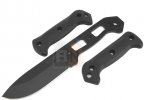
Have I made my point? Do I need to cite more examples of why your opinion is poorly reasoned and also NOT the definition of "full tang"? Look for large bowie-style knives where the blade is dramatically broader than the tang, exposed tang or not the comparative dimensions are dramatically different, as was the case in nearly ALL knives and swords of antiquity up to the present day. Scales do not make a tool "full tang" or not, nor does thickness or breadth or lack of hollowing. The length of the tang relative to the handle is the complete defining characteristic.

NOT opinion. Definition. Look it up, study history, and think freely and unfettered by modern confusion of the English language. :thumbup:
 
I appreciate your enthusiasm, but respectfully disagree. You have not made a point, just attempted to sling some mud.

Tapered tangs are considered full, if they cover the entire width/length of the handle. Thickness is hardly relevant to our point.
Skeletonized tangs are also usually considered "full," since they usually follow the outer profile of the handle.
Hidden tangs are not considered "full," because they are just that: hidden tangs that are NOT the entire width and length of the handle.
My definition, as you call it, phrased as "visible," could have been worded differently; covering it with masking tape? Come on; that's semantic banter at its worst. You know, as well as I, that visibility is not the issue here; it's the shape of the tang, and the fact that it extends to the outer profile of the handle.

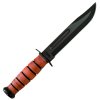
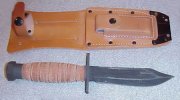
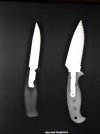
In case you're still puzzled, here are some photos.

Full:
new_bk2.jpg
Tusk_Handle_Contours_sized.jpg


Hidden, or stick, but full length:
11266.jpg
usnusafsurvivalknife.jpg

Partial tang:
tempereance_mora_Xrayed.jpg

Full tang (tang the entire width of the handle) is different from full length hidden or stick tang, which is also different from partial length tang. Believing does not make truth. And please, try to reign in your condescending tone. This is a friendly place, ordinarily.
 
Last edited:
Well, yes, I guess we'll never know for sure. But you both tried to make your point.
Sonny
 
Part-by-part.
I appreciate your enthusiasm, but respectfully disagree. You have not made a point, just attempted to sling some mud.
You disagree with what? The definition? What "mud" am I slinging? Reason, is that "mud"? History? English? I guess that you missed the point. I shall endeavor again.

Tapered tangs are considered full, if they cover the entire width/length of the handle. Thickness is hardly relevant to our point.
Skeletonized tangs are also usually considered "full," since they usually follow the outer profile of the handle.
Hidden tangs are not considered "full," because they are just that: hidden tangs that are NOT the entire width and length of the handle.
My definition, as you call it, phrased as "visible," could have been worded differently; covering it with masking tape? Come on; that's semantic banter at its worst. You know, as well as I, that visibility is not the issue here; it's the shape of the tang, and the fact that it extends to the outer profile of the handle.
...
Full tang (tang the entire width of the handle) is different from full length hidden or stick tang, which is also different from partial length tang. Believing does not make truth. And please, try to reign in your condescending tone. This is a friendly place, ordinarily.

There is only ONE dimension relevant to our point, length. This dimension alone is relevant because all other dimensions of the tang vary as widely as those of the blade fashioned from the same piece of material. Thickness and breadth (including all manner of tapering and 'skeletonization') are both beside the point.

Now, to reason.
You state above that "Hidden tangs are not considered "full," because they are just that: hidden tangs that are NOT the entire width and length of the handle".
First off, "considered" by whom? Secondly, you go on to offer images of "hidden tang" knives that ARE the full length of the handle, immediately contradicting the definition you put forward.
In addition, my example with the masking tape was reductio ad absurdum. Semantics is at its most relevant when discussing definitions and the rationale (or lack thereof) behind them. By wrapping the tang in ANY material, regardless of how thick or thin, and thereby concealing the tang (making it, by definition, "hidden"), your opinion as stated was that such a knife would cease to be "full tang" from your previous post:
"Full tang means that the tang is visible all the way around the outer edges of the handle."
Such a definition is not only inaccurate but absurd (hence reductio ad absurdum). The wrap-material needn't be as thin as masking tape, which is why I offered rubber/plastic over-moulding (e.g. Fallkniven, SOG) to further illustrate my point.

Now you offer the notion that, while it needn't be visible (contrary to your previous statement), a full tang must extend "to the outer profile of the handle". I assume that you mean breadth-wise (i.e. from spine to belly). Referring back to the handle-wrap, any such material around the tang alters the shape of what the hand actually grasps, so I questioned how thick such material could be before you would consider the tang no longer "full". Two layers of paracord-wrap can alter the outer profile of the handle substantially, providing contours not present on the tang of an implement, or flattening contours that were present - in your stated opinion, such wrapping would eliminate the "full-tang" aspect of the implement, as would capping the end of the tang with a pommel - again, absurd by example.
Now lets take another implement as a more dramatic example - a screwdriver. Every screwdriver in my possession consists of a metal rod with a head/blade and a shank extending into a handle - push, encapsulated, or hidden tang. The shank (visible through the handle material in some instances) is free of anything but radial curvature, but the handle is contoured for security and ergonomics (as it would be difficult to apply torque to the tang's profile), such that the tang does NOT extend to the outer profile of the handle in the manner you describe. By the actual definition, this is a full-tang implement, but in your opinion it is not?
I also wonder why your new definition now ignores the stock thickness of the tang - would a tang thinned to a mere millimeter of material but still extending from spine to belly of the handle be "full tang" in your opinion? If not, why not?

It seems that your opinion was originally that only implements in which the handle is composed of a tang and scales attached to either side is "full" but you have reconsidered. I welcome you to continue such reconsideration as imparted in my previous post. As you said: "Believing does not make truth."
If my tone seems condescending, please blame technology or your own perception and, in the spirit of a friendly atmosphere, justify claims presented as objective truth contrary to what is before you. I agree that "for clarity's sake" it is important for all members of a discussion to understand the correct definitions of terms. Terminology is very important, imho, hence the importance of semantics in this regard.


As a final point, we may discuss how the wide variation in material distributed along the length of the tang contributes to tang-strength. The Kabar (and many other hidden-style) tangs maintain stock thickness but are reduced in breadth spine-to-belly. Many swords were constructed with a tapered tang, or rather the material flares out in breadth beyond the handle but is narrow within. Loveless tapered his tangs much the way the blade itself is tapered, narrowing both from guard to pommel as well as from spine to belly, and many modern knives feature 'skeletonized' tangs where material is machined out. But these designs also vary in strength according to how much material is preserved in the tang and how many stress "risers" may be present. It is very easy for a "stick"-tang to present more material support to the blade than a skeletonized tang. Such difference make all the difference between the strength of one tang style and another.

Thank you for the pictures and also for helping to clarify this common misconception regarding the definition of "full tang".
 
Wow!

So..

1) Bark River Knives = good

2) Busse family knives = good

3) Discussion about what exactly makes a knife full tang, stick tang, rat-tail tang, etc is a source of long, possibly endless, debate.

Careful guys. Too much acrimony attracts moderators....
 
just got a bravo 1 cpm 3v and was going to order the new stainless, spoke with brkt and they said the 3v can't be beat for toughness and wear. the other knives that are insane for toughness are the fallkniven f1 and a1 there is a destruction test on youtube for the a1 that is crazy the guy is cutting concrete with rebar. Painful to watch but the videos show how crazy tough and sharp the laminated vg 10 blades are.

Yeah, I'm pretty new to this knife thing too, and from what I gather 3V is pretty remarkable. People make swords out of this stuff.

...I wish I could afford a serious fixed-blade collection.


Here's a video of Eric Glesser introducing Spyderco's first (I think?) knife in 3V

http://www.youtube.com/watch?v=xyRE9rAUs7A
 
Back
Top