
Basic 9, SAR 8, DFLE,CT,Camp Blood Review

Joined
Dec 31, 2005
Messages
2,984
After some thoughts about the Asymetrical Edge on the Basic series of Busse's and wanting to compare the edges on knives to determine what if any differences there are .... I thought I would do a simple chop off review using the Basic 9 with the SAR 8 and a few others which have some chopping ability and come in around the 1lb or 16 oz's weight mark.

I also took out a SJTAC for a bit of bushcraft work ... and a Lapplander folding saw for a bit of a different aspect to the comparison.

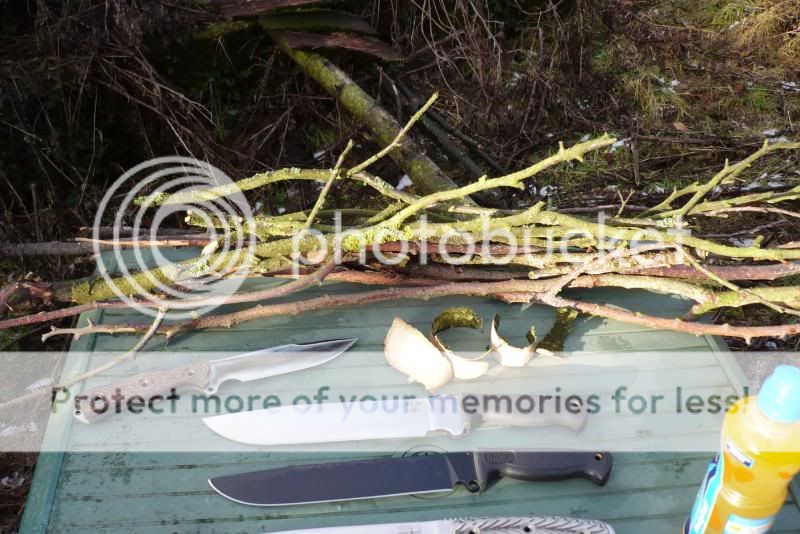
Here are the knives ....

P1000974.jpg


The weights and blade lengths of those in the chop off are :-

DFLE - 10" blade - 17 oz weight
Basic 9 - 9.8" blade - 15.5 oz weight
SAR 8 - 8.5" blade - 18 oz weight
Camp Blood - 7.3" blade - 17 oz weight
Camp Tramp - 7" blade - 13 oz weight

Weather wise we still have remnants of snow on the ground but the majority of it has melted although the ground is sodden wet and there is still a fair bit of snow up on the Moors.

P1000975.jpg


P1000976.jpg


The wood on the ground is completely wet through .... I gathered some branches set aside from limbing a tree I had chopped down in an earlier post on the KZ Chop Off and took some drier dead wood sticks which I could find hung up in branches along with a few bits of bark from trees as a base for a fire and a few slices of birch bark for tinder ...

P1000978.jpg


P1000979.jpg


I wanted to see if I could get a fire going in these wet conditions .... but first off I needed to chop some wood ....

I started off with the Basic 9 .... this still has the factory asymetrical ground edge on the knife and has only ever had a bit of stropping and a run across with a ceramic rod to remove any wire edge when finished .... the edge is therefore as from the factory and despite having done a fair bit of work is as sharp now as when I got the knife ....

P1000980.jpg


For the second lightest knife on the test the Basic 9 has great chopping ability ... like many knives with Res C grips the comfort of the knife when chopping is very noticeable compared to a normal grips and the blade has a nicely "weight forward" feel to it .... the knife could bite deep into the wood and went through the long branch section easily and quickly ...

P1000981.jpg


Able to bite into the wood up to the spine when chopping it only took 6-7 strokes to cut through this section.

I then decided to give it a go at an awkward thicker section where there was a fork in the branch ....

P1000995.jpg


This was thicker stuff and the above pic shows the knife starting to open up a V cut which was as wide as the branch was deep .... this took a fair bit of time to get through... about 20 chops altogether .... but once the V was started the knife did very well ... the extra number of chops were mainly because of a tight angle the knife had to get through where the wood branched off into a fork .... and for it's relatively light easily carried weight this knife performed very well. The asymetrical edge may look a bit unusual but there is nothing wrong with it's ability to chop wood.:thumbup:

Next up was the SAR 8 .... at 8.5 inches on the blade it is slightly smaller but because of the handle design which enables a good rear grip this knife can be chopped with the same leverage of the Basic 9 above. It is slightly heavier at 18 oz's ... about 2 oz's or so more than the Basic 9 but within this weight "range" these slight differences don't seem to matter as much as how the knife feels in the hand. If the knife has a good solid "weight forward" feel to it ... it can chop well ...

P1000982.jpg


The SAR 8 like the Basic 9 was able to bite deeply into the wood and certainly as deep as the blade ... more than the blade thickness if the grip shape was "maximised" with a rear grip position ... which is still quite comfortable in hand although the most comfortable chopping grip is "mid handle" in the normal fashion ...
 
Last edited:
Again similar to the Basic 9 the SAR 8 went through this branch section in 6-7 chops ....

P1000983.jpg


It is in many ways a very similar knife .... the Basic 9 feels more blade heavy when held normally probably because of the hidden tang and the fact that the weight in the SAR8 tang acts like a counter weight to the blade ....when infact overall the SAR 8 is the heavier knife ... if you hold it to the rear of the grip though you can make that extra weight pay off when chopping but the downside to this is that it is not as comfortable ... the upper pommel heel curve of the grip bites into your thumb pad when the knife impacts ... so for extended chopping it is best held normally ....

Taking the knife to a larger section of branch this definately showed to be the case ....

P1000996.jpg


P1000997.jpg


This was quite a thicker section of wood which needed to go through two branches .... it took about 32-34 chops .... by this stage I was not wanting to use a rear grip and definately looking for the most comfortable grip I could find .... it could be simply that I have large hands but for me I would be interested to find out how a thicker grip on the SAR 8 might feel .... I like it's slim profile though and for camp knife use it is quite comfortable "as is" .... the edge on this knife is also as from the factory and is a good solid convex profile which came very sharp. Shaving sharp on the flat of the blade in parts and having a more robust steeper edge from the belly to the tip.

This is the only section I might run over the belt sander to give it comparable sharpness to the flat of the blade .... after that the knife would only need stropping IMO to keep it razor sharp .... and I like the depth of the blade on this knife ... it strikes me as being a very easy knife to keep a zero convex edge sharp if you had to take it to a sander .... almost perfect for a slack polishing belt as the depth is not too deep and would easily be sharpened if you had to use the edge "hard" ... and I reckon the same would apply to using a mouse matt and grit paper too. All told I found the SAR8 to be a very pleasing knife to use in chopping .... not quite as comfortable as the Basic 9 but easily "comfortable enough" and the grip design is well thought out to maximise chopping power if you needed to in "short bursts".

Next up was the DFLE ....

P1000984.jpg


P1000986.jpg


I have to say I love this knife ....:):):) At only 17 oz's the chopping power on this 10 inch blade is in a different league to the others above ... it only took 4 strokes to go through the branch which was slightly thicker as we were moving down from the top. My third chop I did hit just where I wanted to and you can see above how deep the cut went. It only needed triming off with the fourth chop. I like the feel of this knife "very much" and it seems to lend itself to the idea some of the physics boys have been bandying around about speed and power. It has a very nicely weighted feel to it in terms of being balanced but still "weight forward" for chopping...and the 1.5 oz increase in weight over the basic 9 just seems to have a remarkable effect. It does have a larger blade when looked at and it shows through in use.

This knife is quite a remarkable one for me ... it still has the factory edge on it and I have never sharpened it or stropped it! Despite a serious amount of use! It came off the Exchange as a "brand new never used" knife and it had the best "straight V ground" edge I have ever had from all my Bussekin blades. When I got it ....it was "hair popping" sharp ....and dull as it now is in terms of not being shaving sharp ... the edge that is there still goes through wood like crazy :eek: It's one of those knives I have never used for slicing and only chopping and whilst I have been saying to myself I must give it a run over the belts .... I would either forget or come to a "need to use" the knife situation and after a while of taking it out and still finding it doing well .... this knife has now become a long term experiment to see how well it will keep going "as is". The edge seems to have gone off being shaving sharp but never gets any worse from where it is now at. It reminds me very much of an Axe .... and given it is SR77 which is used in some Axe heads ....I am not suprised. It is very tough stuff! It must be over a year or more since I got it ... probably two years ... and it just seems to "shine" on chopping.

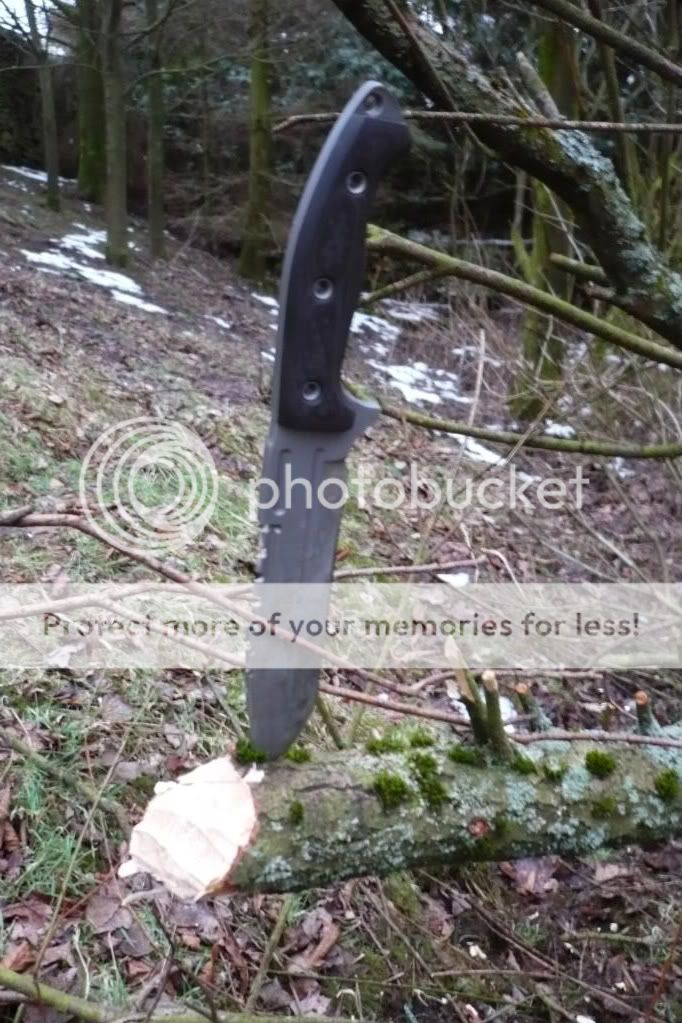
As I am typing this I am holding the knife to just check it over ... it really does need some work on the edge ... there is an inch just infront of the choil which reminds me of what it once was .... really sharp .... but the rest of it feels pretty dull ... I ran the edge over some thick card paper and it "shudders" and only cuts in slightly .... new ... it would have split it in two ... so I guess it is time to sharpen it .... but looking at the results above it does'nt do too bad does it ? I am well pleased with this knife ... and performance wise I would say despite it's light weight it would probably stack up to a BWM .... which when mine comes I will give it a run by ... I also have a BWM LE coming so that should prove interesting ... I think it was Cobalt who said the DFLE was a poor man's SHBM and I think he is right!

P1000987.jpg
 
Last edited:
After the DFLE I got out Jeremy Horton's Skinny Serrated Camp Blood....this is also 17 oz's and yet is .270 thick ...at 7.3 inches and a full tang knife with carbon fibre scales this comes in as quite a light knife for the spec's on thickness. Made from A2 it reminds me why Jerry started out using A2 as it is a very good steel for chopping and takes and holds a cracking edge ...."Platinum Edge" as Jeremy would say .... this knife has been on my webbing for a while now and I took it off to bring it home for a run over the belts and a bit of stropping which it has'nt yet had .... so whilst it is still quite sharp it is'nt as hair popping as it can be .... nonetheless....

P1000993.jpg


This knife bites deep .... it really is a little "pocket rocket" ... it went through the branch in 7-8 chops which is not bad for a smaller 7 inch knife .... it's chopping ability for it's size is one of the reasons I like to use it as a webbing knife although I have swapped it out to give a SFNO LE a try out as they both weigh the same .... otherwise I would have included the SFNO in the test but it is'nt here ...

It has a lot of comfort in the handle shape and having modified the clip to a sharper drop point the knife works very well with a ferro rod using the clip to strike it and the tip makes for a much more centralised ability to focus power to if stabbing or rawling into wood....

100_0507.jpg


Then finally we come to the Camp Tramp .... at 13 oz's this was the lightest knife here ... but it still has that useful "weight forward" balance to it and is able to perform suprisingly well if you were to compare it to the Camp Blood on weight .... it has had an edge put on it by Jeremy though who also stripped and bead blasted the knife for me .... and the combination of a good edge and blade heavy feel enables it to bite deeply on chopping ...

P1000988.jpg


P1000990.jpg


P1000991.jpg


It did the last section of the log in 6 chops for the smaller side fork and 8-9 for the main section .... it really amazed me actually as to how well this knife could chop for it's weight .... and it is a comfortable knife to use .... it felt no real difference to the Camp Blood on chopping but was giving away quite a bit of weight ... this definately showed to me that these Res C knives with skeleton tangs and blade heavy balance can perform much better at chopping than their over all weight would have you expect them to. The comfort of the grip is also quite a big plus :thumbup:

All told I think that for chopping purposes you don't really see a remarkable difference in the type of edge on the knife so long as it is reasonably sharp ...it seems that balance and weight/blade heavy feel play just as much a part in making the knife chop well ... and within a given band of weights it is more the size of the blade/knife which plays a part in increasing performance than the total overall weight ... with longer blades coming out better.
 
Last edited:
Excellent!!!
Cant wait to read the rest when you have it posted.

Curious about the choil on the B9... finger sized? or a bit smaller? :confused:

Looks tiny compared to the DFLE choil.

.
 
Thanks guys ... sorry for the delay ... my upload times to photobucket were the slowest I have had .... although we have a snow blizzard tonight and this may be causing some problems with the phone lines .... I will cover off the Lapplander saw and the bushcrafting side of things in a later post in this thread but I need some kip ... this took a lot longer than I thought it would and I have been up way later than I intended ...:yawn::D
 
Nice review Peter, you've got an awesome collection of choppers there. :thumbup: Also some beautiful scenery in the background too! :cool:
 
Thanks for being patient and the comments so far .... just needed a quick kip and I am fine now ... so let's finish this off ... and have a look at the Laplander Folding Saw ....

P1010001.jpg


This is quite a handy bit of kit in that it only weighs 6 oz's and when unfolded can tackle some quite big jobs ... certainly the thickness of a good limb or log for the fire ... and whilst I know this saw works brilliantly with dry wood it was struggling with this wet stuff .... the bark was very wet and would detach itself from the log and snag the blade up ....

To solve the problem I sawed right round the log and using the spine of the saw scrapped the bark off ...

P1010002.jpg


That worked fairly well until the saw blade started binding in towards the middle of the cut ... so I took the Basic 9 and batoned this into the cut to open it a bit .... like using a wedge .... at .25 thick the Basic 9 is well suited to this role as the blade is not too deep and has a good wedging effect ....

P1010004.jpg


and with some slack created in the cut the saw finally got the job done ....

P1010005.jpg


The Saw is a good "tool" for it's weight but definately struggled with the wet wood ... it took about at least twice as long as the longest time for a knife and when we come to seperate the knives ...because we are just talking a few extra chops we are only talking "seconds" between them. The messing about with the saw was more a case of "minutes" ... although with dry wood the saw is a very fast cutter ....
 
Holy Hades Peter!! :eek:
I feel like I'm reading The Busse Journal! :eek:
:thumbup::thumbup::D
 
Very nice review! That's a lot of good info. I've got to agree that any mid-size or large blades I've had with Res-C handles have chopped extremely well. :thumbup:

Did you get your fire going? :D
 
Well with a few logs chopped I fancied trying some bushcrafting skills on firelighting ....

P1010006.jpg


To get the fire going with wood this wet I knew I would need some thin dry tinder .... and wanted to see how a SJTAC I stripped and modified would do at this task ....

P1010007.jpg


The main edge on this is my sharpest Busse and possibly my sharpest knife .... so delicate use of this for stripping bark on pencil thin dry twigs often led to the knife going through or snagging "buds" and often snapping the twig .... these were like thin biscuits in terms of easily snapping ... so one of the reasons I like working with a smaller knife which has a sharpened swedge is that the more obtuse grind on the swedge lends itself much more readily to be used as a scrapper .... you can see what I mean in the pic above ....

The size of this knife though is just a little bit long for delicate work in terms of looking for the ideal ... you can choke up a little on the blade and this does help ....

P1010008.jpg


and you can work with the edge near the choil as pictured above and this works best of all but compared to the smaller S5LE and RMD I normally use this knife does feel a little large for my preference ... I guess I need more time with this one and the light was fading fast ....

So I went and got my S5LE and a RMD I had'nt used and was keeping as a spare ... as this had a cracking edge on it like the S5 ... and my normally used RMD was in need of sharpening after using it to cut some patterns for sheaths out of heavy hide .... these knives are like "old friends" and work well for me ....

P1010013.jpg


P1010015.jpg


It was'nt long before I had enough tiny fuzz sticks to take a flame from ferro rod sparks flashed onto roughed up birch bark ....

P1010014.jpg


P1010016.jpg


After perservering for a bit trying to get the sparks to fall where I wanted them and to "catch" on the tinder I finally got things going ....

P1010017.jpg


You can then use the bark strip to move the fire to the ground near your tinder and slowly build up a fire ....

P1010021.jpg


And job done .... I enjoyed a cigar and a cup of tea ....:D
 
Outstanding Peter!!! :thumbup:
Great pics and nicely written.

Curious... which would be your first choice... the B9 or the DFLE? :confused:
And is the choil on the B9 large enough for your finger when choking up?:confused:

Thanks for taking the time to share this! VERY :cool:

.
 
Last edited:
Thanks for that thorough chopping and cutting comparison, Peter. The little Camp Tramp is still an impressive knife. And the DFLE, well, it has been my favorite chopper for a while. Don't worry, it sharpens easily. Great review. :thumbup:
 
Outstanding Peter!!! :thumbup:
Great pics and nicely written.

Curious... which would be your first choice... the B9 or the DFLE? :confused:
And is the choil on the B9 large enough for your finger when choking up?:confused:

Thanks for taking the time to share this! VERY :cool:

.

The Basic 9 or the DFLE is like the KZ or the NMFBM ....a really hard choice .... I don't honestly know yet ... I have never tried the DFLE at "edge work" nor really the Basic 9 at the same thing .... I would need a bit more time to know for sure .... and yes I can partly fit my finger in the choil and partly press it against the choil eyelet for choking up ... feels "tight" but OK for me ... although I have thin fingers compared to some .... you could always widen the choil though if you needed to .... I reckon a drum sander dremmel and the knife anchored in a press ... followed by a drum sandpaper fitting at different grits and a polishing pad ... but mine works fine as is :thumbup:

To go back to your question though ...

My thoughts are that I would have a Basic 9 instead of a SAR8 ....and see those as close comparables ....

The DFLE is like the next rung up on the ladder to me .... something to compare to a BWM LE or CG or if you had the money a SHBM ... it chops in that sort of "territory"...

That's how I would justify to myself "keeping both" :D:D:D
 
Back
Top