Basic steps from start to finish?

Joined
Apr 6, 2001
Messages
4,836
hey guys, yes, I have decided to venture down that lonely road of making knives... :D

Does anybody have a quick bullet point of the general steps to make a knife? I know this can differ from one maker to the next, but I am more interested on what you guys do with the different 'grits' before and after heat treat. Eg. 40, 60, 80, 120 - heat treat and then 120 / polish...or, can I go straight from an 80 grit to heat treat and then simply hit the knife with 120 when its done?

I hope I am making sense. :confused:
 
Well,you are making sense,but the question isn't clear.
Assuming you have read up on this field (several books at least),and learned form another smith in your area (highly advised),then there are some basic steps to consider.
1) start at the coarsest grit you NEED to grind out the marks in the steel.If you are forging and the surface is pretty rough,50 grit.If it is stock removal,50 or 80 grit depending on how much you are trying to remove. From there it is a good rule to double the grit each change.50,100,200,400,etc.or 60,120,220,400,etc. Exact doubling is not the idea,but there is no advantage to using every grit there is 40,60,80,100,120,etc. (unless you are selling sandpaper).
2) Planning will avoid half the problems you encounter (not trying to rush things will avoid most of the rest).Draw out the knife on paper -just a bad sketch is OK.Write down the steps you will take to make the knife - all of them! Make a list of all the materials and,tools,supplies,and other things you will need to complete the project. Mentally go through the whole making of the knife -how you are going to shape it (and in what order)- what to forge and what to grind (if forging) - when to do the HT and temper - Finishing and decoration.
3) Do as much as you can before HT ,and make sure you have done all that NEEDS to be done before it is hardened! Drilling tang holes in hard steel is mot the way to enjoy knife making! Don't grind all the metal away from the blade edge area.Leave some to remove after HT.There is a layer of decarb called the "rind" left on the steel after HT.You have to grind it off to get to the good steel under it.About 1/16" thick on the edge is a good place to stop before HT.
4) After HT - GO SLOW - grind bare handed,and dunk the blade in a bucket of water when it gets too hot to be comfortable.You can ruin the temper in one second flat by trying to rush the finishing of the blade.
5) THINK SAFETY - Understand what your tool are supposed to do and what they aren't.Don't force a tool do do what it isn't designed to.Remember - when you have to push hard on something,it isn't being done with the right tool! Buffing is the most dangerous,be very careful.
6) Purchase good materials from good suppliers.If a person makes his living selling knife supplies,he probably knows which are good and which aren't.Salvaged steel and handle material are fun when you are experienced,but best avoided when learning.
Stacy

 
Thx for the advise Stacy.

I took it and have ground some knives up which I am more than happy with. Finished up with a 120 grit finish and will leave it at that I think.

Lesson No. 1 - Respect your buffing machine! I hit one with a short polish to see the type of finish and the tip caught, throwing my hand around and appropriatly taking of the top of my thumb.

Lesson No. 2 - Where a respirator ALL the time when grinding anything. It takes a week to get antler and steel out ya nose....

:)
 
bladsmth that 1/16 decarb you talk about thats not if you foil wrap right
i take blades up to 220 or so before heat treat (foil wrap) makes for cleaning up the blade easy but maybe i should be grinding more off after the HT please do tell
butch
 
Butch,Are you foil wrapping your carbon steel? It would seem to be hard to get a proper quench with a foil jacket on the blade.
It is my opinion (and others may well not agree) that any carbon steel blade will have a certain amount of rind (decarb) on it after quench.Many people have noticed that a new knife doesn't really get sharp,and stay sharp, until it has been sharpened three or four times.That is due to the difference between the steel at the surface and the steel under the rind.Once the surface has been removed,the quality of the blade is greatly improved,thus you should leave a little to take off after HT.With the edge at 1/16" you will sand off just about the right amount.It also reduces edge distortion caused by having too thin a edge at HT.(the Decarb isn't 1/16" thick,that is the edge thickness before HT). What that works out to is a start edge of .060 being reduced to .025 to .030 after sanding.This is a good proportion before forming the final edge bevel.
If you are wrapping stainless,you can go to 95% final dimensions with no problem.
Stacy
 
oooooo i see
and yes i am using foil in my evenheat kiln on both 440c and cpm3v air quenching steel
ive been kind of doing things in the wrong order so far as learning never been one to do things like every one before me ;)
ive been takin the edge to about .050 or so
im also planning on getting some cpm125v and have been told to grind as much as i can before heat treat
guess im going to leave some blades alittle thicker for next time to see how things turn out
 
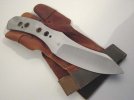
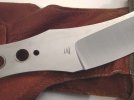
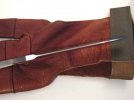
Well, my first effort. Still some work to do. :o
 

Attachments

  • G1.jpg
    G1.jpg
    24.2 KB · Views: 58
  • G2.jpg
    G2.jpg
    30.6 KB · Views: 38
  • G3.jpg
    G3.jpg
    34.8 KB · Views: 39
Butch,In stainless you can go pretty thin on the edge before HT.With a good tight foil wrap and all there is not much damage done to the surface.Not compared to carbon steel and oil quenching. .050 is a good place to stop for most per=HT grinds.You are right about the super alloys - get them near finished and sanded as smooth as you are going to go before HT.
Stacy
 
Great first efort It was a lot higher up the make list for me to get one that good.

You may get a lot of argument and personal taste come into the finish. Some like the deep grind scratches left on the hollow grind they look kind of cool to me. But I have also buffed them to a mirror shine.

For stainless 440c I generally sent to a vacum heat treated. 600 gritt come back perfect very light clean up.

Heat treating open blade, no wrap or foil, sometimes some re sanding is required. I would stop at 320 to 400 grit.
 
Back
Top