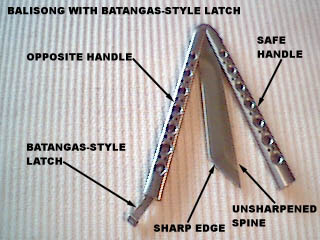
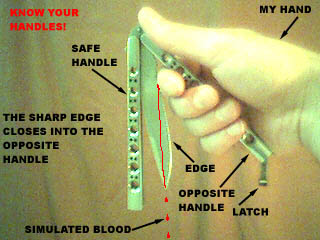
A Batangas-style latch is attached to the opposite handle. This is the most common style of latch.
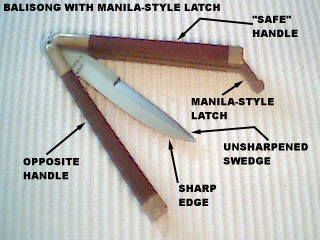
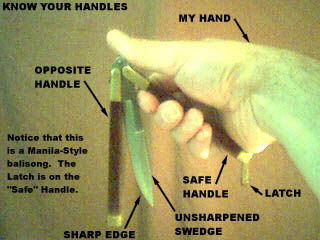
A Manila-style latch is attached to the safe handle.
This, of course, raises the very important question of which handle is which. This is the big secret of the balisong cult. This is your initiation into the illumiated inner circle of balisong artists.
The "safe" handle is the handle that the unsharpened spine of the blade closes into. It's called "safe" because, on a single-edged blade, you can not be cut while holding this handle.
The opposite of safe is dangerous. The opposite handle is the handle that the sharpened edge of the blade closes into. (Some people call this the "bite" handle.) When manipulating a balisong, the artist must exercise great care when holding the opposite handle.
Notice, please, that in both of these pictures, I am holding the handle with the latch. Yet in one picture, I am holding the safe handle while, in the other, I am holding the opposite handle. The latch does not determine which handle is which.
On a balisong with a double-edged blade, such as a spear point or Kris, the opposite handle is the handle that does not have the latch attached. On such a balisong, the handle with the latch attached is not "safe", so it is called the "latch handle."
If a balisong has a double-edged blade and is also latch-less, then the handles have no names since there is no distinction between them.
You may want to review the terminology page on my web site.
http://www.balisongcollector.com/terminology.html
------------------
Chuck
Balisongs -- because it don't mean a thing if it ain't got that swing!
http://www.balisongcollector.com