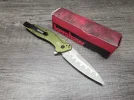
Benchmade Codex87 and laser based metal fusion

This is gonna be the next big thing

  • Yes

    Votes: 0 0.0%
  • No

    Votes: 6 50.0%
  • This has been around forever. Are you new or something?

    Votes: 4 33.3%
  • Benchmade knives are overpriced

    Votes: 3 25.0%

  • Total voters
    12
I thought they were going to sinter an interesting blade shape before I opened the article. This, I don't see any point for. It's basically san mai with a much more limited lifespan, looks like the harder steel doesn't extend to the spine and will sharpen out.

I'd be interested to see sintered blades in shapes that would be difficult or impossible to machine and grind, but that would be more for niche art knife applications. For most knives, this tech just wouldn't be efficient.
 
One simple observation is the major difference in the corrosion resistance of the Rex 121 edge vs the stainless body. If that combination of materials is left for any time in just a mildly corrosive environment you will get a good amount of corrosion. It's a galvanic cell waiting to happen.
 
Read the article, came back to say "Looks like Kershaw's dual-steel process". I really like those Kershaw knives, never got my hands on one though.
Edit to add, it's not even along the entire cutting edge, just the belly and tip, and there is not enough of it to go through very much sharpening. Yeah, it won't need sharpening for 10 years, but still, there's not much steel there in that high wear zone where some hunters are prone to over sharpening anyway. At least my dad is. He doesn't even check the edge after a deer, runs straight to the coarse/medium diamonds for a "touch up", which is 10-20 aggressive passes on the diamond stone. I'm trying to break him of this.
 
Last edited:
This and the refreshed Bugout will easily be $500+ and I don't think you're tempting a large number of knife enthusiasts with a Benchmade at that price point unless it is an Anthem.
 
I don’t love it but I don’t hate it either. I like to see new ideas applied to knives. Even if it’s not perfect, it’s definitely unique and many will want it for that aspect alone. Blades made with different materials have been around for a LONG time. It’s a concept that for some purposes makes a lot of sense.
 
That thing is 1 reprofile away from it barely having any rex121. Hmm, I like innovation though this one isn't for me.

A san mai'd version would make more sense.
 
I doubt many would buy this to use, and of those even fewer will have the sharpening skill to address the two steels differently and get the most life and benefit out of the rex121
 
Read this article from the SHOT Show - https://gearjunkie.com/knives/first-look-codex87-horizon-edge

Benchmade made a fixed blade with Dama and a Rex121 edge.

And was curious to hear this group's thoughts on the tech of fusing one metal to another.

Can we laser fuse metals together to build the ultimate Frankenstein knife, or will this go down like 3D TVs after a while?

How It’s Made​

Benchmade uses a laser-based fusion process to apply powdered Rex 121 directly along the edge, and then heat-treats the blade as a single unified piece. There are no bonded layers and no seams you can feel in use. According to Benchmade, this is the first production hunting knife to apply bi-metal technology this way.

Not even close to the Kershaw process, and the result is quite different. Kershaw bonds two chunks together. (I'm guessing they use a brazing technique.) Benchmade is applying powder and melting it with a laser to add the layer. More like 3D printing using metal than anything else.

That thing is 1 reprofile away from it barely having any rex121. Hmm, I like innovation though this one isn't for me.

A san mai'd version would make more sense.
I tend to agree with that concern. I suppose it depends somewhat on how thick a layer they apply. But eventually wearing through the resulting layer of Rex 121 seems like an inevitable result if used long enough in the real world.

Speaking as an old materials and process engineer, this concept gets a hard pass from me. I consider it a curiosity, rather than a a process to make a product with a viable long term life expectancy. San Mai gets yo to the same place without the concern of long term durability.
 
Not even close to the Kershaw process, and the result is quite different. Kershaw bonds two chunks together. (I'm guessing they use a brazing technique.) Benchmade is applying powder and melting it with a laser to add the layer. More like 3D printing using metal than anything else.


I tend to agree with that concern. I suppose it depends somewhat on how thick a layer they apply. But eventually wearing through the resulting layer of Rex 121 seems like an inevitable result if used long enough in the real world.

Speaking as an old materials and process engineer, this concept gets a hard pass from me. I consider it a curiosity, rather than a a process to make a product with a viable long term life expectancy. San Mai gets yo to the same place without the concern of long term durability.
These are the types of things I'm wondering about. Not all methods are created equal. And some things may not be a good idea in the first place.

I know we've got some metallurgy experts on here, so I'm hoping to hear form more of them.
 
Not even close to the Kershaw process, and the result is quite different. Kershaw bonds two chunks together. (I'm guessing they use a brazing technique.) Benchmade is applying powder and melting it with a laser to add the layer. More like 3D printing using metal than anything else.


I tend to agree with that concern. I suppose it depends somewhat on how thick a layer they apply. But eventually wearing through the resulting layer of Rex 121 seems like an inevitable result if used long enough in the real world.

Speaking as an old materials and process engineer, this concept gets a hard pass from me. I consider it a curiosity, rather than a a process to make a product with a viable long term life expectancy. San Mai gets yo to the same place without the concern of long term durability.
Agreed, for those of us who thin our edges upon receiving a knife, that's not a good idea with this knife lest you cut off years of its lifespan.
 
Asked Shawn Houston/Big Brown Bear what he thought on FB of this as a concept. He said he'd need to see it under a microscope to really know much. Which makes sense. And then you'd need to see it again after it had been sharpened a couple of times and use it to make an informed opinion. I suppose we should be happy that there are companies trying new things out. I do wish Benchmade wasn't so overpriced for what you get. I'm gonna to stick to my 2 Osbornes for now.
 
Back
Top