
-
The BladeForums.com 2024 Traditional Knife is available! Price is $250 ea (shipped within CONUS).
Order here: https://www.bladeforums.com/help/2024-traditional/
You are using an out of date browser. It may not display this or other websites correctly.
You should upgrade or use an alternative browser.
You should upgrade or use an alternative browser.
Benchmade steel
- Thread starter gull wing
- Start date


- Joined
- Aug 5, 2001
- Messages
- 4,306
Hmmm....I had just the opposite experience. All my BM's are old school and all are 154cm. They hold an edge quite well and I can get them quite sharp with very little effort, in my experiences.
Last edited:


- Joined
- Sep 13, 2017
- Messages
- 9,115
As Knarfeng mentioned, S30V will hold an edge longer than the 154cm used previously.
One thing I really like about the 154cm however, is how tough it is. For an average user it takes edge impacts and resists chipping better than S30V in my uses. It sharpens very easily as well.
S30V is no slouch though. It’s a nice middle of the road steel choice.
One thing I really like about the 154cm however, is how tough it is. For an average user it takes edge impacts and resists chipping better than S30V in my uses. It sharpens very easily as well.
S30V is no slouch though. It’s a nice middle of the road steel choice.
The problem was with the Bailout in 3V. The heat treat was spec'd soft for toughness and people got upset because they wanted more edge retention.Wasn't there a problem with Bailout M4? I haven't heard any other bad things about their blades outside of not coming centered.

No complaints or problems in any of my BM. I have them in 154CM, S30V and D2. 154CM is great steel for what I use my blades for. I have folders and fixed blade from BM that have held up great over 10+ years and takes a wicked edge. Personally I wouldn't mind seeing more of the 154CM in some of their newer models like the Bugout. S30V has been just as good and personally it's where I'm at for their knives. I see no need for my intended use to go with anything that is considered more premium steels like M4 or M390.

- Joined
- Jun 29, 1999
- Messages
- 10,070
My BM Mini-Rukus -- my first knife in S30V -- takes a very fine edge, morseso than my Spydercos in that steel. My BM 710 and Grippie in D2 take a similarly fine edge, compared to my Dozier K2 (which cuts like a miniature chainsaw, no complaint). I don't care for CM-154 (CPM-154 is another matter) whether BM or Emerson; it's OK but not particularly outstanding in any aspect IMHO.
As others have mentioned, if edge retention while cutting abrasive materials for long periods of time between sharpening is what you are after: S30V is going to do better than 154CM. The tradeoff is that it is far more difficult to sharpen, CBN or diamonds almost being a requirement and it has a higher probability to chip if you are hitting very hard things like staples etc.
S30V now also has the advantage of being prolific. Economies of scale mean that BM can produce knives with S30V for far cheaper than they could back when S30V was a new thing.
S30V now also has the advantage of being prolific. Economies of scale mean that BM can produce knives with S30V for far cheaper than they could back when S30V was a new thing.

Chuck_Nunface
Gold Member
- Joined
- Oct 26, 2020
- Messages
- 4,147
I'll say this: I'm not a huge BM fan and only have 2 - a modified grizzly ridge in s30v and the new mini adamas I picked up recently in Cru-Wear. BM's HT of cruwear seems spot on - holds a decent edge, strops back to shaving and is nice to sharpen.
I’ve owned many Benchmades in S30V and 154cm. I really couldn’t tell much difference between the two in any way. Both had good edge retention, and sharpened up very easily. I really don’t understand their reason for dropping 154cm as a standard blade steel. However, it did give them an excuse to increase the prices of their Griptilian line.

AntDog
Basic Member
- Joined
- Apr 3, 2001
- Messages
- 27,712
I freaking love Benchmade’s S30V. It gets razor sharp easily and holds the edge for a long time. It also holds up well to hard work without chipping, denting, or rolling. If you like their 154CM you’ll be mighty impressed with their S30V.
If I really have to G.S.D. and I can’t bring a fixed blade, this Presidio is the one I grab.
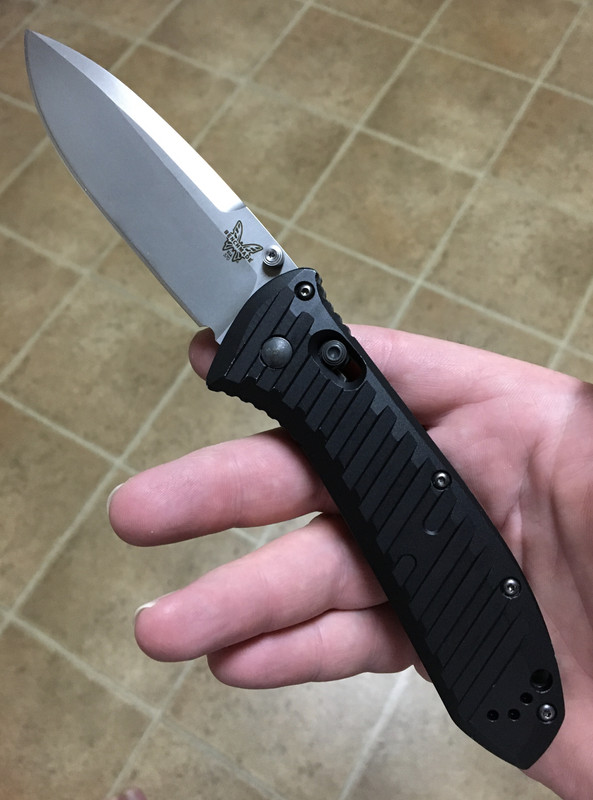
If I really have to G.S.D. and I can’t bring a fixed blade, this Presidio is the one I grab.
- Joined
- Sep 26, 2006
- Messages
- 195
S30V is a *very* wear-resistant steel. I think most of us have totally lost sight of that. Sure, M390 or the like has more carbides, and S30V trades away some toughness compared to some steels. But it deserves to be the gold standard for performance.
Hardness in a knife will be very difficult to determine unless:
A) you have another knife to compare in cutting tests, and it has the same edge geometry in addition to the different level of hardness
B) you have a hardness tester
C) you spend significant time re-sharpening a lot of knives
So...
Based on an extremely limited set of data :
(I also have three of the listed Benchmade knives of my own to compare informally)
Benchmade has, at times, run steels soft. In addition to the 3V fiasco, Look at the M390 knives in this chart. (I own the Barrage and can attest to softer-than-expected heat treatment.)
(Note that most other manufacturers are doing the same with M390. Kershaw and Spyderco being notable exceptions.)
That said, more recently, Benchmade seems to have shifted their target. Some of their S30V is actually testing harder than some of Spyderco's. (Everything sitting within tolerances for HT and testing error, I'm sure.)
But IMO the biggest problem Benchmade knives have is grind profiles. If you re-grind at least the back-bevel secondary edges to thin out the cutting geometry, they're excellent knives. (I also remove the thumb studs.)
If you want to talk about a manufacturer running shamefully low hardness on otherwise-premium knives, look at the numbers for Lionsteel...
Hardness in a knife will be very difficult to determine unless:
A) you have another knife to compare in cutting tests, and it has the same edge geometry in addition to the different level of hardness
B) you have a hardness tester
C) you spend significant time re-sharpening a lot of knives
So...
Based on an extremely limited set of data :
Google Sheets: Sign-in
Access Google Sheets with a personal Google account or Google Workspace account (for business use).
docs.google.com
Benchmade has, at times, run steels soft. In addition to the 3V fiasco, Look at the M390 knives in this chart. (I own the Barrage and can attest to softer-than-expected heat treatment.)
(Note that most other manufacturers are doing the same with M390. Kershaw and Spyderco being notable exceptions.)
That said, more recently, Benchmade seems to have shifted their target. Some of their S30V is actually testing harder than some of Spyderco's. (Everything sitting within tolerances for HT and testing error, I'm sure.)
But IMO the biggest problem Benchmade knives have is grind profiles. If you re-grind at least the back-bevel secondary edges to thin out the cutting geometry, they're excellent knives. (I also remove the thumb studs.)
If you want to talk about a manufacturer running shamefully low hardness on otherwise-premium knives, look at the numbers for Lionsteel...
Last edited:

The problem was with the Bailout in 3V. The heat treat was spec'd soft for toughness and people got upset because they wanted more edge retention.
Amazing, take a super tough steel, use it in a lightweight folder, and then run it softer than normal because, uh, maybe people were looking for a 3" splitting maul?