

- Joined
- Sep 3, 2004
- Messages
- 450
The fun part about cutting competitions is that as a knifemaker you are constantly thinking about improvements. The shape of the blade, the edge geometry, the grip and the method of hardening are all topics that occupy my limited brain.
A few days ago my good friend and knifemaker Erik Markman was visiting me and we decided to test our cutting knives. Soon we decided that they could be improved upon, so what do you do with the old ones? We both wondered if our hardening was good enough. That the knives kept their sharpness more than well we already tested. But what about the rest? I wanted to break my knife to see the grain size at the edge and at the back. I also wondered how far I could bent the fully hardened, forged O1 toolsteel blade.
We placed the blade in the vise without any wooden blocks for about 1.5 inches from the tip. The blade was to strong for me so I placed a steel pipe over it. Finally Erik bent it more than 90 degrees but still it didnt break. The blade sprung back to a 50ish degrees. The edge is undamaged.
Next we put Eriks blade In the vise. His knife is made out of 1.5026 (comes in the neighbourhood of 5160), selectively hardened and is more tapered than my knife. With all his weight on the knife he managed to bent it more than 90 degrees. His knife also didnt break or crack what so ever.
You can see a difference between the two blades where the bent starts. I think its the hardening method and geometry of the blades that makes this happen.
We learned a lot from this test. First of all we know that our hardening is more than ok. Also we noticed the hidden/through tang construction that we both use a lot is mighty strong. When the pipe was slit over the first blade the handle bent quit a lot, but sprung back into place without any damage. The last thing we learned is that we can make a fully hardened blade out of O1 for cutting competitions and not have to worry about bending the blade during a comp (which my first cutting comp. blade did).
Here are some pics (with a bit of luck some bending pics in the coming days):
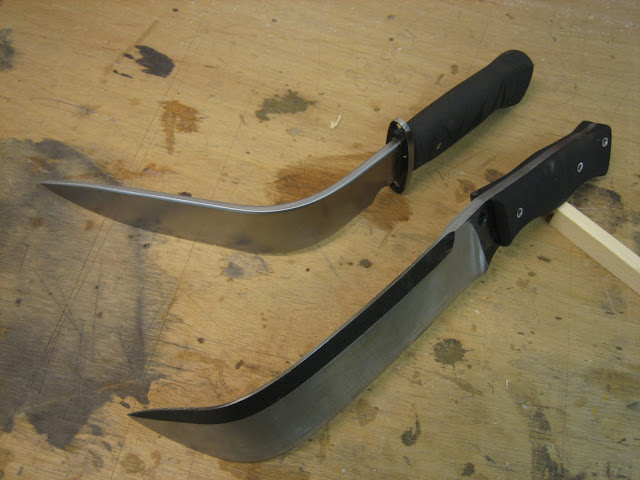
Top knife is from Toni
Steel: O1
thickness: 6mm
Hardening: full
Hardness: 60/61 RC
Bottom knife is from Erik
Steel: 1.5026
Thickness: 6mm?
Hardening: Selective
Hardness: 60 RC?
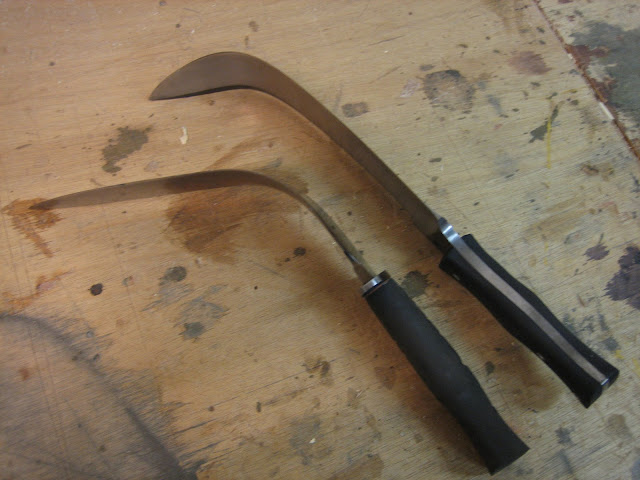
A few days ago my good friend and knifemaker Erik Markman was visiting me and we decided to test our cutting knives. Soon we decided that they could be improved upon, so what do you do with the old ones? We both wondered if our hardening was good enough. That the knives kept their sharpness more than well we already tested. But what about the rest? I wanted to break my knife to see the grain size at the edge and at the back. I also wondered how far I could bent the fully hardened, forged O1 toolsteel blade.
We placed the blade in the vise without any wooden blocks for about 1.5 inches from the tip. The blade was to strong for me so I placed a steel pipe over it. Finally Erik bent it more than 90 degrees but still it didnt break. The blade sprung back to a 50ish degrees. The edge is undamaged.
Next we put Eriks blade In the vise. His knife is made out of 1.5026 (comes in the neighbourhood of 5160), selectively hardened and is more tapered than my knife. With all his weight on the knife he managed to bent it more than 90 degrees. His knife also didnt break or crack what so ever.
You can see a difference between the two blades where the bent starts. I think its the hardening method and geometry of the blades that makes this happen.
We learned a lot from this test. First of all we know that our hardening is more than ok. Also we noticed the hidden/through tang construction that we both use a lot is mighty strong. When the pipe was slit over the first blade the handle bent quit a lot, but sprung back into place without any damage. The last thing we learned is that we can make a fully hardened blade out of O1 for cutting competitions and not have to worry about bending the blade during a comp (which my first cutting comp. blade did).
Here are some pics (with a bit of luck some bending pics in the coming days):
Top knife is from Toni
Steel: O1
thickness: 6mm
Hardening: full
Hardness: 60/61 RC
Bottom knife is from Erik
Steel: 1.5026
Thickness: 6mm?
Hardening: Selective
Hardness: 60 RC?


 . There are controversial destruction tests by a particular member on these forums and it always gets someone riled up. Hardheart was just poking fun at those who get offended by such destruction tests.


