Bent backspring?

silenthunterstudios

Slipjoint Addict
Joined
Feb 2, 2005
Messages
20,039
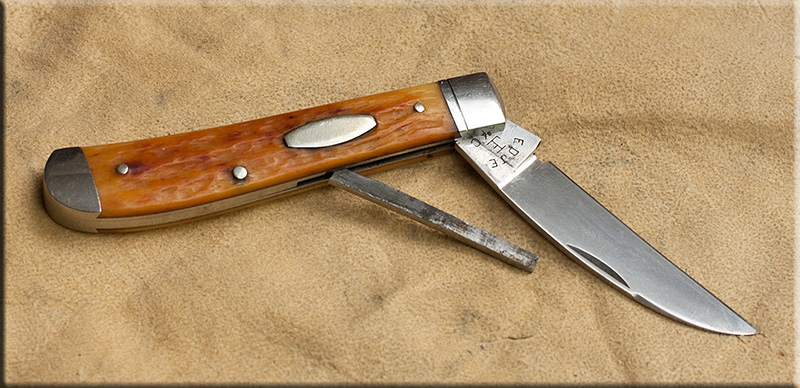
I was looking over a knife before I sent a description and pics to a member here, and was dismayed to find the main blade backspring had an indentation in it. The backspring was bent! I have had a Buck 703 spring break in my hands while opening it (the infamous problem reported with 7xx patterns). I have seen old knives in heavily used condition that still have great walk and talk. This knife is a stockman pattern, a really pretty looking knife, that has had a soft pull, but works fine. It was made under one name by another company. I have seen some other instances of soft springs from the same company. I was just wondering how easy it is for a backspring to be damaged. The steel is D2, I am not sure what steel the backspring is made of. I am going to contact the current holder of the copyright to inquire as to whether I should send the knife to him, or to the company. This knife sat in my knife drawer, then was placed in my knife roll for knives to go on the chopping block. I didn't really use this knife much more than carry it around and cut a few things when I was recuperating last year. It looks new too, a real shame.
 
Is there a possibility that it's a manufacturing defect and just never got noticed until now? Once a backspring is hardened and tempered, it's a pretty tough piece of metal. I don't know if you can cut with enough pressure to bend one in use. I've only seen one other back spring break, and that was on a army issue Camillus MLK (demo) knife, and they were known for that. I'd be interested in what the current company name holder responds with. Good luck.:thumbup:

Carl.
 
I once ordered a Robeson Mastercraft Whittler that arrived with the spring snapped in half. It looked ok, but if you looked closely, you would see an indention and hairline crack. Needless to say the blade (coping) had no walk and talk. Usually this is a result of the two blades residing on that spring being opened at the same time thereby producing an abnormal amount of pressure against the spring pin. YMMV

Edit: this is one of the reasons I am so fond of Jack knives where the blades reside on one end.
 
I hope that turns out well. That looked like a fine old stockman.

I agree with Carl, it seems that it would almost have to be a manufacturer's defect as breaking a backspring (keep in mind the billions of traditional patterns produced) is almost unheard of. I am thinking something must have warped it during the heat treatment.

And bending one while in use? After reading your post, I don't ever recall that happening.

I have a knife with a problem from the same company with a problem and I hope you will get back to us here when you find out what is to be done by them. I am a fan of some of their knives, but they are inconsistent enough with their product that I won't buy more unless they maintain good customer support. (Under the previous ownership it was great!)
 
I hope no one thinks I am making an attack on the company. I have already talked with the current owner at Northwoods and will be sending the knife into Queen once I hear back from them. In the pics it is clear that I have both the spey and sheepsfoot blade open, but the issue is with the main blade backspring. My only contention would be that I had another issue with one of the Schatt and Morgan jacks, a "depressed" spring on the main blade. I have a sort of the same issue with my single blade jack, and premium stockman from the same Heritage series. I was told that the depressed spring would not be an issue with use, and if I had a break, send it back in for a refund. The two blade jack goes to opening mail, shame because it is a nice knife. I will let Ryan Daniels or his wife take a gander at it at the Chesapeake show this year and tell them what the Repair department said. I am confident that this one will either get a new spring or I'll get a credit. Just a shame for an older knife. I was going to sell it before I noticed this, but had that sellers remorse. Oh well, if I get it back fixed it will go in my pocket.
 
Last edited:
Not a bent example, but backsprings do fail on occasion. Carried this custom slipjoint for 10 years during which time the backspring snapped twice. Blade and spring were D2, spring probably rusted in my pocket. Don't attribute it to the level of craftsmanship as the blade took a great edge and you can see the fitment of the dovetailed bolsters. First time it broke he took it apart and fixed it, second time his ex probably threw it in the trash. Too bad as I had an emotional attachment after carrying it so many years. Bone worn almost smooth.

brokenslipjoint.jpg
 
John, that is a beauty, a real shame that happened. I've got a lot more knives to choose from, not the first knife to have a broken backspring. Unfortunately, this probably won't be the last one either. C'est la vie.
 
Queen's D2-bladed knives have springs in 420HC (confirmed this with them, via email).

420HC is pretty ductile, so I'm not too shocked if there's some denting/bending with it. I'd think Northwoods/Queen should make it right though, if sending it back.


David
 
Dan, that's really strange to see something like that on the non-business end of the headspring, that side doesn't get stressed nearly as much as the blade side. If you peer down into the knife can you see a blemish or maybe a small crack in that area? Pretty wild how it actually bent THAT much.

Eric
 
With all due respect to the maker, D2 is a horrible choice for a spring material. Generally speaking you avoid harder metals for parts that are subject to stress cycling, like a knife spring. I believe the carbides in D2 would act like inclusion defects and exposed to stress cycles actually migrate together and make a crack.


And yeah I would guess that spring warped during heat treat. Is it bowed up inside? I can't imagine that it would bend like that without completely yielding.
 
Mark, I believe those springs are 420HC. I just find it strange that the spring would bend into the knife when the spring tension should force the bend (or break if that were the case) out of the knife. Also, if the spring had warped during heat treat it would surely have been spotted before the knife was assembled. Is the bent area of the spring polished? If so that would mean that it was even with the back of the knife at the time that it was finished. The only thing I can figure is that there's a break or VERY weak area on the inside of that bend, and the tension from the spring at the blade tang is forcing the spring, with the center pin as a fulcrum, to bend at that point.

Eric
 
Last edited:
I was referring to the custom mentioned above with D2 springs. 420 should be a good spring steel as it hasno carbides.

And I agree that if it were warped during heat treat it would be obvious on assembly, but Queen has let some real headshakers through qc, as, I suppose, have all of them.

I suppose the force on the blade end could cause rotation about the center pin and flexure in that direction but it seems odd that it would deform that way without yielding completely. Usually to get a bend like that, you would have to overbend to a tighter radius and let it spring back to that lesser curvature.
 
Last edited:
With all due respect to the maker, D2 is a horrible choice for a spring material. Generally speaking you avoid harder metals for parts that are subject to stress cycling, like a knife spring. I believe the carbides in D2 would act like inclusion defects and exposed to stress cycles actually migrate together and make a crack.

Huh? D2 can be hard or soft, A2 can be hard or soft, O1 can be hard or soft, CPM154 can be hard or soft.

D2 is fine for springs. If the springs were tempered at a bit too high hardness it might cause a breakage. If the cross section was off it might cause a breakage.

Cross section determines flexibility. Hardness determines if a piece of steel breaks or takes a set once the limit had been reached.

The third law of steel says all steel flexes the same amount until it reaches its elastic limit. We can change the elastic limit through heat treating.

If I'm way off, please tell me, but I think d2 is fine for backsprings.
 
Generally yes you are right. In a sense steel is steel is steel. Youngs modulus is the same, the yield stress is the same. And yes you ca run D2 soft. But just like 1020 carbon steel would make a pretty crummy blade, D2 is not optimal for springs or parts subject to cyclic stress.


In theory hardness has no impact on the strength and flexibility of steel. But hardening generally involves production of crystal structures in the steel that can drastically affect its fatigue strength. In a high alloy steel like D2, those crystal structures are present even in an annealed state and the material is still brittle compared to annealed carbon steel.

While it could be tempered to work as a spring, over time and cycles D2 will be more subject to breakage than a carbon steel.

In other words your analysis is correct except that it fails to take into account the different fatigue strength of steels under cyclic loading like a back spring. Super steels, with their high carbide content for hardenability, will not make a very durable spring compared to lower alloy carbon or stainless steels.
 
Last edited:
Sorry to belabor this, but maybe someone will find it interesting. I'm a mechanical engineer and one of the reasons I chose that field was my interest in metallurgy, so I geek out on stuff like this.

Anyway, surface finish is a large factor in fatigue strength: the smoother and shinier the better. Even a scratch or pit can cause problems with crack propagation. So I guess we had better be careful with our backsprings! :-P


In the grand scheme the number of cycles a backspring undergoes is relatively low, although I suspect the loading is medium to high. It isn't a super critical spring, but fundamentals of machine design should be observed, which, in addition to cost, means you don't see super steel springs.
 
Frank is, as usual, correct. Should have said hardness rather than hardenability and more accurately abrasion resistance, which isn't hardness except in the sharpening sense: both qualities can make a bear to sharpen.
 
Back
Top