
Bent Blade and Heat Treat?

Joined
Jan 6, 2011
Messages
25
Quick Background..

I've been making simple 3 piece knives using the stock removal method for about a year and a half. I started off making skinners from stainless and sending them off to heat treat. I've had excellent results with the blades performance.

Recently I've become interested carbon steels and made a few knives from O1. They too have been sent off for heat treat. I do not do any heat treating.

One of these knives is a large 12" OAL knife that balanced nicely and felt great so I decided that I wanted to really get out and abuse it. I figured it could be used a "test" piece so that I could gauge durability of my components. I wanted to see how much abuse the epoxy bond would take before separation, etc..

After lots of chopping and cutting of wood and rope with good results I made a "target" from 2x4s and started teaching myself to throw. Well, long story short the knife endure about 4 evenings worth of abuse before eventually bending behind the ricasso just before the scales.

What does this bending represent as far as the way the blade was heat treated? Would a non-differentially heat treated blade bend in such a manner or would it simply break? For some reason, I was under the impression that the blade would spring back to its original shape unless the blade and handle were heat treated differently.

I was able to put the knife in a bench vice and bend it back into shape with minimal effort and this too concerned me about the way it was heat treated.

These results may be perfectly normal for a typical heat treat so please excuse my ignorance in the matter.

Thoughts?

.
 
Don't throw knives not specifically designed for it. Ever.


The good news is, if the edge held up well during your cutting and chopping tests, and it bent some but didn't break under horrific, warranty-voiding abuse, you have a good tough knife. Now stop throwing it. Repeated bending isn't good for any steel.
 
It sounds like you've got a good, tough knife. Now like JT said, STOP THROWING IT AROUND! :)

If the edge held up to all you did to it, it's pretty hard. If the tang/body/spine bent and didn't break, it's not so hard. What this suggests to me is that the blade end of the blank was hardened and the tang portion wasn't. As far as I'm concerned, this is the way it ought to be done, for exactly the reason you've illustrated: hard cutting edge combined with a tang that can take abuse without breaking.

You might want to contact your heat-treater and ask if it's only the blade end that they actually harden. I can't think of any other reason the knife should have behaved as it did.
 
There is of course one exception to the no-throwing rule... destructive testing. I don't recall where I first read it, but it's a great idea to really beat the snot out of a knife from time to time, especially when trying a new alloy or HT process.

After normal cutting tests, mild abuse like chopping 2x4's with skinners, and prying chunks out of said 2x4, I do occasionally drop point-first and slam a blade flat on the concrete floor just to see what will happen. They often break (duh). I've been known to soak them in vinegar and purposely leave them wet and dirty in a leather sheath for several days... they usually rust (duh). But as I tell my customers, "I do it so you don't have to!"

Throwing knives are very specialized and can be made to last indefinitely. If that's what you need, do a little research and make some :)

You might want to contact your heat-treater and ask if it's only the blade end that they actually harden. I can't think of any other reason the knife should have behaved as it did.

Makes sense to me. The whole blade may have been fully hardened, then the tang tempered back a bit with a localized heat source. It's very popular for exactly the reasons you described.
 
Don't listen to James, Misfire... throw everything! Ha!
After lots of chopping and cutting of wood and rope with good results I made a "target" from 2x4s and started teaching myself to throw.
It is clear to me that you did this for testing purposes.(mixed in with a little fun) In the end, it really doesn't matter the reason. I throw my knives all the time. I also dig, pry, baton, hammer, etc.... That's how I use a bush knife so I expect it to take the abuse and survive in one piece. Are my knives better because I can dig and pry? No, knives aren't meant for these tasks.... bring a shovel, prybar, hammer, axe and saw on your next dayhike, silly-bean. Destruction testing can tell us a lot about heat treat, geometry, adhesives, materials, etc... From a maker's standpoint, knowing how and when my knives will fail is important to me. Some folks are satisfied knowing what their knives can do... IMO, you'll never completely know what your knife can do, until you find out what it can't.

Back on topic. I think you need to talk to the heat treater you are using. If they are fully hardening and tempering the entire knife, they need to explain how it was able to deform. You may want to get hardness tests done on several key areas of the blade, too. I think your blade did what any tough knife should do. It is nice that you were able to cut and chop so well and that the knife didn't fail under abuse... but you need to know exactly why it behaved like that.

Rick
 
Playing a game of Mumbly Pegs, eh? Aaah, there was a fun game! Or did you call it stretch? Here's a question, why shouldn't you throw a non-throwing knife? Is it concern for snapping the blade, or something else? I figured anything not made for the kitchen or pocket should be able to be thrown. The ability to be thrown is a must for hunting knives.
 
Playing a game of Mumbly Pegs, eh?

Oh man, you triggered some great memories with that one.... I have 2 scars! Which reminds me to take away my son's pocket knife. Kids, I apologise to my parents at least once a week for the stuff I did... that my kids are now doing. What goes around, comes around.
 
Are these knives that you are actively hunting game with? I'm no expert outdoorsman, but I can't recall ever needing to throw a knife whilst hunting...
 
Playing a game of Mumbly Pegs, eh? Aaah, there was a fun game! Or did you call it stretch? Here's a question, why shouldn't you throw a non-throwing knife? Is it concern for snapping the blade, or something else? I figured anything not made for the kitchen or pocket should be able to be thrown. The ability to be thrown is a must for hunting knives.

Dunno about that. If you look at a throwing knife you'll notice a few things such as edge holding ability not much better than mild steel. Edge geometries not designed for prolonged cutting and temper regimes designed for toughness and springyness. None of these qualities will be much use to you when attempting to skin a warthog for example, where because of the sandy nature of the dirt trapped in the fur and the toughness and thickness of the hide, you want edge retention so at least you can skin one carcass before needing to re-sharpen. Most hunting knives are used for butchery and skinning not to actually hunt with them. Why would you throw away possibly your only defence against a wounded (and dangerous) animal? Even if you were good enough to hit a vital spot, you'll likely not get the penetration to kill it immediately and more likely just infuriate the animal, inviting attack. Better to lash it to a pole if looking for extended range.
 
Why? :confused: wait.. what? Either you're pulling our legs or I've really been missing something all these years...

In case you don't have a flyswatter. Just to pass the time. Lot's of reasons. Have you seen Starship Troopers: "The enemy cannot push a button if you disable his hand!"
 
WOW! Thanks for all the great replies!

The throwing really just seemed like a good way for me to determine if the Akra Glass I was gluing the scales on with was worth the extra money it costs. The shock generated from thowing would be hard to match with chopping and battoning. Since nothing abuses equipment like a beginner, I figured I'd learn to throw it. I've really enjoyed it and may have to look into making a knife or two just to throw.

The epoxy bond lasted longer than I imagined and not as long as I'd liked. This knife has been used by me quite a bit the past couple of months. I've been looking for reasons to chop and cut stuff just so I can use it. So far I've been happy with the performance.

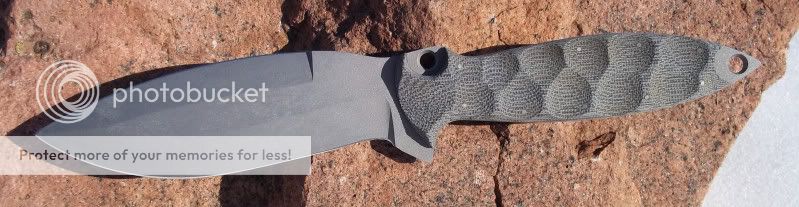
Here is a "before" pic of the knife just for kicks.(Most hate the way it looks. It's been called a fish, shovel, spear, etc.. but I REALLY like the way this one handles and feels.)

100_0563.jpg


Chad


.
 
Last edited:
Chad
Go ahead and throw your knife, I don't care. ;-)

I notice that you have not one but TWO holes in your handle. I've seen this on many "tactical" knives, as well as multiple tube-lined holes in lieu of pins or rivets. What is/are the reason(s)? I've always guessed/assumed that they were there so a person could lash it to a stick and make a spear. I understand that sometimes a wrist strap is used with a front-of-the-handle hole but am not sure why. And while I've been typing this up it occurs to me that a person could hang little charms from the front hole, the kind that girls wear on bracelets. ;-)

Enlighten me please.

- Paul Meske
 
The throwing really just seemed like a good way for me to determine if the Akra Glass I was gluing the scales on with was worth the extra money it costs. The shock generated from thowing would be hard to match with chopping and battoning.

Your logic makes sense. If you really want to make sure your scales to stay on, use Corby bolts. Look up "Glue Wars", every epoxy fails at some point. I've never known corbys to break or work loose, even when they weren't epoxied or loc-tited.

I understand that sometimes a wrist strap is used with a front-of-the-handle hole but am not sure why.

Because if you lose your grip during a mighty chop and the thong is at the front, the knife doesn't swing around and try to cut your arm off like it does when the thong is at the back. The handle stays very close to your palm. Probably not a big deal on medium knives, but it's practically standard now on big competition cutters.
 
Chad
Go ahead and throw your knife, I don't care. ;-)

I notice that you have not one but TWO holes in your handle. I've seen this on many "tactical" knives, as well as multiple tube-lined holes in lieu of pins or rivets. What is/are the reason(s)? I've always guessed/assumed that they were there so a person could lash it to a stick and make a spear. I understand that sometimes a wrist strap is used with a front-of-the-handle hole but am not sure why. And while I've been typing this up it occurs to me that a person could hang little charms from the front hole, the kind that girls wear on bracelets. ;-)

Enlighten me please.

- Paul Meske


Paul, I simply like the way they look. I suppose for utilitarian usage you have plenty of options with multiple holes just as you described above. Also, as James said, it is safer to lanyard a chopping knife in the "front" hole than a hole in the tang.

I have to admit that the profile around the front and rear holes was much "wider" when I originally ground it out. While working the scales down to the handle I let the knife get away from me and I lost a bit of "meat" at the front hole. That is one reason for that ugly angle that cuts close to the front hole and why that knife became a "test" blade.

I've incorporated front and rear holes in a few of my recent knives both tactical and camp.


Chad
.
 
Back
Top