
-
The BladeForums.com 2024 Traditional Knife is available! Price is $250 ea (shipped within CONUS).
Order here: https://www.bladeforums.com/help/2024-traditional/
You are using an out of date browser. It may not display this or other websites correctly.
You should upgrade or use an alternative browser.
You should upgrade or use an alternative browser.
Best fire making method?
- Thread starter meshmdz
- Start date


- Joined
- Jul 12, 2002
- Messages
- 3,291
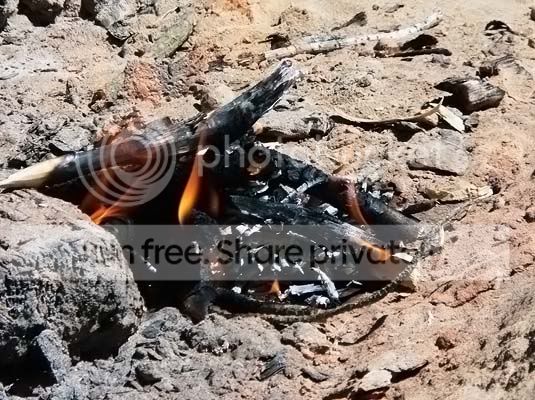
In our area, I guess my preference is to gather up some dried grass and small dried limbs an inch or so in diameter. I make some shavings from the gathered wood and loosely pile them onto the dried grass. Then I make a TP shaped structure so the fire had plenty of air. I leave a couple of pieces out and spark the tinder to life, using my SAK and a BSA Hotspark and then put the missing pieces into place. Out to out, the fire is less than 12", which is a good size for me when out alone. But then, our summers are hot and our winters are dry and cool, but not real cold, so big fires aren't really necessary. Just big enough to warm me and heat my brew/food.

- Joined
- Jan 7, 2003
- Messages
- 2,373
Short answer, a half pint of gasoline. Why fool around?
Long answer - depends on the season.
Right now in central Brazil it is dry season. The nights are cold, 50's and breezy so you do need a fire for warmth. Even in dry season when we have a cold front come through we can get night rains so hypothermia is a real danger. Fortunately everything is bone dry so much so that there is a real risk of starting a brush fire. Making a fire is not the problem as there is ample fuel and tinder available and it readily bursts into flame with little provocation.
Rainy season (Nov - Feb) is another animal entirely. It will rain almost constantly for up to a month at a time and even standing deadfall is soaked through. Nights are also cool (70's) and wet and hypothermia is still a risk if you are soaked and there is a breeze.
Prepared tinder in such conditons is a survival pack essential. It can be very hard to find dry tinder as even the stuff out of direct rain has absorbed humidity and won't light easily. I will usually pack a pair of 5 inch citronella candles, these get used for light and bug control as well. I also use PJ treated cotton balls wrapped in foil. These work very well, are easy and inexpensive to make, and pack well.
Preparing the fuel is important in rainy season too. You have to know how to identify which types of wood don't get waterlogged easily or at least find some wood that was protected from the rain if possible. Baton, split, scrape, shave, and make fuzz sticks, as necessary.
It isn't necessary to "knife" all of your fuel supply, just make a little more than enough to get a fire going and the heat will do the rest of the work for you. Time is important in the bush and your time is better spent on other essentials than playing with your knife and firewood, provided you generated enough fuel to get things going.
In wet weather, exaggerate the proportions of kindling and tinder necessary. I try to collect a really healthy supply of pencil-sized kindling and strip off any wet bark with my knife. Don't get frustrated if your first attempts fail. Your first attempts will begin to dry the tinder so keep using the same stuff as long as the dry parts are catching fire. Even using a candle it has taken me up to a half hour to get a fire going to the point that it will dry it's own fuel.
In such conditions the candle or a ball of PJ treated cotton really speeds up the process.
NOTE: Can we adopt a standard abbreviation for Petroleum Jelly Treated Cotton Balls? Maybe PJTC?:thumbup:
Mac
Long answer - depends on the season.
Right now in central Brazil it is dry season. The nights are cold, 50's and breezy so you do need a fire for warmth. Even in dry season when we have a cold front come through we can get night rains so hypothermia is a real danger. Fortunately everything is bone dry so much so that there is a real risk of starting a brush fire. Making a fire is not the problem as there is ample fuel and tinder available and it readily bursts into flame with little provocation.
Rainy season (Nov - Feb) is another animal entirely. It will rain almost constantly for up to a month at a time and even standing deadfall is soaked through. Nights are also cool (70's) and wet and hypothermia is still a risk if you are soaked and there is a breeze.
Prepared tinder in such conditons is a survival pack essential. It can be very hard to find dry tinder as even the stuff out of direct rain has absorbed humidity and won't light easily. I will usually pack a pair of 5 inch citronella candles, these get used for light and bug control as well. I also use PJ treated cotton balls wrapped in foil. These work very well, are easy and inexpensive to make, and pack well.
Preparing the fuel is important in rainy season too. You have to know how to identify which types of wood don't get waterlogged easily or at least find some wood that was protected from the rain if possible. Baton, split, scrape, shave, and make fuzz sticks, as necessary.
It isn't necessary to "knife" all of your fuel supply, just make a little more than enough to get a fire going and the heat will do the rest of the work for you. Time is important in the bush and your time is better spent on other essentials than playing with your knife and firewood, provided you generated enough fuel to get things going.
In wet weather, exaggerate the proportions of kindling and tinder necessary. I try to collect a really healthy supply of pencil-sized kindling and strip off any wet bark with my knife. Don't get frustrated if your first attempts fail. Your first attempts will begin to dry the tinder so keep using the same stuff as long as the dry parts are catching fire. Even using a candle it has taken me up to a half hour to get a fire going to the point that it will dry it's own fuel.
In such conditions the candle or a ball of PJ treated cotton really speeds up the process.
NOTE: Can we adopt a standard abbreviation for Petroleum Jelly Treated Cotton Balls? Maybe PJTC?:thumbup:
Mac
- Joined
- Jul 11, 2005
- Messages
- 8
It's a good idea to carry some tinder in a small, waterproof container if you know you're heading for the woods. Otherwise you just use what dry material you can find. I usually prefer to "build" a fire by adding fuel piece by peice rather than "start" a fire from a pre-assembled structure like Longbow does. I like this method because I can position each piece of fuel in the flame so it will catch fire quick and the whole fire will grow more quickly. Once the fire is big enough, you can toss in the bigger fuel wherever and it will catch, but when you are first starting the fire, it is a delicate thing that can die quickly if you don't feed it just right. A pre-assembled structure can be advantageous too, especially when there is wind and rain; you can build the structure to shelter the initial flame until it grows big enough.
Cliff Stamp
BANNED
- Joined
- Oct 5, 1998
- Messages
- 17,562
pict said:It can be very hard to find dry tinder as even the stuff out of direct rain has absorbed humidity and won't light easily.
Locally there are several types of bark which can be used even if wet, even when still raining. Heavy pitch bark won't absorb water and once it is lit it will burn even fresh wood. Birch bark can be dried very easily and there are a number of fungi/lichens than can also be used wet as they are very airy and easy to dry against the clothes. Some won't even hold water and you can shake the water off them and they will light. In the winter is it harder as everything is under feet of snow and ice so it is hard to keep a fire going. Boughs from pine and other similar trees with very resin filled needles will burn well though. I generally like some kind of lay with wood underneath to catch the embers/coal and not waste them against the ground and a brace to allow the flame to dry out heavier wood and not crush the light wood which is burning. Once you get a decent coal bed though you can just throw the wood on.
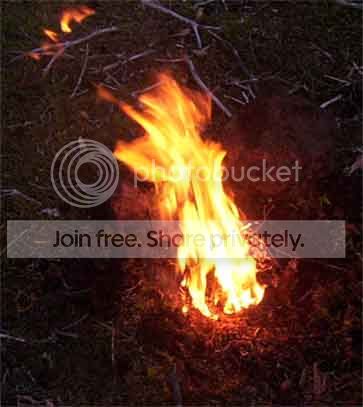
That is dried needle boughs, they burn similar to gas, intense flare up, very bright and massive heat but no sustained flame.
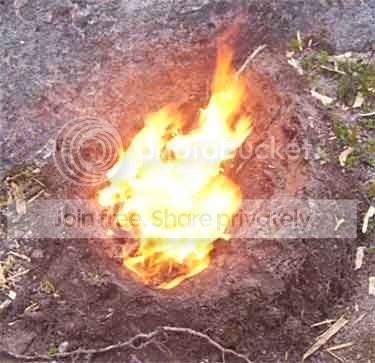
This is a pitch bark fire, it also burns very hot with a lot of flame, but unlike the boughs will burn for an extended period of time. You can easily get a half an hour of solid and heavy flame from a few pieces of bark the size of your hand.
-Cliff
- Joined
- Jan 7, 2003
- Messages
- 2,373
Cliff,
Stuff with resin in it like that is solid gold for firestarting. Here we don't have any native pines in my part of the state. I test everything for burnability, especially in rainy season. So far I haven't found anything here that acts like pitch or fatwood. Mac
Stuff with resin in it like that is solid gold for firestarting. Here we don't have any native pines in my part of the state. I test everything for burnability, especially in rainy season. So far I haven't found anything here that acts like pitch or fatwood. Mac
- Joined
- Jul 12, 2002
- Messages
- 3,291
1spider7monkey9 said:It's a good idea to carry some tinder in a small, waterproof container if you know you're heading for the woods. Otherwise you just use what dry material you can find.
I agree. Sometimes dry materials aren't always available, which is why I carry fatwood shavings, cotton wool, ranger bands and spark-lite tinder, as well as a few ignition sources. But my preference is to use what's available.
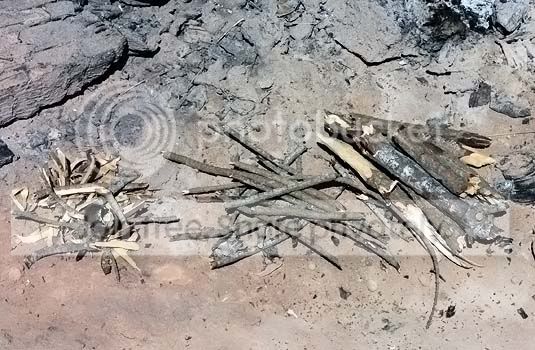
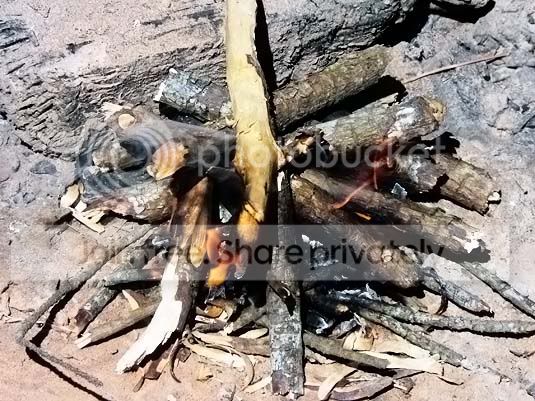
Cliff Stamp
BANNED
- Joined
- Oct 5, 1998
- Messages
- 17,562
pict said:So far I haven't found anything here that acts like pitch or fatwood.
Yeah that is why knowing the native enviroment is extremely critical. Locally I would scout for such trees because it only takes a few minutes to find one with really heavy pitch. For survival/emergency purposes I would always pack tinder for reasons you have stated before, even in this enviroment.
-Cliff

- Joined
- Aug 15, 2003
- Messages
- 494
Alan,
I'm sure some are laughing at the road flare right now... but a road flare already saved my butt. Went through the ice on a cold, windy day. Managed to get to the river shore, found a pile of dead wood. Dug out the road flare, stuck it under some wood, et voilà. 2 minutes later I had a 6 feet tall fire roaring.
That being said, petroleum jelly and coton balls do marvels. Fatwood is another alternative, albeit it is harder to start with just a spark than cotton. Rubber (from tires, vibram soles or tire tubes) also works great.
Cheers,
David
I'm sure some are laughing at the road flare right now... but a road flare already saved my butt. Went through the ice on a cold, windy day. Managed to get to the river shore, found a pile of dead wood. Dug out the road flare, stuck it under some wood, et voilà. 2 minutes later I had a 6 feet tall fire roaring.
That being said, petroleum jelly and coton balls do marvels. Fatwood is another alternative, albeit it is harder to start with just a spark than cotton. Rubber (from tires, vibram soles or tire tubes) also works great.
Cheers,
David

Cutshaw
Moderator
- Joined
- Aug 15, 2004
- Messages
- 7,274
I bought a brick of firestarter. It looks like a sectioned piece of a firelog like one purchases for home. I've cut it into wedges and stored it in ziplock bags. Chunks end up in my BOB and always go with me backpacking.
The road flare is a GREAT idea too. I've always kept a couple of aerial flares in my kayak when touring and felt that I could rip one apart and light it as a firetool in a pinch. (Notice I didn't say AIM it at the tinder and shoot it!)
Longbow - I've got that same OHT GAK. It's a great knife for the cash! I wouldn't want that to be my only blade in a survival situation, if possible, but with it and the khuk from your avatar I would feel well equipped!
The road flare is a GREAT idea too. I've always kept a couple of aerial flares in my kayak when touring and felt that I could rip one apart and light it as a firetool in a pinch. (Notice I didn't say AIM it at the tinder and shoot it!)
longbow50 said:Here's a few photos of a fire I built recently. I did use a little dried grass, but it didn't make it into the photos.
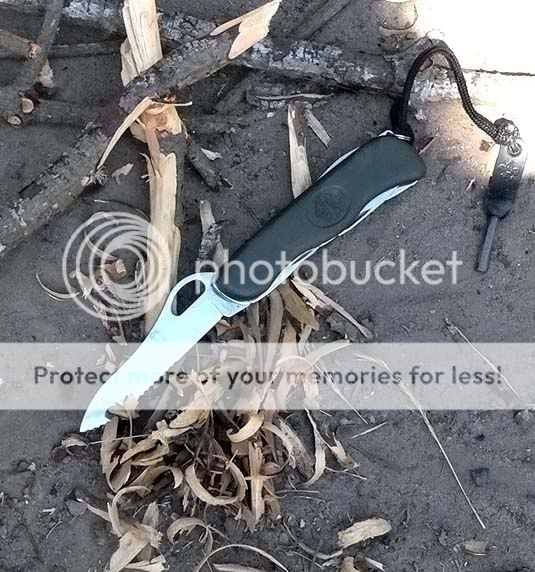
Longbow - I've got that same OHT GAK. It's a great knife for the cash! I wouldn't want that to be my only blade in a survival situation, if possible, but with it and the khuk from your avatar I would feel well equipped!
I've seen a lot of mention of road flares lately both on this forum and others. I've never dealt with flares before, but it seems like it would be a great addition to a pack for both signalling and firestarting in a pinch. Can anyone recommend a good place to purchase these road flares? I'm looking around online now and I've found a couple sites that seem to sell road flares, but I'm not sure which type to buy, and the sites I have found so far seem to sell them only in large quantities (72).

- Joined
- Dec 3, 2005
- Messages
- 1,991
dave,
goto Wal-Mart to the automotive section...They sell a 3-5 pack of road flares...
I really need to start practicing making fires without matches...It is just a skill that i have let go over the years..
Good info in this thread:thumbup:
goto Wal-Mart to the automotive section...They sell a 3-5 pack of road flares...
I really need to start practicing making fires without matches...It is just a skill that i have let go over the years..
Good info in this thread:thumbup:
stickbobby
Banned
- Joined
- Apr 6, 2006
- Messages
- 297
Making a fire with a magnesium rod takes about 5 seconds to learn. Put a key ring through the magnesium rod and carry it on your key chain. Carry a little packet of tissues with you too. You can make a fire very easily with it. Just try you see it is much easier than you thought.
Moine, you know I'm not one of the laughing ones, But for the edification of other members, can you please share with us if you feel you could have made fire with more traditional methods (spark based, lighter, etc), or were your motor skills affected too much to even handle small objects, let alone have to sit there and coax the fire?
Alan
Alan

The best method when its wet around here is two use a mixture of birch bark and fine feather sticks. Later split wood can be added again birch is best as it seems to generally be the driest, but I use willow more frequently. If you are in the conifer plantations getting fire is a lot easier as they are generally denser and there is more dry wood.