Best footswitch, see posts 10,13,14,19,29,45,51,52

Joined
Aug 17, 2010
Messages
883
Hey all,

I want to put foot switches on my grinder(s). I keep coming back to these:

Linemaster Hercules

Part #:531-SWH

Description:Momentary Single Stage Switch

* Foot Operated
* 125-250 VAC, 20 AMPS
* 1HP
* NEMA 2, 4, 13 Enclosure with shield

I want to use them on motors that are 115/230V, 1.5-2HP, 8-10 AMP (at 230V, which I'm using).

From what I can tell, these are industrial switches and more than adequate for my needs. They retail around $130+ new, $50 used. I just don't have any experience with these.

Anyone use these, or do you recommend something else?

Thanks,

Erik
 
Last edited:
This switch will handle you 110v needs and it's cheaper but adequate. After all its a switch.

This model is a Power Maintained Foot Switch

http://www.harborfreight.com/power-maintained-foot-switch-96618.html

This model is a Momentary Power Foot Switch

http://www.harborfreight.com/momentary-power-foot-switch-96619.html

I think the first one would be more suited for your needs. Now for 220v motors you may want to go the other route! If you had a link to the other switch I might be able to tell you more about it!
 
Last edited:
That momentary one looks like it might work, but I question the durability.

I would recommend going to ebay and looking up "Linemaster" or "Clipper Switch". I purchased a lot of them off ebay about 2 years ago, 9 in total, for $45. I have them on all my drill presses, and disc grinders.
 
I tried both the harbor freight ones for the price.

The two position on/off one became momentary after about a month. Stays on only if you keep pressure on it with your foot.

The momentary switch gets stuck on once in a while and I have to unplug it and almost stomp on it to get it reset again.

I'd look for something like Ed suggested. Just my experience.
 
That momentary one looks like it might work, but I question the durability.

I would recommend going to ebay and looking up "Linemaster" or "Clipper Switch". I purchased a lot of them off ebay about 2 years ago, 9 in total, for $45. I have them on all my drill presses, and disc grinders.

I agree. I have one HF switch and it stays on at the most inopertune time. I sure wouldnt rely on it so its on the disc grinder. Its nice to have a good one on the drill press so I can use both hands. Our dog keeps stepping on the pedal though.:eek:
 
I have a switch that I believe is the same as the HF switches

If you are having problems with the HF switches, you can open them up and change the actual switch inside.

The actual switch is simple cheap common micro switch.
They are likely under rated and the contacts are burning/sticking.
You can swap them out for heavier rated switches in the same package
 
Just a side note to give ideas to those with time on their hands:

Take an appropriately rated SSR and wire it to control a socket that is of the type needed ( mount the SSR on a heat sink). Use any cheap footswitch as the trigger source to energize the SSR. With only millivolts in the control circuit, the footswitch can be cycle tens of thousands of times. It will mechanically wear out before it burns out.
One big advantage is that the only voltage going up the wire from the foot pedal is 3-24 volts. Murphy loves wires carrying high voltage running to the floor around sharp and hot things.
The whole assembly can be built in a project box , and moved from place to place if needed. It can be made to run 220VAC or 110VAC.
 
Just a side note to give ideas to those with time on their hands:

Take an appropriately rated SSR and wire it to control a socket that is of the type needed ( mount the SSR on a heat sink). Use any cheap footswitch as the trigger source to energize the SSR. With only millivolts in the control circuit, the footswitch can be cycle tens of thousands of times. It will mechanically wear out before it burns out.
One big advantage is that the only voltage going up the wire from the foot pedal is 3-24 volts. Murphy loves wires carrying high voltage running to the floor around sharp and hot things.
The whole assembly can be built in a project box , and moved from place to place if needed. It can be made to run 220VAC or 110VAC.

If you have a VFD on the motor, the same idea applies.
A low power footswitch signal circuit controls the load.
 
Right you are,Count.
Any circuit with a low voltage/current switch or control circuit can easily be run by a foot switch. After all, it is just the remote switch sitting on the floor.

I have a couple foot controller switches I picked up cheap in a box lot a few years ago. They have Up and Down pedals. I have one converted to run the hydraulic press and the other will go in the new shop to run the VFD. I will be able to Start, Stop, and change the speed by foot . These two were industrial units and tightly sealed.

I have one that I am still looking at to decide the use I will give it. It is a foot control for a stage lighting system. It has four "Up-Down" foot-tap bars, and four corresponding foot control pedals. I was thinking of all sorts of things I can do with this. One of the crazy ideas has been to make an electronic foot control for the forge. All I would need to do is build the control panel that the foot switch plugs into. Then any devices that need control can be plugged in to the control circuits.
I could have one circuit for the main shut-off solenoid and the ignition spark generator. That way I step on the "Main Power" tap pad to allow the gas to flow, and then step on the "Ignition" pedal to light the forge.
I could use the next pedal to switch from PID to Manual control. The tap pad would drop the forge to idle when I am hammering/pressing, or stepping away for a minute, and the foot pedal would change from manual to auto.
The third pad/pedal could be used to start and stop a video camera or still camera.
The last one would mute the music or maybe raise/lower the volume.
 
Just a side note to give ideas to those with time on their hands:

Take an appropriately rated SSR and wire it to control a socket that is of the type needed ( mount the SSR on a heat sink). Use any cheap footswitch as the trigger source to energize the SSR. With only millivolts in the control circuit, the footswitch can be cycle tens of thousands of times. It will mechanically wear out before it burns out.
One big advantage is that the only voltage going up the wire from the foot pedal is 3-24 volts. Murphy loves wires carrying high voltage running to the floor around sharp and hot things.
The whole assembly can be built in a project box , and moved from place to place if needed. It can be made to run 220VAC or 110VAC.


Hey Stacy, (or anyone else that has done this before)

You got me taking a real close look at the solid state relay idea from a safety and economy standpoint. I'm running my motors at 230VAC at 8-10 amps, so I have two "hot" lines at 115VAC each (on a dual 20A breaker). The SSRs I've looked at all seem to be single pole except for some very expensive stuff. It appears that I would take two SSRs like this and wire the foot switch, power source (battery) and the low voltage connections (3 and 4) from both SSRs together. One hot line would pass through one SSR and the other hot line would pass through the other SSR (#s 1 and 2).

This particular SSR is rated 3-24VDC in, 24-380VAC out and is 25amp. It doesn't have a HP rating, but my motors are 1.5 and 2HP

How on that? And thanks.

I know it's been a while and I just re-read this thread, I'm running 230VAC.


ssr25da-25a-single-phase-aluminum-heat-sink-ssr-solid-state-relay-138801n.jpg
 
Last edited:
You can use one leg of the 230VAC circuit to turn on and off a motor. Without a complete circuit, there is no current flowing. Using two legs will make a safer circuit...but costs twice as much. On a plain motor circuit, one SSR is fine.

SSRs are rated at half their size for non-heat sink use, and I like to be well above the rating even with a heat sink. In a hot shop, a cooling fan blowing air through the heat sink fins helps a lot . Your 25amp SSR should handle the 16-20 amps you are drawing as a single unit, but if it were me ,I would use a 40 amp SSR.
If you are using two SSRs, then you are in fine shape with the 25 amp units.

I am always one for overkill, so I normally use two SSRs on a 230VAC circuit.
I'll explain the difference for those who like to understand these things.

On a 220/230/240VAC circuit the current flows through both legs and there is no ground connection. Each leg individually reads 110VAC to ground and 220VAC across each other. If you open up one leg, the circuit opens. However, the other leg will still read 110VAC to ground. On a simple 220VAC motor circuit, opening one leg is all you need to do to stop the motor.
On some appliances, like an air conditioner, clothes dryer, mill, or a HT oven - there are other circuits running on 110VAC as well as the motor/element/compressor which runs on 220VAC.
On these circuits, the main switch usually breaks both legs, but the control switch ( On/Run/etc) just breaks the leg going to the 220VAC device. This allows the other leg to continue to supply the 110VAC to the lights/fans/PID/timer/X-Y axis motors/etc so they still operate.

If there is a possibility that the hot leg going to the main load will come into ground, then both legs of the load circuit need to be shut off with a switch...or an SSR. If you turn off only one leg on a HT oven,the coils will stop heating.......BUT....if you accidentally touch the coil and are grounded in any way, the still hot leg will deliver a severe and potentially fatal shock.
On a resistive device ,like a HT oven, the circuit should have both legs shut off when stopped.
On a motor, normally that is not a worry. But, if you shut off a motor that is wired with only one leg through a switch,and then work on the wires....you will get a big shock.


On a 220VAC HT oven, wiring the control line (3-32VDC) to the dual PIDs through a microswitch that is closed by the door being shut will cause both legs to open when the door is opened. This saves the coils a bit and eliminates the possibility of a shock by having a blade or tong touch a coil.

On a motor of any size, the main power switch should be a motor start switch. These are not the same as a light switch. Even a heavy duty light switch will quickly arc out in use on a high draw motor circuit. Motor starter switches come in single pole (110VAC), double pole (220VAC), and three pole ( 3PH). A motor start switch shuts off all hot legs when in the off position.
The use of an SSR takes this load problem off the switch and puts it on an electronic relay. If the device or motor is turned on and off by a SSR, a heavy duty light switch will work, as long as it is rated well above the amps being drawn. However, if you have the SSR control switch in the On position, and then turn on the main power switch, it will arc.....so use a motor start switch on any large motor.
 
Thank you Stacy for the great information and explanation. It is a big help. I'm glad you mentioned the motor start switches as well. I use them, but I didn't always know that they were necessary.

Erik
 
I bought most of the parts. I'm going to try to make a sealed box that has external heat sinks; that can be plugged into the end of the power cord for momentary power, or removed for constant on/off. I'll share the project here.

It's going to be a while because Amazon tried to get me for $45 shipping on $90 worth of light parts. Now most of my parts are coming direct from China with free air freight.
 
Most of the parts showed up early this week - even the SSRs direct from Hong Kong, lol.

I went out and picked up a few things today - some cable clamps, heat sink compound, a 9 volt connector, plugs, etc. Although I want to make two of these, I decided to start with one first to see how it went.

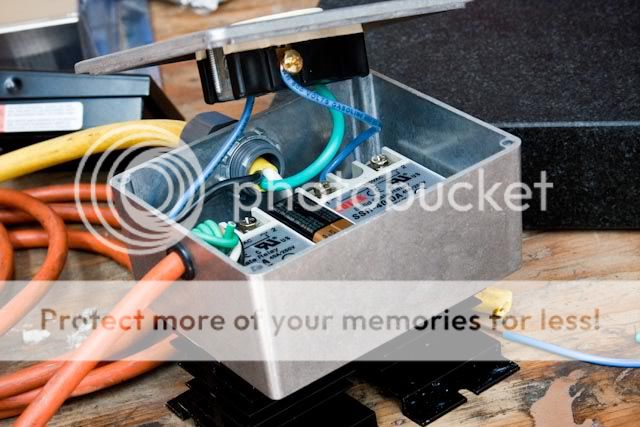
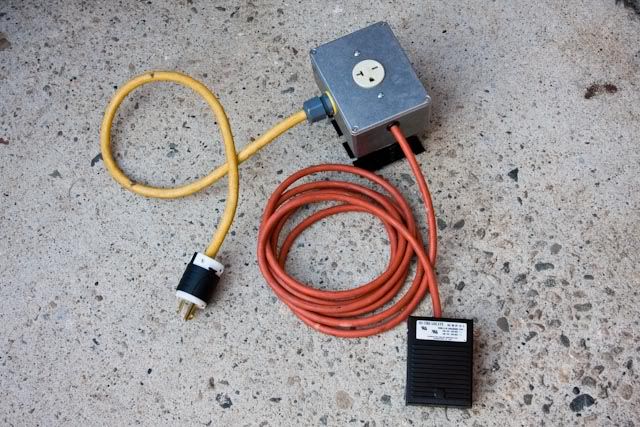
I pretty much did what Stacy said for a solid state relay footswitch that can handle high voltage but only has 9 volts on the floor (under my water bucket, so that's good). I wanted something that would be easy to use or bypass when it was not necessary. I also wanted it somewhat sealed, but since heat is an issue, I used the heat sinks on the outside of an aluminum project box and used heat sink compound between the SSRs, the box, and the heat sinks to ensure good conduction and hopefully heat dissipation.

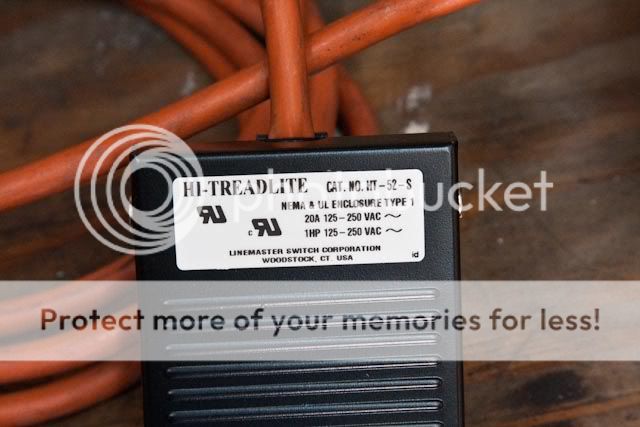
I got the solid state relays with heat sinks from Hong Kong, the footswitches and the aluminum boxes on Amazon and the connectors and misc stuff from Home Depot and Radio Shack. The 12/3 wire and the 14/3 wire are parts of extension cords.

This thing works. I've only tested it, time will tell how it holds up.

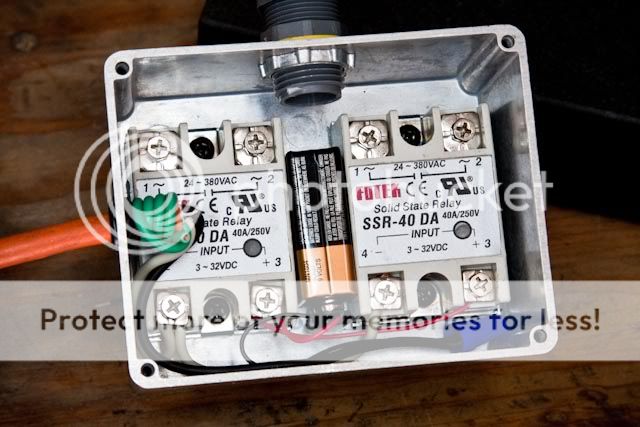
Here is the low voltage wiring.

IMG_9782.jpg


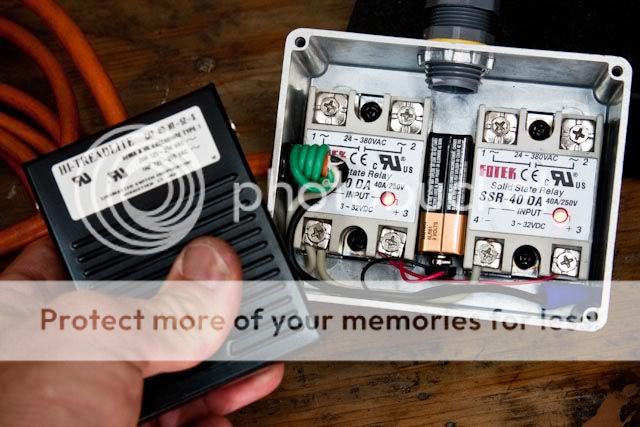
Testing the relays. Notice the indicator lights.

IMG_9784.jpg


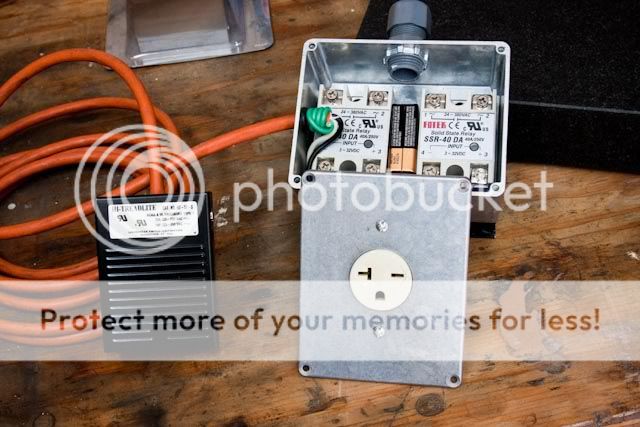
I mounted the outlet in the cover.

IMG_9787.jpg


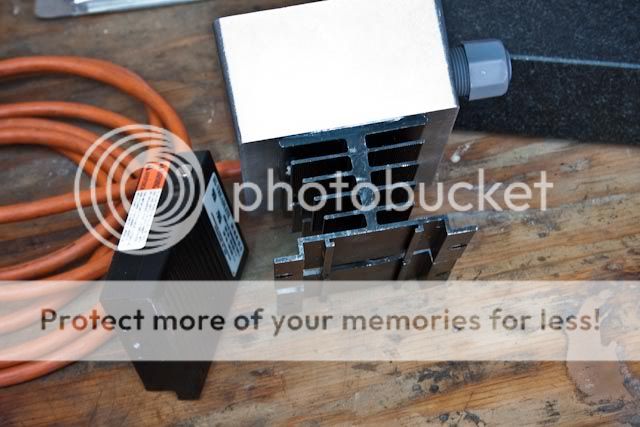
A shot of the heat sinks.

IMG_9789.jpg


High voltage in.

IMG_9790.jpg


Close up of the switch.

IMG_9786.jpg


Complete unit.

IMG_9792.jpg


Thank you again, Stacy. If this thing holds up, it's going to be awesome.

Erik
 
Last edited:
First off I love it, Kudos for actually taking the time and energy to make it.
My question is is it a momentary switch or a press to turn on and press to turn off type of switch.
Let us know how long the 9V lasts, if it does not last long Maybe you could put in there a AC to DC 9 pwr supply so no batteries necessary, might be tight though.
 
Back
Top