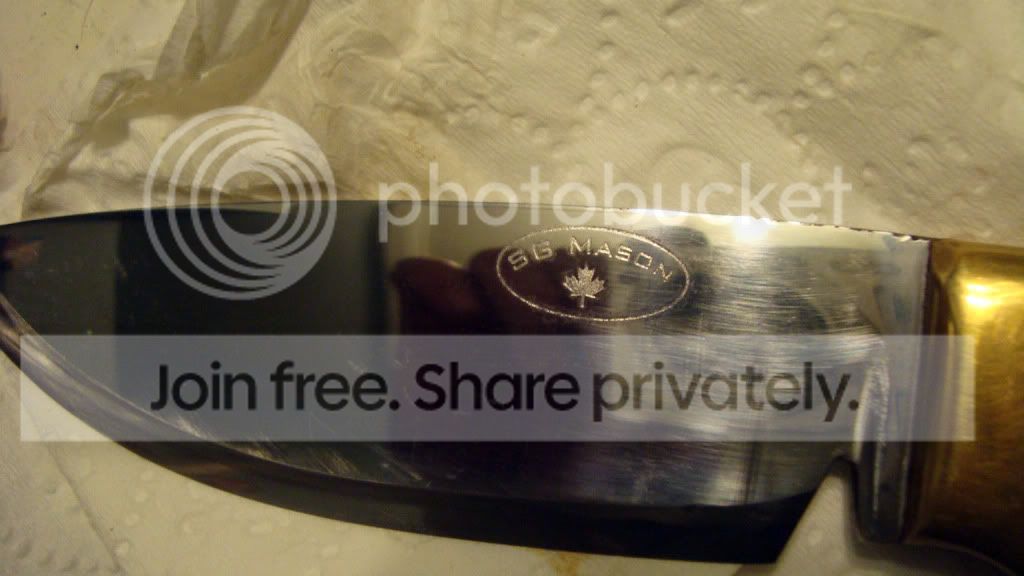
Best time to etch makers mark

Joined
Aug 28, 2009
Messages
7,951
I am getting near the end of my hand sanding, just finishing up 1500 and have 2000 and 2500 to go. So I am wondering when is the best point to mark the knife? Finish up the sanding, mark it, clean it up, mask it and then put on the scales, or finish everything then mark it?
 
For me, etching the makers mark is the second last thing to do - just before final edge honing. George. Practice, practice, practice on scrap till you are sure the etch is right. Don't ask me how I know, but it is such a pi** o** to screw up the etch on a finished blade. :(

Rob!
 
Hey Unky,
In my limited experience I've decided that I like to etch before attaching handles. I think the handle slabs can get in the way sometimes and I have more freedom of movement when etching on just the finished blank.

Also, if you do happen to mess up the etch and need to re-sand and etch again, it's much easier to do without the handles in place.

This is just what works for me, but I'm going to be doing all of my etching pre handles from now on.
 
I like to etch just before the last grit paper used. Use the last grit to clean up around the makers mark.

A wet stencil holds in place better than a dry stencil. Water or alcohol works.

Fred
 
Fred clear tape works better then water at holding the stencil on then water
i acetone the to be marked area then dry then mark

i wil then finish the sanding that is needed then finishe the scales (sharpening is dead last step i do before shipping )
 
Hey Unky,
In my limited experience I've decided that I like to etch before attaching handles. I think the handle slabs can get in the way sometimes and I have more freedom of movement when etching on just the finished blank.

Also, if you do happen to mess up the etch and need to re-sand and etch again, it's much easier to do without the handles in place.

This is just what works for me, but I'm going to be doing all of my etching pre handles from now on.

I like to etch just before the last grit paper used. Use the last grit to clean up around the makers mark.

A wet stencil holds in place better than a dry stencil. Water or alcohol works.

Fred

The combination of these is what I was thinking. The scales do get in the way of where I would like to place the mark, and I am getting a bit of bleed through because I am just try to get it done with a Q-tip:o I think tomorrow I am going to have to go out and by the proper stuff to make a full sized pad to etch with.
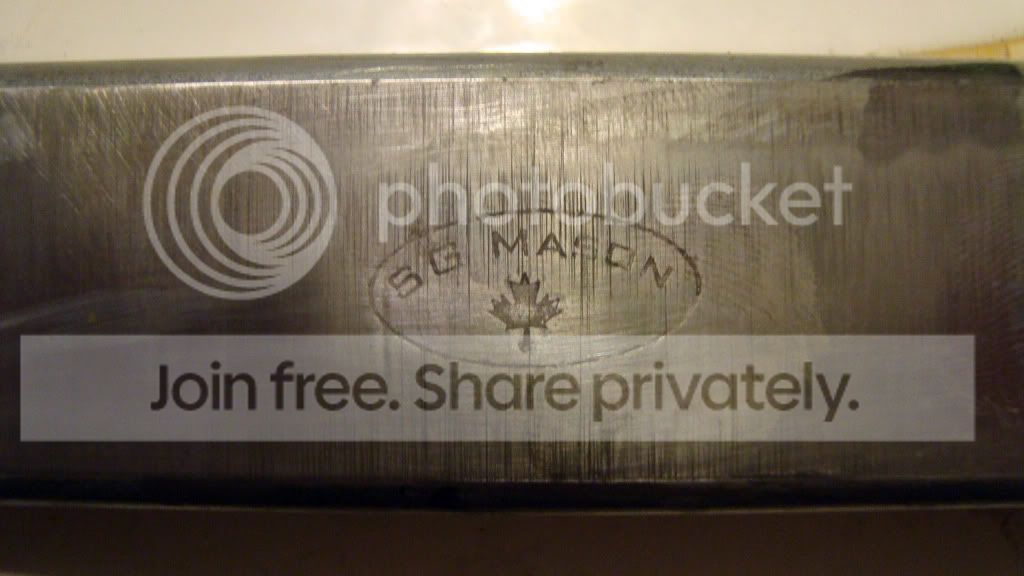
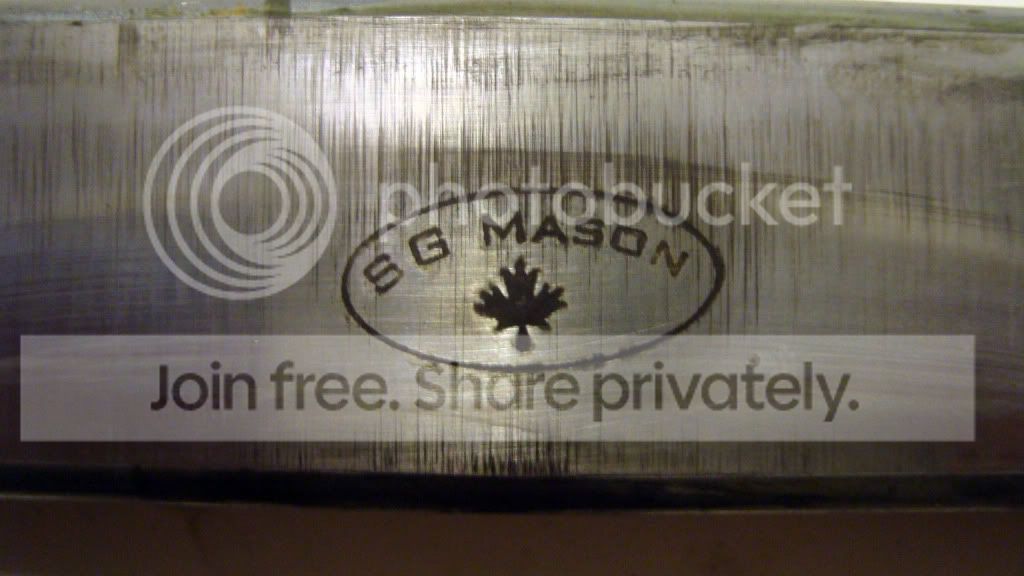
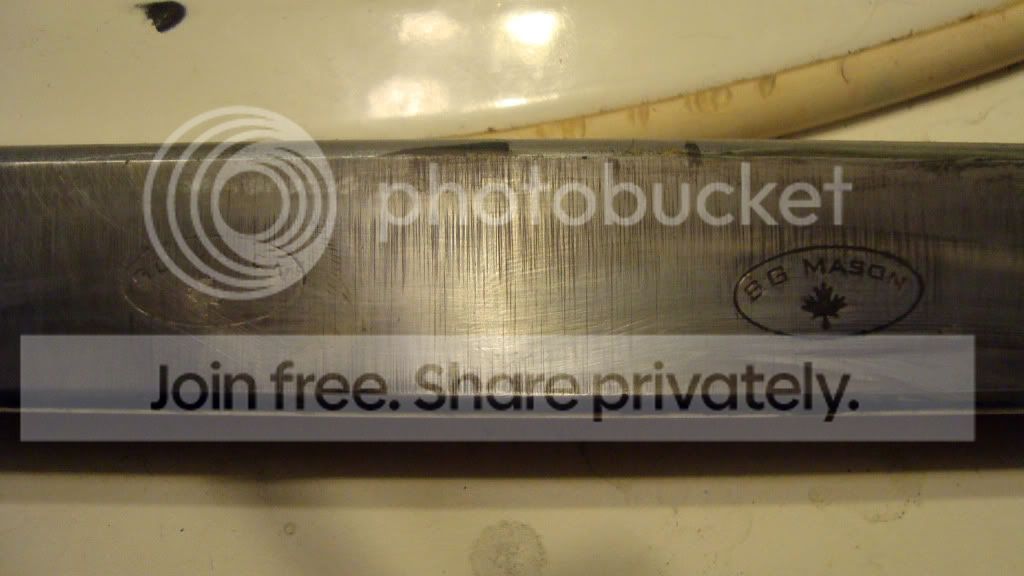
Unfortunately I don't have any scrap steel to practice on:( so I went over to the shop and grabbed a piece of tube made of an unknown steel. It is rough and may be part of the bleed through. When I make a proper pad I will try it on the home HT knife I made, its already ugly and so a few more marks on it wont make it any worse.

these two were done with a Q-tip and a car battery charger

DSC02068.jpg


It got some depth but no darkening, so I switched the leads and got this

DSC02067.jpg


It got both depth and darkened nicely but still had the bleed through. Both were cleaned up easily, but the overall etch is uneven on both because of the Q-tip.

Both in the same picture

DSC02069.jpg
 
My etch is the last thing I do, not including final edge finishing. I'm fairly certain that I can easily screw up a knife at some point grinding the edge on it and don't want to scrap something I etched (if I can help it). I'm even considering waiting until the sheath is ready before I mark it.
 
Here's my basic steps:

-Make the blade
-Heat treat
-Hand finish
-Secure and shape handle scales
-Make sheath
-Sharpen
-Etch
-Oil and ship

A couple of thoughts on etching.

--It does take practice to know how your individual machine and stencils are going to work.

--I use a damp (not wet) q-tip for more control, but that's just me. I also use plain old salt water for my etching solution.

--Too much etching solution will tend to wash out the etch as well as create a larger halo around the etch.

--If I have a halo that doesn't clean up with a rag, I will use a piece of sandpaper placed on the edge of my countertop and held tightly over the edge of the counter. I then place the blade gently on the paper at the ricasso, only contacting the paper where it is pulled over the edge of the countertop (holding the knife by the handle, angled with the tip pointing about 45 degrees towards the ceiling), and smoothly pull down towards the floor, dragging the flat over the paper and smoothly off of the paper. Several passes like this, simply drawing the knife off of the paper will sharpen up your lines and remove your halo. It takes some practice not to create fish hooks, and I try to avoid having to do this at all. What grit to use depends on your finish grit. I usually use 600 grit.

--nathan
 
I usually etch just before the final polishing of the blade, the before last step.
then I polish with rag cotton and fine polishing compound.
The last step is always sharpening the edge.
 
the halo is why i do it right before the last round of sanding on the blade
i etch as deep as i can ans as dark and not worry about a halo (ppl have asked me if i stamp my mark cause its so deep )

i tell the i just take my time and burn it in deep (hey if you already have a few hours in the knife whats a few more min making sure you mark is nice, deep, and black )
ooo and it helps "lock" the black on better to clean with acetone before you neutralize and clean the blade
 
I also etch before attaching the guard or handles. If I will be polishing/etching for a hamon, I will do the etch after I have taken the blade to final grit, but before I start etching/polishing w/ vinegar & Mothers. Like Butch said, this allows me to etch deep and then take care of any halo-ing that should occur.
 
the halo is why i do it right before the last round of sanding on the blade
i etch as deep as i can ans as dark and not worry about a halo (ppl have asked me if i stamp my mark cause its so deep )

i tell the i just take my time and burn it in deep (hey if you already have a few hours in the knife whats a few more min making sure you mark is nice, deep, and black )
ooo and it helps "lock" the black on better to clean with acetone before you neutralize and clean the blade

Hey Butcher,
You say to clean with acetone BEFORE neutralizing and cleaning the blade. What steps do you take after acetone to prep for etching? I usually just wipe down with acetone and then wash in warm water and dish soap then towel dry. Sometimes I notice that when I'm etching there is no reaction on the blade at all, like the machine isn't even on and I'm wondering if it's because of how the blade is prepped.
 
Depending on type and quality of the etcher one is using, After the knife is complete the last three steps I perform are etch, light buff and sharpen. I have a Marking Methods etcher and do not get bleed throughs. Stencil quality is an issue as well, using quality stencils is very important to prevent bleed through.
 
I got my stencils from Ernie Grospitch, on the recommendations of other users so I am pretty sure that they are quality stencils, putting the blame for any problems completely on my shoulders:o
 
George,alot of your bleed through is from the rough surface,best to sand your test piece to 400 grit then practice.
Stan
 
What I really didn't like was the blotchy look because of using the q-tip. I am just on my way home from picking up a piece of felt to make a proper pad.
I was sure most of the bleeding was from the rough steel so I wasn't too worried about that and the blade will be sanded out to 2500 before etching I just want to do a couple more test pieces first
 
SO my homemade etching pad worked like a charm:thumbup: and all I had to spend was $5 for a piece of felt. I am going to do a couple more test runs to make sure, but this time I will use smooth metal, I am thinking of marking my files next, then my rough shop knife and then my first knife. If I get those two right I will move on to my latest blade.

I figure I will sand it out to 2500, etch, re-sand at 2500 for any halo, acetone, mask, and get to work on the handle. If I get good results on the files and older knives I will post some pictures
 
We have success:thumbup:

Thanks to everyone's input my first knife is marked

DSC02080.jpg


Not only is it the first knife I marked but it was on the first knife I made, hence all the scratches on it:o I have to admit that this knife was used hard over the last year and most of those scratches were well earned.

I only lightly went over the mark with some 2500 grit paper so there is a little halo in a few places. I feel that if I gave it a proper polishing at 2500 all the halo would be gone. This sucker is sharp and has already bit me good once so I don't want to tempt fate with it again. Time to finish up the new knife, etch it and polish it up to get rid of any halo.

My next project after I put together my FC tank is going to be a proper etching machine.

Once again thanks for all the help everyone

George
 
Back
Top