BK&T, Ranger Knives, ESEE and Others...Is There That Much of a Difference

Joined
Oct 26, 2001
Messages
303
Hey all,

I would like to get some help and advice from you guys. I am not that knowledgeable on knife steels, edge retention, strength and so on. I have been looking around for an all purpose hunting/camping and so forth type of fixed blade with a blade that's around 5-7 inches long. I have some ideas in mind that I think might be a good choice, but I want to learn a bit more about what makes a good knife from a mediocre one before I buy.

One of the knives I like is the Becker BK-7 and the BK-16. I also like the ESEE, the Ontario Ranger and others that are in this style. To my untrained eye, many of these knives from these makers look very similar. They have some of the same blade shapes, thicknesses, and steels.

I am curious whether one brand of these is better than the others. I know I likely have left some brands that belong in the group with the others, off the list. Please include them for me and mention them, if you feel they deserve being brought up.

Take a BK-7. That is one stout looking and feeling knife. I believe it's 1/4" thick and that has to enable it to withstand a tremendous amount of abuse and work. Mush more so that a great many other fixed blades, I would think.
One thing is that the Becker Knives are less expensive than many of it's similar cousins. I believe some of the ESEE fixed blades are up around the $150 mark.

Would you all mind explaining to me what would make you choose one brand over the other when they are so similar? At least to my untrained eye they are similar. To you they might not be at all. Forgive me for asking if that is the case.

Any info you care to pass on about this would be appreciated. Thank you kindly for your help and time.

Have a good week.
Larry
 
N Nalapombu
Before we get intothe production knives, JK Knives can make you what you want. He uses O1 tool steel and his Heat Treat is Fantastic. One of the better dollar values out there in terms of price vs. performance.
---------
Ok, I am a Becker fan, so my answer is to go with them for a production knife or JK Knives for a Custom.

But speaking of the brands you mentioned the alloys are similar, but the Cro-Van (Becker) has some slight alloying ingredients that offer slight benefit, but nothing crazy.

Where the differences between the brands really show is in the Becker handle shapes.
As it is states below, Beckers come with Grivory slabs (sort of like Spydercos FRN). Ethan Becker says that the shape of a handle is where the grip comes from. The texturing can be as bad as it is good, but mostly it is just trying to make up for a poorly designed handle by scant amounts of traction.

There is a video posted on here that shows someone coating his hands and the stock Becker handles in oil and stabbing a tree stump, just to show that the shape is where the grip comes from, not a rough surface. A rough surface on a lesser thought out design just leads to hot spot, blisters and tears in the skin...
-------
Now onto the knives.
This depends on what you want the knife to do, and what you pair it with.

The BK16 will be a great companion knife to a larger knife, hatchet, saw, or a great hiking knife. This is the "tweener" size, it isn't as small as the 14 or 11, and does have a full size handle. If you have a longer knife for wood processing, this smaller knife becomes your utility knife.

The BK7/10/12 are your heavier use camp knives that are more of a one knife option. They can split larger wood across the center, instead of bites off the side, working in. They are a bit longer and heavier while.offering a fuller grip that will not fatigue your hand as quickly. Though most that buy a BK7, say they should have gone with th BK9, since it weighs a little more, but is a better wood processor than the others, mostly due to the length.

The BK7/9/10/12 offer longer blade length and the larger sized Becker handle. These knives are .188 thick (or 3/16"), not 1/4", that is the BK2. With that in mind, most that buy the BK2 find that the weight is a detriment for all but the most abusive tasks (need to field dress a Buick? then the BK2 is your knife).

After handling Many Beckers, both in production and out, my choices are the BK4, BK5, and BK15. Though most folks do not want the learning curve of the 4 and the 5, but once you get it down, they are masterpieces. But if you are OK with this, you should be able to get the 4/5 for around $50 each on the exchange and the 15 will he around $100.

Long story short, buy the BK16 for a lighter carry or BK12 for a heavier carry but more "one knife" option, that can still be carried fine or a BK4 or BK9 and a BK16. The 4/16 or 9/16 combo can be carried, but it will be heavy and you will often leave the 9 in the car while hiking.
Or
Go with around BK4, BK5 and BK16 and have all of your bases covered.

With an aftermarket sheath added in (and sometimes slabs), the price balances out. But I am a fan of the stock slabs, and have them on all of my Beckers, I just hit my 4 and 5 with some sandpaper since it scuffed the surface, but stays smooth enough to not risk blisters and hot spots.

That being said, the company support and community is where the dollar value comes into play and Becker has it in spades.
 
Last edited:
Esee, Becker, and Ontario are all decent blades. I know you will get many years of use out of any of them.
Some things to consider......

Becker- No questions asked warranty- givory handle-reasonably priced-sheaths aren't the greatest.
Esee- micarta handles-better sheath-lifetime warranty-a bit more expensive
 
Bill & Monofletch are right on the money here. I've had both ESEEs and Beckers. Either one will work well, both are very tough & capable. they both use similar steels that are well heat treated. Products from both brands could benefit from some edge "reworking" when you get them. They come a bit thick and not as sharp as I like my knives. But their steel is very easy to work with.

The Becker is going to be a little less of an investment but neither one will break the bank, even with the aftermarket add-ons like a decent sheath and handle slabs. The-Knife-Connection has a good selection of ready-to-go aftermarket stuff for both brands.
 
I can tell you one thing, Becker and ESEE have some of the best heat treats around for 1095 steel.
The HT and the blade geometry are the most important things in any knife.
Agree with what dalefuller dalefuller said, you're good with Becker or ESEE, and a little sharpening/re-profiling of the edge.
 
While the Beckers and ESEE's are great knives, let me throw in some love for the Ontario Ranger series.

Absolutely bombproof, designed and backed by a real deal US Army Ranger and knifemaker, Justin Gingrich. I have seen him repeatedly shoot them with no effect. Designed by him to be a knife for what he and his fellow Rangers do, which is beat the bejeebus out of anything in their way.
 
I've really ended up gravitating to Esee and Tops for my fixed blades. Just a notch above in terms of handle materials and sheaths, imo. And the HT on the 1095 really is excellent, as is the warranty.
 
Last edited:
I can also agree you might want to check with JK Knives and get exactly what you want for a great value.

Now the Esee and Beckers are both great knifes. I personally carry a folding saw and small axe so I prefer to carry a bit smaller fixed blade can reccomend the new Esee 4HM or 6HM if you want more length ... the new HM series handle shape is more comfortable then the older models.

For Beckers Ive tried several but my two favorites are the BK5 and BK15 ... both longer but thinner stock but still strong enough for anything I'd need them for ... but maybe not the most practical for general use ... so the BK16 can make a good knife to pair with a larger knife or axe.

I will mention LT Wright knives ... as they are my choice by far for a camping hiking general use outdoors knife. They are a bit more expensive but they are great knives. And are several designs options ... and choices of handle materials and textures ... and blade steels and they are comfortable to use all day.

After those my thoughts step up in price so I won't post those.

The last thing I'll mention ... the Beckers have fairly large handles so if you have small or medium size hands you may prefer the Esee ... if you have larger hands either Esee or Becker will be comfortable ... just a matter of preference.

Poor shot but a quick pic comparasion of a few mentioned ... Becker BK2 ... Esee 4HM ... and Becker BK15


last the old Esee 4 beside the Esee 4HM new handle
 
Last edited:
N Nalapombu
Before we get intothe production knives, JK Knives can make you what you want. He uses O1 tool steel and his Heat Treat is Fantastic. One of the better dollar values out there in terms of price vs. performance.
---------
Ok, I am a Becker fan, so my answer is to go with them for a production knife or JK Knives for a Custom.

But speaking of the brands you mentioned the alloys are similar, but the Cro-Van (Becker) has some slight alloying ingredients that offer slight benefit, but nothing crazy.

Where the differences between the brands really show is in the Becker handle shapes.
As it is states below, Beckers come with Grivory slabs (sort of like Spydercos FRN). Ethan Becker says that the shape of a handle is where the grip comes from. The texturing can be as bad as it is good, but mostly it is just trying to make up for a poorly designed handle by scant amounts of traction.

There is a video posted on here that shows someone coating his hands and the stock Becker handles in oil and stabbing a tree stump, just to show that the shape is where the grip comes from, not a rough surface. A rough surface on a lesser thought out design just leads to hot spot, blisters and tears in the skin...
-------
Now onto the knives.
This depends on what you want the knife to do, and what you pair it with.

The BK16 will be a great companion knife to a larger knife, hatchet, saw, or a great hiking knife. This is the "tweener" size, it isn't as small as the 14 or 11, and does have a full size handle. If you have a longer knife for wood processing, this smaller knife becomes your utility knife.

The BK7/10/12 are your heavier use camp knives that are more of a one knife option. They can split larger wood across the center, instead of bites off the side, working in. They are a bit longer and heavier while.offering a fuller grip that will not fatigue your hand as quickly. Though most that buy a BK7, say they should have gone with th BK9, since it weighs a little more, but is a better wood processor than the others, mostly due to the length.

The BK7/9/10/12 offer longer blade length and the larger sized Becker handle. These knives are .188 thick (or 3/16"), not 1/4", that is the BK2. With that in mind, most that buy the BK2 find that the weight is a detriment for all but the most abusive tasks (need to field dress a Buick? then the BK2 is your knife).

After handling Many Beckers, both in production and out, my choices are the BK4, BK5, and BK15. Though most folks do not want the learning curve of the 4 and the 5, but once you get it down, they are masterpieces. But if you are OK with this, you should be able to get the 4/5 for around $50 each on the exchange and the 15 will he around $100.

Long story short, buy the BK16 for a lighter carry or BK12 for a heavier carry but more "one knife" option, that can still be carried fine or a BK4 or BK9 and a BK16. The 4/16 or 9/16 combo can be carried, but it will be heavy and you will often leave the 9 in the car while hiking.
Or
Go with around BK4, BK5 and BK16 and have all of your bases covered.

With an aftermarket sheath added in (and sometimes slabs), the price balances out. But I am a fan of the stock slabs, and have them on all of my Beckers, I just hit my 4 and 5 with some sandpaper since it scuffed the surface, but stays smooth enough to not risk blisters and hot spots.

That being said, the company support and community is where the dollar value comes into play and Becker has it in spades.


I could not have said it any better.

A BK4, 5 and 16 (together, all three) will have you completely set for less than some other knives (as in one knife's price) that will not perform any better. For what it's worth, a BK-2 is just a blast to own and abuse.
 
I own a Esee 4. Got one an upgrade on the Sheath. Super knife. You do need to take care of the 1095. You need a good carry option. If you cant carry it it will just sit in the drawer.

There are many carry options for the Esee's. I would look at www.knifeconnection.com I think this is the best site for Esee or Becker.

rustyspike
Rich K
 
For regular general use knives, there basically are three dominant blade shapes; drop point, clip, and saber. Sub groups would include Wharncliffe or sheepsfoot and some of the skinning blades that are essentially drop points with perhaps more blade belly. The drop point seems to be the favored general purpose blade shape. Fighting knives tend to lean toward a clip point.

Lots of similarities between the various company offerings under $150 these days especially when 1095 steel is used. Most of the differences are personal taste in terms of handles, blade grind (edge), and so forth. I have gravitated toward what I consider "value" and as a result, I favor the Becker line a lot. I still pick up things made by Fallkniven, Bark River, and others occasionally. I look for a well made knife as opposed to one that has some sort of bomb proof warranty. I'm not that hard on knives and should something happen, I'll look at the knife for the cause, but often it would simply be my own foolishness in terms of using that caused the problem.
 
I would start with a Becker BK2. It's a tank, comfortable and multipurpose. Bk16 and a bk9 make a great duo. I like esee and the sheaths are better but the handles are too square for me and I get hot spots. I don't have any history w/ the Ontario ranger series but the rat and spec / spec plus lines are great too. Tops deserves mention as well (tops bob). You really can't go wrong either way. I prefer the production over custom. If you want to spend more there is bark river too (bravo 1). Opinions vary. I would keep my eye on the exchange and let fate decide.
 
Ive tried all the companies you mentioned. I havent had a bad one from any of them.The steel they use or heat treat has not made a difference to me as much as 1) handle material and shape 2) sheath 3) customer service 4) blade geometry

Tops gives you so many choices but that Becker BK16 (with micarta upgrade scales) is a lot of knife for the money.
Even with a knife like the bk16, I use a SAK more often. Cutting stuff doesn't require a bomb proof knife, although it is nice when having to process wood unexpectedly. Just make sure it is comfortable in hand and the geometry is suited for the type of expected use and you'll be ok. Good luck.
 
I would start with a Becker BK2. It's a tank, comfortable and multipurpose. Bk16 and a bk9 make a great duo. I like esee and the sheaths are better but the handles are too square for me and I get hot spots. I don't have any history w/ the Ontario ranger series but the rat and spec / spec plus lines are great too. Tops deserves mention as well (tops bob). You really can't go wrong either way. I prefer the production over custom. If you want to spend more there is bark river too (bravo 1). Opinions vary. I would keep my eye on the exchange and let fate decide.
My first Becker was also the BK-2. I never really liked using it. But for a woods knife, I tend to favor something with thinner blade steel like the BK-16. Honestly, my favorite is the BK-15 as I tend to prefer this blade shape for general duty. As mentioned, I do more cutting with my SAK than probably all of my normal fixed blades combined. I am looking forward to a Becker Kephart in the future, but we'll see if that happens.
 
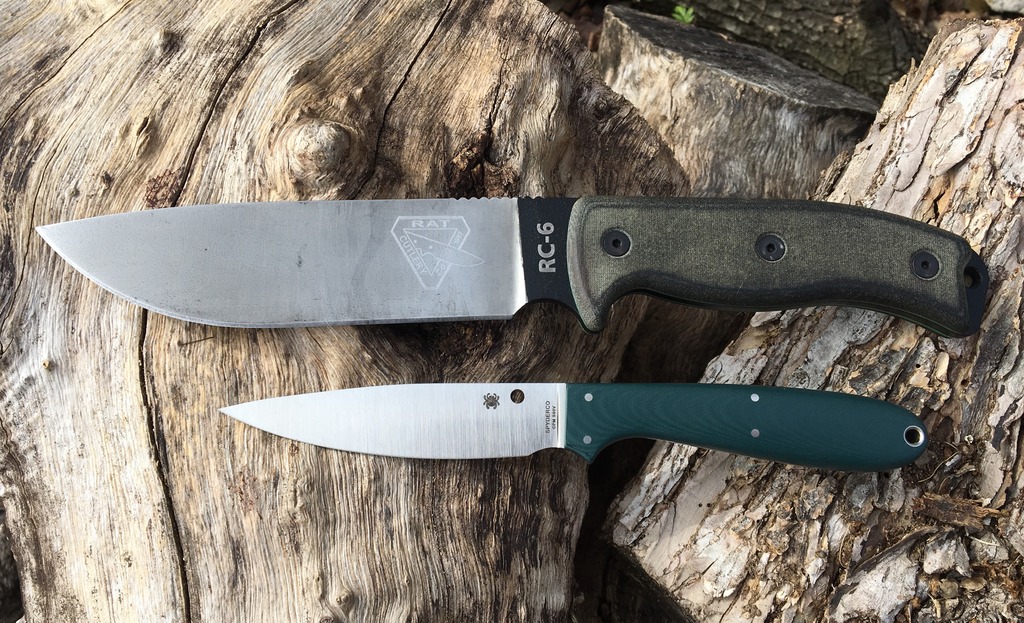
All good knives discussed here. I went with RAT Cutlery 6 (ESEE). I just found one for $117 shipped.
Dg9KI4n.jpg
 
I'll add a couple thoughts on the Ontario Ranger series. I have an RD7 and it's one of my absolute favorites, but it took a little work to get it there. I convexed the edge and rounded the cornera of the handle scales more to be a bit more comfortable in my hand. Not super difficult mods, but the scale mods I found to be particularly necessary.
 
My first Becker was also the BK-2. I never really liked using it. But for a woods knife, I tend to favor something with thinner blade steel like the BK-16. Honestly, my favorite is the BK-15 as I tend to prefer this blade shape for general duty. As mentioned, I do more cutting with my SAK than probably all of my normal fixed blades combined. I am looking forward to a Becker Kephart in the future, but we'll see if that happens.

Yeah. I just don't "get" the BK2. That kind of thickness is ok on a 9" blade where you'll be chopping, and batonning (if that's your thing) thicker pieces of wood. That's where the strength of 1/4" shines.
But in a blade hats only 5" long, I kinda have to wonder why. Not a great chopper, but too thick for the fine stuff. Basically, yes it's bomb proof but to me, the knife totally misses the point.

Now my BK16 was the knife that got me into knives.... that is a masterpiece.
 
I can only say I've owned a rat 5 and thought it was a nice all-use knife. However, I greatly prefer thinner blade stock for hunting as a lot of slicing is involved and thinner blade stock tends to do that better. A lot of the beckers can be thick to increase their durability which is great for their intended purposes. I don't care for blade thickness much over 3mm and many are 5mm and up. Moravkniv knives are of the thinner blade stock which kind of helped establish my like for thinner steel.

Bushcraft knives tend to be similar in design to what you're looking at but they can have a different blade grind and are usually thinner. Again, some models from the brands fit very well into this type of use. I'm of the opinion that a bushcraft type knife makes a good do-it-all knife, within reason, for many people. I have a custom from a knifemaker in process that I'm pretty excited about.

The Ontario blackbird and bushcraft are what I prefer and the esee 6. I'm less familiar with beckers because I have a preference for micarta and just haven't looked at beckers from the aesthetic point of view. I'm waiting for something used to come by to try one and I'll likely try a bk32 though I'm testing out this type of design on a cheaper schrade I found used cheap. If you haven't figured it out already, I prefer knives on the shorter end most of the time and this is because I usually have a hawk or hatchet with me so the length desired for battoning isn't needed. Brush clearing can usually be done with the knife/hatchet combo too but I've found pruning shears can tear through brush quickly for building a natural blind or the like.

Truth be told, I like carrying multiple knives. Something bigger for bigger task (fixed blade) and something small and slicey for small tasks (fixed or folder). Something like an OKC rat 2 with the bigger knife seems to do well but I have a few smaller fixed blades as well that would be comparable to a rat 3 or izula-II (handmade D2 knives from forum). Recently I've taken a liking to a traditional trapper so I can have a clean blade and dirty blade in one knife but I wouldn't like it with gloves so cold weather (most of hunting season in MI) could be interesting. Having said that, buck 110's are probably the most common knife in the group I hunt with.

Enjoy learning about the plethora of awesome options. I think that's half the fun of being a knife enthusiast and user, learning more and trying out new blades for differing tasks.
 
Last edited:
I know you're asking for a particular type of info here but you keep mentioning you're new to these knives so I just wanted to float this out there. Feel free to ignore it.

You sure you want one of these? I have a knife similar to the bk7 only better and I NEVER take it with me for anything but car camping. I'm not saying they can't do work but they are a PITA to carry and I don't normally find a need for it outside of splitting kindling from pre-sawn logs you buy at the camp site. A mora you keep sharp and a folding saw like a silky will be much more useful IME. Cheaper, lighter and more efficient for most things. That said, sometimes you just want a big knife. ;)
 
Back
Top