Blade geometry...Is this good?

Joined
Jul 26, 2008
Messages
1,006
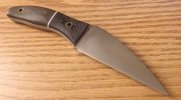
Hello. I was wondering if you guys could tell me if the geometry on this blade looks good or not based on the pictures. It's a skinning knife I made. It is 1/8" at the spine, not quite perfectly flat ground, more of a very, very slight convex going from spine to edge. The blade is 0.050" thick about 7 mm in from the edge as you can see from the calipers. Is that good? Thanks.

20200430-151803.jpg

20200430-151904.jpg
 
Needs to be thinner.

Hoss
Thanks, can you offer me a comparison? How much thinner, and what is too thin? I can always take it to the wet grinder for a bit.

I compared mine to a Puma white hunter and the geometry on those is way thicker.
 
Last edited:
You have a pretty tall blade and you could take the grind up higher ...I’m thinking .035 might be a better number for you to try to reach at 7 mm from edge
 
Thanks, can you offer me a comparison? How much thinner, and what is too thin? I can always take it to the wet grinder for a bit.

I compared mine to a Puma white hunter and the geometry on those is way thicker.

What steel and what hardness?
 
I have no idea how thin your steel and heat treat will support. Without controlled heat treat, we are guessing.

Well I am looking for a blade geometry that is going to stand up to some outdoor use. Skinning yes, but also wood cutting, chopping and maybe some batoning. A general purpose sorta knife. I'm not really looking to have a scalpel-thin knife as an outdoor knife. I guess it will just have to be some trial and error.
 
Last edited:
Well I am looking for a blade geometry that is going to stand up to some outdoor use. Skinning yes, but also wood cutting, chopping and maybe some batoning. A general purpose sorta knife. I'm not really looking to have a scalpel-thin knife as an outdoor knife. I guess it will just have to be some trial and error.

I meant no insult. Without knowing the structures and hardness, no one can predict the minimum geometry that will hold up. Thin edges need higher hardness, but high hardness without refined grain will result in a chippy blade. Do you have lath, mixed, or plate martensite? Grain size? Are you Rc58, 60, or 62? Consistent across the whole blade?

This is why repeatable results are needed. I’ll suggest trying to go to 0.010”-0.015” at the edge before sharpening. I typically go with 0.007” with W2, and 0.005” with z-wear, each at Rc62 or a bit higher.
 
I meant no insult. Without knowing the structures and hardness, no one can predict the minimum geometry that will hold up. Thin edges need higher hardness, but high hardness without refined grain will result in a chippy blade. Do you have lath, mixed, or plate martensite? Grain size? Are you Rc58, 60, or 62? Consistent across the whole blade?

This is why repeatable results are needed. I’ll suggest trying to go to 0.010”-0.015” at the edge before sharpening. I typically go with 0.007” with W2, and 0.005” with z-wear, each at Rc62 or a bit higher.

No worries, I did not take any insult. It's a learning process and can be rather frustrating at times. My blades are 0.013" approximately 2 mm directly behind the edge without sharpening. I don't know how I would be able to tell the type of martensite. I have been told the grain is not perfect, but it is not bad either. It passes the brass rod test and I can still chop antler tines without damage.
 
As a knife user, it appears to me your blade is fine for the type of use you describe. the edge is thin enough to take a very sharp edge. If a file will actually take a bite out of your knife, then it is softer than Rc 58, based on my experience. Your handle is nice as a side note. 1084 has low wear resistance and that connected with its hardness there should be a good balance of ease of sharpening and edge retention.
 
As a knife user, it appears to me your blade is fine for the type of use you describe. the edge is thin enough to take a very sharp edge. If a file will actually take a bite out of your knife, then it is softer than Rc 58, based on my experience. Your handle is nice as a side note. 1084 has low wear resistance and that connected with its hardness there should be a good balance of ease of sharpening and edge retention.


Thanks. A file will just barely scratch it, but you wouldn't be able you actually file into it. I've taken the edge of my blade and whacked it directly against the edge of a Buck 110 and my edge showed no damage whatsoever meanwhile the Buck knife had nicks in it's edge from where my blade hit. Don't know if that says much or not.
 
So I was watching some videos and doing some research and further examination of my blades. I discoverd that I was using tbe calipers wrong. Found out that I am supposed to squeeze them together to have the jaws line up straight. When I do that my blades fairly consistently measure around 0.038 to 0.035 about 7mm in from the edge. Thickness directly behind the edge is 0.015 to 0.013 or in that neighborhood.
 
So I was watching some videos and doing some research and further examination of my blades. I discoverd that I was using tbe calipers wrong. Found out that I am supposed to squeeze them together to have the jaws line up straight. When I do that my blades fairly consistently measure around 0.038 to 0.035 about 7mm in from the edge. Thickness directly behind the edge is 0.015 to 0.013 or in that neighborhood.

Assuming a reasonable heat treat, that should hold up. 20dps is safe, 15dps will cut better.
 
Nice knife, RCR.

As a 1084 guesser myself, here are my 2¢:

.020" behind the edge will cut well, and most people will find it sharp, and it will hold up to hard use. This is about the geometry you'll find on Spyderco value line like the Tenacious and Resilience. I feel these steel are similar in performance to 1084, being low wear resistance, but high toughness.

.015" behind the edge, and most people will find there is "something special" about how it cuts, and it will hold up to intelligent hard use.

.010" behind the edge and it will amaze most people with how it cuts, but you'll want to avoid twisting or prying cuts in hard wood, or for skinning, hard strikes against bone; My guess is that with the heat treat you mentioned, then this geometry, with a 15° per side primary edge and a 20° per side toothy microbevel will be strong enough to handle intelligent hard use, and will be stable enough to cut well for extended periods of time between sharpenings, especially if its microbevel is honed routinely and kept toothy. Try it and see?

You have a pretty tall blade and you could take the grind up higher ...I’m thinking .035 might be a better number for you to try to reach at 7 mm from edge

This is about the geometry on my own EDC in 1084, and .012" behind the edge; I tempered it twice at 400°, and used the sharpening protocol I mentioned above. It handles all EDC (paracord, cardboard, packages, plastic), and wood carving just fine, and prying cuts in dry twigs and branches causes some microscopic deformation I just can feel with my fingernail, but not see by my naked eye. The edge does pass the brass rod test quite handily. I'm tempted to bring this one down thinner, and would if the knife didn't have a pointy wharncliffe tip that's already as fine as I want to go. Speaking of which, thanks for the thread, as it reminded me to hone this baby.
My EDC Wharny.JPG

I have no idea how thin your steel and heat treat will support. Without controlled heat treat, we are guessing.

1084 is a good steel for guessers. Guess, then grind, then gain good ground on genius.

 
Back
Top