Blade Grinds (Need Help Please)

Hollow ground knives excel at tasks like skinning game but are no good for batoning, the blade is too thin. Flat ground knives work well at almost all tasks and should work fine for what you want to do but a convex blade would be best. A convex blade is one of the easiest to maintain and it also works the best for batoning because of the blade geometry.


welcome to BF!
 
Gotta go with a convex grind if you plan on doing some crazy hard chopping and batoning. I mean, there must be a reason why all those Bark River knives are convexed.
 
A convex blade . . . works the best for batoning because of the blade geometry.

Why is that? My understanding of blade geometries (which is elemental), would suggest a flat grind would baton better, but I'm curious to hear your thoughts
 
Why is that? My understanding of blade geometries (which is elemental), would suggest a flat grind would baton better, but I'm curious to hear your thoughts

The convex edge shape puts more metal behind the edge, strengthening it and allowing it to absorb inpacts from chopping and batoning better then a traditional "V" edge.
 
Well I think we're talking grinds here, not edges. I completely agree that a convex edge batons better than a V edge. One reason is that it offers less resistance. When talking grinds, I would think a convex grind offers more resistance than a flat grind, which is why I am curious about the claim that convex is better for batoning. A flat ground blade can have a convex edge, which in my very basic understanding of blade geometry seems like the ideal combination for batoning. Thoughts?
 
Well I think we're talking grinds here, not edges. I completely agree that a convex edge batons better than a V edge. One reason is that it offers less resistance. When talking grinds, I would think a convex grind offers more resistance than a flat grind, which is why I am curious about the claim that convex is better for batoning. A flat ground blade can have a convex edge, which in my very basic understanding of blade geometry seems like the ideal combination for batoning. Thoughts?

Ah. I would assume that a FFG blade with a convex edge would be best for batoning and chopping.

A full height convex blade would encounter more resistance due to the thickness of the blade.
 
Well........A saber grind would be monstrously tougher than a convex grind, and flat vs convex has to do with how thick the edge is. Obviously a convex edge set at 5deg. is in no way going to be tougher than a beveled one set at 15. I think some folks get "convex" confused anyway, you can convex any edge, but something like a Bark River is a full ZERO grind that just happens to be convex.
 
I'm glad you guys cleared that up for the new guy. It can be really confusing when people start using convex edge and convex ground blade interchangably. As to the hollow vs. flat, I prefer a fully flat ground blade, spine to edge. As for hollow grinds, Strider and Mineral Mountain Hatchet Works make very beefy hollow grinds on 1/4" thick spines. Woodentsick, if you have a knife you've been using and like, measure right behind the sharpened edge using a micrometer or caliper if you have one. If the thickness right behind the edge is 0.025" or greater with a good steel, and you only baton wood, I wouldnt think you'd have any trouble with either a flat or hollow grind. If you are just starting out batoning and havent got a lot of practice, move that measurement up to 0.030" or greater, as any major lateral load will bend the edge or break it if you give it a bad hit and twist it in the wood.
 
Why is that? My understanding of blade geometries (which is elemental), would suggest a flat grind would baton better, but I'm curious to hear your thoughts
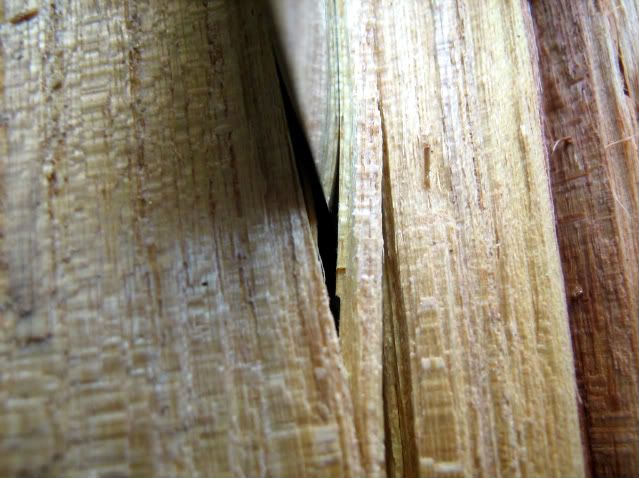
There is less friction on the edge and the convex shape aids in pushing material to the sides instead of sticking to the blade. When you baton with a convex blade the sides of the blade and not the edge are what's really do the splitting. The smooth roll to the thickest point is the key to its effectiveness, less points of contact = less friction. There is also less edge wear when batoning with a convex blade because the wood tends to split before the edge comes into contact with it.

Camper061.jpg


A full flat or saber ground blade has too much surface area for material to stick to, creating large amounts of friction and tend to get stuck in the wood. The toughness of a convex blade is also much greater than other types again because of the geometry, more steel closer to the edge yet retaining the cutting ability of a very thin blade. It may be a 5-10deg convex angel but your final edge is closer to 15-20deg. A properly ground convex blade should always come to a zero edge.
Picture498.jpg
 
Back
Top
