Blade shape input

Joined
Jun 17, 2010
Messages
1,054
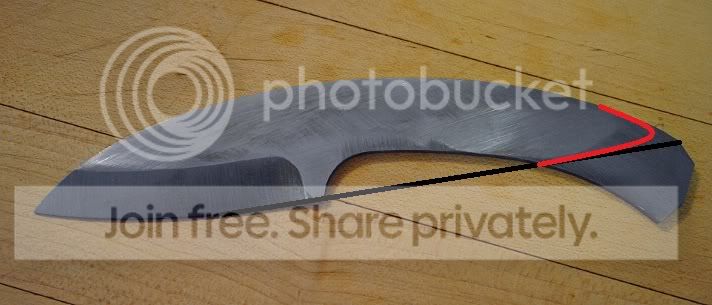
I'm looking for some input on this design. I originally was going to make it a warny with a fairly pointy blade, slimmer in the blade mostly by removing material from the edge upward, with it higher near the tang but ending at the same point. Then I decided that I wanted to keep some belly and a bit more blade thickness. The handle area is a very comfortable curve for someone with average sized hands. I'll probably put 1/8" thick scales on it once I settle on a blade design and finish up. If I don't change anything the bevel grind will climb a bit higher still, it's not quite finished but I wanted to pause here and be sure. Likewise with the underside of the handle curve, it's not fully blended yet but enough to get the idea.

Suggestions, comments, ideas? I've redrawn this one about a dozen times with another dozen blade profile tweaks, I just can't decide if I'm liking it because it works, or because it just works for me.

I just realized there's no scale for the image. It is 6.75" long right now, figure a bit smaller once I'm done. About 1.25" at the highest part of the blade.

shape1.JPG
 
I think it looks great. The proportions are very good and the lines and smooth and fluid. Ergonomically, I believe it will be very nice to work with as a general-purpose knife.
 
only problem I could see is the ammount of usable blade would be limited to about the first 1/4 of the blade when working on a flat surface, but freehand looks like it would be very usable.
Chris
 
Thanks guys. I agree that there's essentially no flat section to the blade but as a general purpose knife that's not the end of the world. With the length available I was running into the issue of any flat section making the rest of it look odd and this very gentle curve was the best balance I could find. Kind of ironic, given that the original plan was a warny but I wound up with a short piece of steel at the end of the bar and this worked better than that design.

I plan to finish this up, at least as far as heat treat and maybe cleanup, tomorrow.
 
It doesn't appear to be a very useable knife due to the curve in the handle.Certainly it is not a skinner. What is the use to be? You are asking for help. Frank
 
General utility. Not a skinner. The curve naturally keeps the edge of the blade facing more inward. It almost feels like an extension of your hand. Holding it naturally you get an edge comfortably placed to cut something on a table or the ground. The rest of the blade is curved up out of the way and is there for things like cutting rope or a box or other packaging. Think about a lot of smaller knives. You don't have the elevation on the handle to let you put that flat section of the blade on table top anyway, your hand's in the way. Instead you wind up using the belly or point most of the time for those tasks.

For me it fits the same niche as pretty much any EDC knife. It's not a skinner, it's not a bowie, it's not a chopper or dagger or fighting knife. Of course, if you have a particular way you want to use a knife this might not work at all, the lack of flat section but not sufficient curve compared to most knives factors in there.

Honestly, I'm not sure how the curve in the handle limits you in this case, the design tilts the blade down relative to your hand, and while maybe it looks too curved to be comfortable I can only say that both people who have held it find it very comfortable and natural feeling. The other person said it felt like having a claw as an extension of their hand, point and slice, so to speak.

I'm not saying you're wrong though, Frank. I don't have a specific job in mind for it. That's probably why I'm asking. It didn't fit an established mold to use as a reference. The original plan was a more traditional warnclif design with a less curved handle that gently sloped to the point.

Just as a concept, would you be more in favor of the design if I sliced the handle a bit to make it a bit straighter and then sliced the bottom of the blade off flush as a warnclif? That's one of the variables I sketched out. There's probably not enough left on the handle to really straighten it but I could definitely reduce that arc significantly. You get a more slim blade design top and bottom, fairly pointy but not too thin to hold up.
 
I think that you have a nice flow but if like others are saying it won't be as useful as it could be because you have the handle extend so much further below the blade edge. If you look at the attached picture that demonstrates my amazing ability to manipulate photos you'll see what I mean. The black line represents a flat surface, any of the handle under that line needs to go for you to really be able to use the blade on any flat surface.

If it works for you then I say screw what everybody else thinks, but you did ask for critiques so that's what you're getting! ;)

Best of luck, you better post follow-up pics...

shape1.jpg
 
Hmmm, why are you drawing the line from the BASE of the blade? Even with that line your fingers are in the way on anything this size so you have to tilt upward anyway. Draw the same line from the front 25% of the blade instead and you'll see how I'd use this on a flat surface like a table top. On the other hand, what am I using it on a table for? I can't remember the last time I used anything but a chef's knife that way. Even a paring knife won't let you get the blade flat to the table unless your hand is off the end of the table so the handle doesn't matter.

It's a good idea though. Maybe I should trim some off the handle no matter what, just to at least give the option of using more of the blade on a flat surface
 
I think it looks good. If you were makeing more of them in the same pattern the above comments on cutting on a flat table would be worth taking to heart, but for one knife, for you, that's already cut out I think it will be perfect.
 
Don't hesitate to make it because yuou like it and want it but as a hunting knife the truth is , it will be pretty much useless. You say it's made to cut in. Thats the one thing on a hunting knife you don't want . Frank
 
Frank, I think the confusion is the role of the knife. I don't see this as a hunting knife at all. You're 100% right, as a skinner, hunting knife, meat prep... this is a horrid design. You'd wind up turning the work into swiss cheese. Honestly I see this as an edc type design that is likely to spend 90% of its cutting time being used on boxes or other packaging.

Thanks for all the ideas folks. That's what I needed, a fresh look at it to make me see potential flaws and think about it objectively again. It's an ugly day out so probably no grinding but I'll do some drawing on the changes you've encouraged or inspired and see what grabs me. This is probably not going to be a repeat design, too many flaws and limits as you guys pointed out. I may not even sell it, just keep it and use it as a reminder to make sure I plan better from the start even when working with a shorter than desired piece. I could have made a nice small skinner or neck knife out of the piece.

Dick, I really like that wood, beautiful. It's a shame to have marked up the blade on that one for testing, but if like me you don't harden the tangs I guess that's just how it goes.
 
Much of the feedback or critique that is given by makers comes from form follows function reasoning; Which I believe is a good place for most design work to originate. Many designs have been around for years and are reproduced by many knife makers, the reason being; some designs work better than others for specific uses and therefore become a more or less permanent style in the world of custom knives.

Your design could be one of those designs, but we won't know until we see if it becomes part of the mainstream of knife designs.

Never let yourself be intimidated into not trying new and different approaches to knife making; materials design technique or what have you.

At the same time look at what has been proven and has longevity and take from that what you choose and incorporate it into your own work.

My advice is to make the knife and see how functional it is when it is used for the designed purpose. If it turns out well you may be on to something; if not you have learned something in the process.

Regards, Fred
 
Thanks, Fred. That's my plan. The input was valuable, even the parts I disagree with, because it makes me think about it differently than I had been and look at potential problems and situations I hadn't considered. In this case a lot of the problems folks pointed out are probably not an issue for daily use but whether this design does any better than a design without those limits remains to be seen. I'll finish it up, either today now that it's cleared up or tomorrow. Then i'll put a cord wrap and edge on it and use it for a few days and let a bunch of people play with it before I decide whether to put a traditional handle on it. If I'm just keeping it as a concept and treating it like a utility knife then I won't bother with a "real" handle and will use the time to make something else.

As for form following function, I agree completely, but I think a lot of knives incorporate elements that are pointless in terms of function just because that's what we have come to expect. One of those elements is the flat section of the blade being closer to the handle in nearly every knife. Why? The majority of smaller knives, when held normally in the hand, cannot put the flat of the blade onto a flat surface unless your hand is off the side of that surface. You wind up using the belly of the knife anyway. That flat area generally gets used when cutting something we're holding or have folded over the blade like a piece of rope. My thought was that if that's the case then why have that flat anyway? I wanted to try a fairly steep curve where the blade gets pointed downward relative to the handle and that made a logical pairing with the blade change and combined they fit the piece of steel left from the bar. :)

When I run through everything I've done with a knife other than my chef's knife in the past few weeks I don't come up with anything that would have been a problem for this one, that's why I think it has some merit for an edc. It won't do a lot of things we expect of a camp or hunting knife. It won't be much use for chopping up food, though it might do well slicing up my various hot peppers. :)

I had an idea earlier that I might follow up on. Finish up the blade and put the wrap on it then if I still like it after using it a while I'll send it out to some one from here to try. Maybe have it passed around to a few folks.
 
Hmmm, why are you drawing the line from the BASE of the blade?

I want to take a crack at that question, even though it wasn't aimed at me. I'll answer by asking another question... what is the purpose in continuing the grind past the point at which it can come in contact with the surface being cut? You ground the edge back to the rear 25% of the blade. If you only intend to use the front 25% isn't the rest of the edge superfluous?

Mind you, I can think of answers to my own questions, but those answers would be based upon alternative uses. I couldn't say whether anyone would agree that the knife design is appropriate to those uses, though, because I'm too much of a noob to know such things. ;)

- Greg
 
If you wanted to cut something on a flat surface then yes, only the front 25%, but the rest of it would be handy for anything else except when using the point itself.

I've got it tempering now.

I'm pretty sure I'll like it better with a real handle, but the cord wrap will let me test the blade design without investing more time and money into it before I know what I think. :)
 
Make whatever you want brother. It's ok to ask for opinions from the veterans, but when it comes down to it, innovation comes from the implementation of ideas and opinions that no one else had or agreed with.


...man, that was some seriously smart and intellectual sounding crap that just came out of me. hahahahaha.
 
Every day carry. It's generally used to mean a knife not meant for a specific task, and small and discrete enough to wear day to day. Of course, depending on where you live and work that can vary a lot. Someone living in the sticks and working as a Ranger or animal control might consider a large bowie an edc while a city person might stick to thin neckers or other knives small enough for concealment.

My own take on it is a knife meant for the every day chores I encounter. Whether it's opening a box or product packaging or trimming a piece of wood or plastic to fit where it belongs or helping me get out a splinter.

eta: by not meant for a specific task I mean they tend to not be something extreme. So generally not a very pointy dagger or exaggerated skinning designs... Something general purpose rather than specialized. Most people who carry a blade have a folding knife of some sort, that's the primary example of an EDC knife.

I didn't change anything before HT, just finished up the bevel and cleaned up the profile since it was still rough edged. HT went well and I'll put a quick edge on it tomorrow and we'll see how I like it in practice and not just theory. I left the bulk of the tang un-hardened so I'm free to make any of the tweaks to it that you guys suggested.

And here are a couple pics. I'm tentatively calling it the Talon because of the comment about it feeling like a claw. I've left it pretty rough post HT, just sanded a bit and put a basic edge on. Despite being a chisel grind I put 15% secondary grinds on either side for the edge, I have been meaning to try this and figured if I'm making a test knife I might as well get the most testing I can out of it. :D
talon1.JPG

talon2.JPG

I'm not liking the angularity at butt. I'm thinking I'll round it over into a smooth curve when I put the scales on.
 
Last edited:
Back
Top