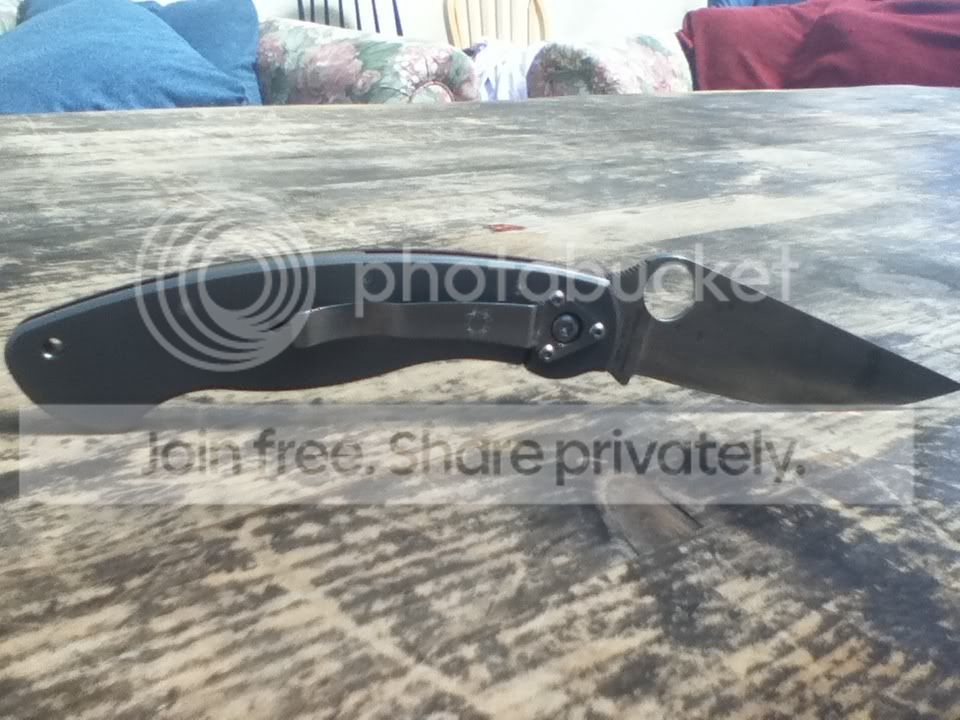
With a variety of different blade/tip shapes out there, I am curious as to what shapes have worked well for different usage cases based on peoples' experiences. What are your experiences with different blade shapes in different use cases? What has worked well for you, and what hasn't?
I've always preferred drop point and spear point shapes as good for general purpose use. They both sport a pretty strong tip for penetration, and the slope of belly allows for a smooth and steady slicing motion. I'm a bit mixed about recurves though. I like the way they look, but I don't know that they add much to the functionality of the main part of the edge. They do make sharpening a bit more difficult though. The drop point blades also seem to be the only ones that offer FFG, which makes long/deep cuts through rigid materials easier. I've put these to use opening packaging (from envelopes to thick 2-ply cardboard, and from plastic bags to rigid plastic blister packs), cutting food, shaving/shaping wood, cutting holes in sheet rock, cutting rope/cord, slicing through synthetic or woven materials (hoses, nylon straps), and other miscellaneous tasks.
I only have a couple of clip point knives, and really, a couple of those are probably more drop points (technically, the back edge is concave, but only slightly). The edge shape is the same as drop/spear points. I wonder if the reduced width near the tip makes much of a functional difference. I haven't used my clip point blades much, generally favoring the drop or spear points. From my limited use of my clip point blades, they function pretty much the same as drop/spear points, but I do sometimes worry about the durability of the tip.
I've got mixed opinions for Wharncliffe blades. Because the edge tends to be straight/flat, most of my shallow cutting (eg. opening packages) ends up focused on the top 1/4" or so of the tip, causing very uneven wear. They do, however, make the initial penetration a bit easier than drop/spear/clip points. On the other hand, the flat edge works very well for food prep. The Needs Work is my top pick for a portable folding knife for food prep. The straight edge is reminiscent of santoku style knives, and the shape of the handle resembles kitchen knives (letting you cut all the way down while keeping your fingers elevated). Combine that with a Leek, and you've got your cutting board knife and a paring knife.
I got a tanto blade because I was curious about the improved tip strength. The tip does definitely feel sturdy, and the overall blade shape does look pretty cool. It pierces well, but the cutting, at least for me, felt a bit awkward. To cut with the top edge (by the tip) required holding the knife at a pretty steep angle. The main blade is also flat, so other than deep cuts, the only part of the blade that seems to get any use is the 1/4" or so right at the vertex. Realizing the scraping generally isn't a recommended use of a knife, I have found that the tip edge of my tanto blade does work pretty well as a scraper.
I've always preferred drop point and spear point shapes as good for general purpose use. They both sport a pretty strong tip for penetration, and the slope of belly allows for a smooth and steady slicing motion. I'm a bit mixed about recurves though. I like the way they look, but I don't know that they add much to the functionality of the main part of the edge. They do make sharpening a bit more difficult though. The drop point blades also seem to be the only ones that offer FFG, which makes long/deep cuts through rigid materials easier. I've put these to use opening packaging (from envelopes to thick 2-ply cardboard, and from plastic bags to rigid plastic blister packs), cutting food, shaving/shaping wood, cutting holes in sheet rock, cutting rope/cord, slicing through synthetic or woven materials (hoses, nylon straps), and other miscellaneous tasks.
I only have a couple of clip point knives, and really, a couple of those are probably more drop points (technically, the back edge is concave, but only slightly). The edge shape is the same as drop/spear points. I wonder if the reduced width near the tip makes much of a functional difference. I haven't used my clip point blades much, generally favoring the drop or spear points. From my limited use of my clip point blades, they function pretty much the same as drop/spear points, but I do sometimes worry about the durability of the tip.
I've got mixed opinions for Wharncliffe blades. Because the edge tends to be straight/flat, most of my shallow cutting (eg. opening packages) ends up focused on the top 1/4" or so of the tip, causing very uneven wear. They do, however, make the initial penetration a bit easier than drop/spear/clip points. On the other hand, the flat edge works very well for food prep. The Needs Work is my top pick for a portable folding knife for food prep. The straight edge is reminiscent of santoku style knives, and the shape of the handle resembles kitchen knives (letting you cut all the way down while keeping your fingers elevated). Combine that with a Leek, and you've got your cutting board knife and a paring knife.
I got a tanto blade because I was curious about the improved tip strength. The tip does definitely feel sturdy, and the overall blade shape does look pretty cool. It pierces well, but the cutting, at least for me, felt a bit awkward. To cut with the top edge (by the tip) required holding the knife at a pretty steep angle. The main blade is also flat, so other than deep cuts, the only part of the blade that seems to get any use is the 1/4" or so right at the vertex. Realizing the scraping generally isn't a recommended use of a knife, I have found that the tip edge of my tanto blade does work pretty well as a scraper.